Fragile Truce
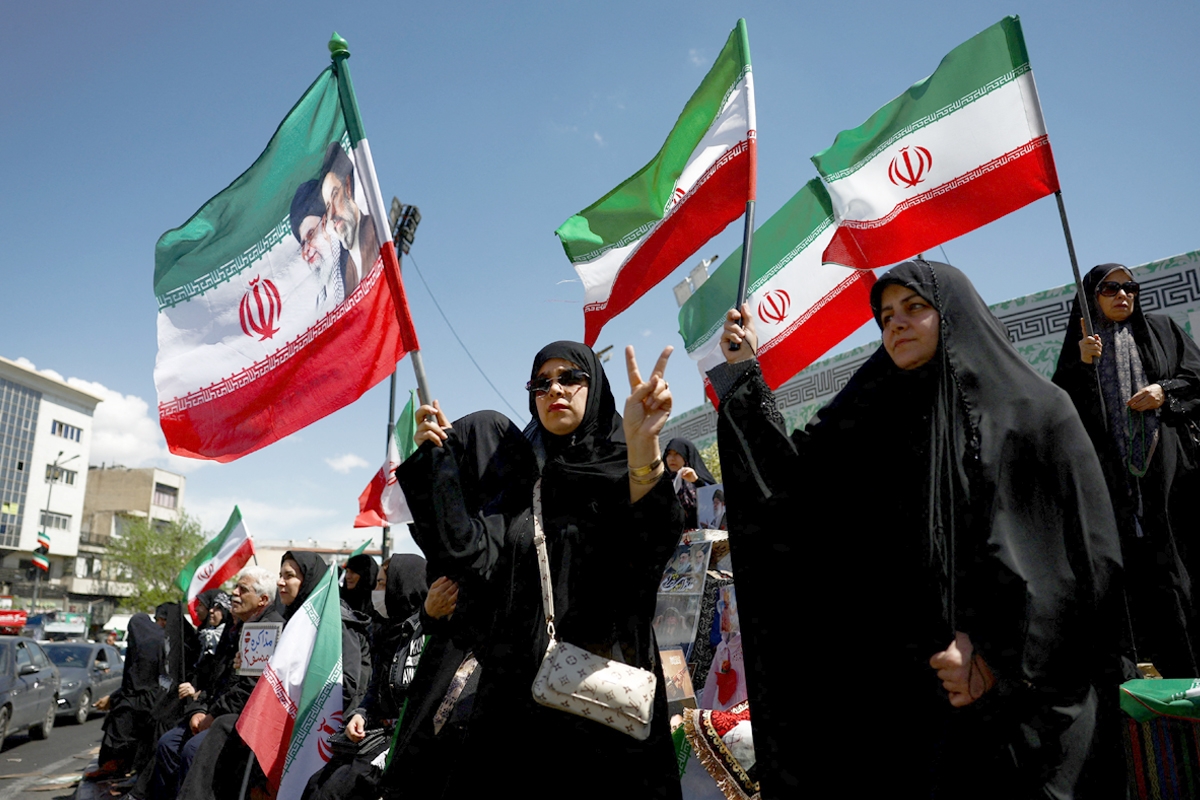
The United States and Iran have agreed to a two-week ceasefire in Islamabad, with participation from Pakistan and China, amid negotiations on opening the Strait of Hormuz and the nuclear file.
Translated by Alqyas from Al-Jarida — Original source
Forty days after the outbreak of the US-Israeli war against Iran and its expansion to encompass the entire region, the United States and the Islamic Republic agreed to a two-week ceasefire during which peace talks will be held in Islamabad, following Pakistani mediation efforts and a decisive Chinese contribution.
Minutes before the expiration of US President Donald Trump’s deadline to Tehran to reach an agreement or open the Strait of Hormuz without facing any threats or retaliatory measures that could erase it from the map of world nations, Pakistani Prime Minister Shehbaz Sharif urged Washington and Tehran to accept a temporary truce, calling on the Iranians to open the vital maritime corridor as a gesture of goodwill, which both sides announced they had accepted on Tuesday night–Wednesday morning, albeit with differing interpretations.
The ceasefire entered into effect yesterday morning without a specified time, but several gaps emerged, particularly on regional stages, especially the Lebanese one, and regarding how the “Hormuz” strait will be reopened and the terms to be negotiated between Washington and Tehran, foremost among them the nuclear file.
For his part, Trump announced his agreement to a temporary halt of military strikes that he had threatened would target all Iranian bridges and power plants for two weeks, conditioning the continuation of this on the full, immediate, and safe opening of “Hormuz.”
He described the agreement as a “complete and comprehensive victory at 100%,” affirming that harsh military pressures forced Tehran to the negotiating table after Washington achieved and surpassed all its field objectives.
He noted that the two-week period would be dedicated to finalizing a long-term peace agreement, emphasizing that the United States would play a pivotal role in securing international navigation through the strait to ensure the stability of global energy supplies and alleviate traffic congestion, adding that “there will be many positive measures, substantial sums of money will be made, and Iran can begin the reconstruction process.”
He added in a post on his platform “Truth Social”: “We will prepare shipments of various supplies, and we will be present to ensure everything goes smoothly. I am confident this will happen, just as we are witnessing in the United States. This may be the golden age of the Middle East.”
Without clarifying his stance on Tehran’s attempt to impose transit fees on ships in the international corridor, Trump indicated that he would speak with them regarding “fees and the easing of sanctions” imposed on Iran.
In separate remarks, Trump said Washington would work “closely” with Tehran to extract the nuclear dust from under the rubble, referring to highly enriched uranium believed to be buried under facilities bombed in Isfahan and Natanz. Trump renewed his comments about a change in the regime in Tehran, stressing that there would be “no uranium enrichment.”
Earlier, Trump indicated that he “received a 10-point proposal from Iran,” expressing his belief that it constitutes “a practical basis for negotiation, as almost all previous points of disagreement have already been agreed upon. This period will allow for the activation and signing of the agreement after arranging technical and logistical details to conclude a historic settlement after nearly 45 years of hostility.”
However, the US president later stated in other remarks: “We have a 15-point agreement, most of which have been agreed upon. We will see what happens later. We will see if we can accomplish it.”
Trump declined to disclose whether he would revert to his “previous threats” to destroy power plants and bridges in case the agreement fails. He considered this “an important day for global peace, and Iran wants this to happen. They have had enough, and so has everyone.”
In a separate post, he confirmed that an immediate 50% tariff would be imposed on all goods sold to the United States by any country supplying Iran with military weapons.
Trump was also quoted as saying that Lebanon is not covered by the agreement, pointing to Hezbollah’s role in the current escalation.
Meanwhile, US Secretary of Defense Pete Hegseth and Chairman of the Joint Chiefs of Staff General Dan Caine held a press conference at the Pentagon, where Hegseth declared that the United States had achieved victory in the war.
Hegseth stated that Iran had accepted a ceasefire under “immense pressure,” adding that rebuilding Iran would have taken decades if a comprehensive strike had been carried out, but “the regime’s leader realized that the agreement was better.”
For his part, Caine said: “I would like to thank our Gulf partners who fought alongside us every day—Saudi Arabia, the UAE, Bahrain, Qatar, Kuwait, and Jordan—who joined us in defending, protecting, and standing ready to defend again our people and our assets if necessary.”
Caine warned that US forces are prepared to resume combat with Iran if the truce between the two countries ends.
Amid speculation about whether he would travel to Islamabad tomorrow to participate in direct negotiations with the Iranians, US Vice President JD Vance described the agreement as a “fragile truce,” noting that “a final agreement is possible if the Iranians negotiate in good faith.”
He added that Trump “has instructed US representatives who will negotiate with Iran to do so in good faith, but if the Iranians do not reciprocate, they will realize that the President is not someone to be trifled with,” warning that “Trump is not patient in achieving progress.”
Amid reports of discrepancies between the Persian and English versions of the agreement between Washington and Tehran—opening the door to contradictory interpretations of key disputed points regarding the future of Hormuz and Iran’s nuclear program—Iranian Foreign Minister Abbas Araghchi announced that his country had agreed to open the corridor for two weeks, subject to “technical restrictions imposed by the Iranian Armed Forces.”
Meanwhile, Iran’s Supreme National Security Council stated that the war is not yet over, saying in a statement that negotiations would begin in Islamabad tomorrow, and affirming that the Iranian proposal, which includes 10 points, stipulates acceptance of the uranium enrichment program.
It claimed that the United States had agreed to all terms of Iran’s peace plan, including providing assurances against attacking Tehran, recognizing its control over Hormuz, and compensating it for financial losses.
While the Islamic Revolutionary Guard Corps emphasized that it “does not trust American promises and keeps its finger on the trigger,” Iranian President Masoud Pezeshkian viewed the ceasefire, which accepted the general principles desired by his country, as “the fruit of the blood of our great martyred leader Ali Khamenei, and an achievement of the solidarity of all the people,” according to his statement.
On another note, confusion erupted in Tehran over whether Parliament Speaker Mohammad Bagher Qalibaf would lead Iran’s negotiating team to Islamabad, while Axios reported that the new Supreme Leader, Mojtaba Khamenei, actively participated in the negotiations and that his approval was decisive in reaching the agreement.
While both Tehran and Washington sought to portray the ceasefire as a victory for both sides, Israeli Prime Minister Benjamin Netanyahu announced his support for Trump’s decision to suspend strikes for two weeks, but stressed that the truce “does not include Lebanon,” following statements by the Pakistani Prime Minister, the main mediator between Tehran and Washington, that the agreement “covers all locations, including Lebanon.”
Netanyahu said in a statement: “Israel supports US efforts to ensure that Iran does not pose a nuclear, missile, or terrorist threat to the United States, Israel, its neighbors, and the world,” adding that “Washington has informed Israel of its commitment to achieving these goals, which are shared by the US, Israel, and their regional allies, within the framework of upcoming negotiations.”
As Netanyahu insisted on continuing and intensifying military operations against Hezbollah, sharp criticism erupted within Israel over the deal. Opposition leader Yair Lapid described the ceasefire as a “political and strategic failure,” warning that its repercussions could last for years.
While some viewed the ceasefire as an attempt to contain a broader escalation rather than a final agreement, reports indicated that the Iranian Navy was ordering ships to obtain prior permission to transit the Strait of Hormuz to avoid being destroyed.
An attack on Iran’s oil refinery on Lavan Island sparked a fire but caused no injuries.
This came before reports emerged that the Islamic Revolutionary Guard Corps had halted oil tanker passage through the strait, citing “Israel’s violation of the ceasefire” as the reason.
Tasnim News Agency quoted a well-informed source as saying that Tehran is considering withdrawing from the deal if Israel continues its intensive attacks on Lebanon, amid expectations of missile strikes against Israel.
While the Financial Times reported that the White House pushed Pakistan to mediate the ceasefire, sources told The New York Times that China played a crucial role in the “final moments” before Trump’s deadline expired, with Beijing exerting intense pressure on Tehran to show the necessary flexibility and agree to partially reopen the Strait of Hormuz, warning of catastrophic global economic consequences if Iran’s energy infrastructure were targeted.
On the international reaction front, a joint European-British-Canadian statement welcomed the ceasefire between the United States and Iran, calling for negotiations to reach a permanent agreement that would end the war and emphasizing the contribution to ensuring navigation through the Strait of Hormuz.
