Kuwait Welcomes Truce, Calls on Iran and Its Proxies to Cease Attacks
Kuwait welcomes the ceasefire between the US and Iran and urges Iran to immediately halt attacks, while Gulf states record damages from Iranian strikes
Translated by Alqyas from Al-Jarida — Original source
Amid global calls for all parties to the ongoing war in the Middle East to comply with their obligations under international law and pave the way for resolving key issues, including Iran’s nuclear program, US President Donald Trump’s announcement yesterday of a temporary ceasefire with Iran received widespread Gulf, Arab, and international acclaim, with praise for Pakistan’s role in it.
Kuwait welcomed Trump’s announcement of a ceasefire with Iran, commending the efforts made, particularly Pakistan’s role in sparing the region further escalation.
Kuwait urged full commitment to the ceasefire to ensure the consolidation of de-escalation and create conditions for dialogue, calling on Iran and its proxies, including affiliated factions, militias, and armed groups, to immediately halt all hostile acts and practices that undermine stability and respect for state sovereignty, thereby ensuring such violations are not repeated.
Saudi Arabia expressed hope that the ceasefire between the US and Iran would mark a step toward a comprehensive and sustainable de-escalation that enhances regional security and halts any aggression or policies that infringe upon the sovereignty, security, and stability of regional states. It emphasized the importance of keeping the Strait of Hormuz open to maritime navigation, ensuring freedom of international trade and stability in energy markets.
Qatar viewed the ceasefire as an initial step toward de-escalation, stressing the need to build on it urgently to prevent the spread of tensions in the region. It reiterated the necessity for Iran to immediately halt all hostile acts and respect state sovereignty, ensuring such violations are not repeated.
In the UAE, Presidential Advisor Anwar Gargash stated that the UAE had “won” the war between the United States and Iran.
Writing on the X platform, Gargash said, “The UAE has won a war it sincerely sought to avoid,” adding, “We won through an epic national defense that safeguarded sovereignty and dignity and protected achievements against brutal aggression.”
In Oman, Omani Minister of Transport, Communications, and Information Technology Saeed Al-Maawali affirmed yesterday that the Sultanate’s position on the Strait of Hormuz is clear: “No fees can be imposed on the passage of ships, according to all international maritime transport conventions signed by the Sultanate.”
Al-Maawali told members of the Shura Council, “Many countries have not signed these conventions, including Iran and the United States, so there is a legal vacuum,” noting that the Omani Ministry of Foreign Affairs is discussing this matter and expressing hope for improvement.
Despite the ceasefire announced by Trump and Pakistani Prime Minister Muhammad Shehbaz Sharif entering into force, Kuwait, the UAE, Saudi Arabia, and Bahrain were subjected to missile and drone attacks from Iran yesterday.
Hours after the truce announcement, Kuwait’s Ministry of Defense reported that “air defenses have been dealing since 8:00 AM local time (05:00 UTC) with an intense wave of malicious Iranian hostile attacks. Twenty-eight drones targeting Kuwait have been dealt with.”
It added that it “managed to intercept a large number of hostile drones, some of which targeted vital oil facilities and power stations,” but noted “serious material damage to oil infrastructure facilities, power plants, and water desalination plants.”
In the UAE, the Ministry of Defense dealt with 17 ballistic missiles and 35 drones coming from Iran yesterday, confirming that it had intercepted more than 537 ballistic missiles, 26 cruise missiles, and 2,256 drones since the beginning of the Iranian terrorist aggression.
Abu Dhabi’s government confirmed yesterday that debris fell on the Habshan gas complex, injuring three people—two Kuwaitis and one Indian—and sparking several fires at the site, leading to a temporary suspension of operations pending an assessment of the situation.
In Bahrain, the Defense Force destroyed six missiles and 31 drones that targeted the kingdom over the past 24 hours, affirming that its systems continue to counter successive waves of malicious Iranian attacks, which have totaled 194 missiles and 508 drones so far.
In Saudi Arabia, the Ministry of Defense announced yesterday that it intercepted five ballistic missiles and destroyed nine drones during “the past hours,” shortly after a ceasefire came into effect.
The Iranian Revolutionary Guard acknowledged that it targeted energy complexes and oil pipeline infrastructure in the region, including the Saudi Yanbu pipeline, which transports crude oil from the Gulf to the Red Sea, as well as other facilities in the kingdom.
Iranian state radio stated that “missile and drone attacks occurred against the UAE and Kuwait a few hours after Iranian oil facilities on Lavan Island were targeted.”
Meanwhile, the Jordanian Ministry of Foreign Affairs confirmed yesterday that the ceasefire is a step toward ending tensions and dangerous escalation in the region, and must lead to a comprehensive and sustainable de-escalation that ensures a halt to attacks and practices undermining the sovereignty, security, and stability of states, while enhancing regional security and the safety of citizens.
For his part, Egyptian President Abdel Fattah al-Sisi described the agreement as a “positive development,” calling on all parties to engage seriously in negotiations to reach a permanent ceasefire agreement and restore security and stability in the region.
Palestinian President Mahmoud Abbas viewed the truce as an important step toward strengthening the sovereignty of regional states and achieving a permanent end to the state of war, emphasizing the need to include occupied territories facing continuous settler and occupation force aggression, whether in Gaza, the West Bank, or Jerusalem, as well as regarding the cessation of “aggression against brotherly Lebanon.”
In France, President Emmanuel Macron called for full and comprehensive respect for the ceasefire between the United States and Iran, extending it to Lebanon, in order to create conditions for negotiations paving the way for a permanent resolution of issues related to Iran’s nuclear program, its ballistic missiles, and its regional activities.
Macron reiterated that the “defensive” mission, involving 15 countries as proposed by France to help resume navigation in the Strait of Hormuz, would begin operations “when conditions are met in coordination with Iran.” He requested that Lebanon and Iraq be included in the de-escalation.
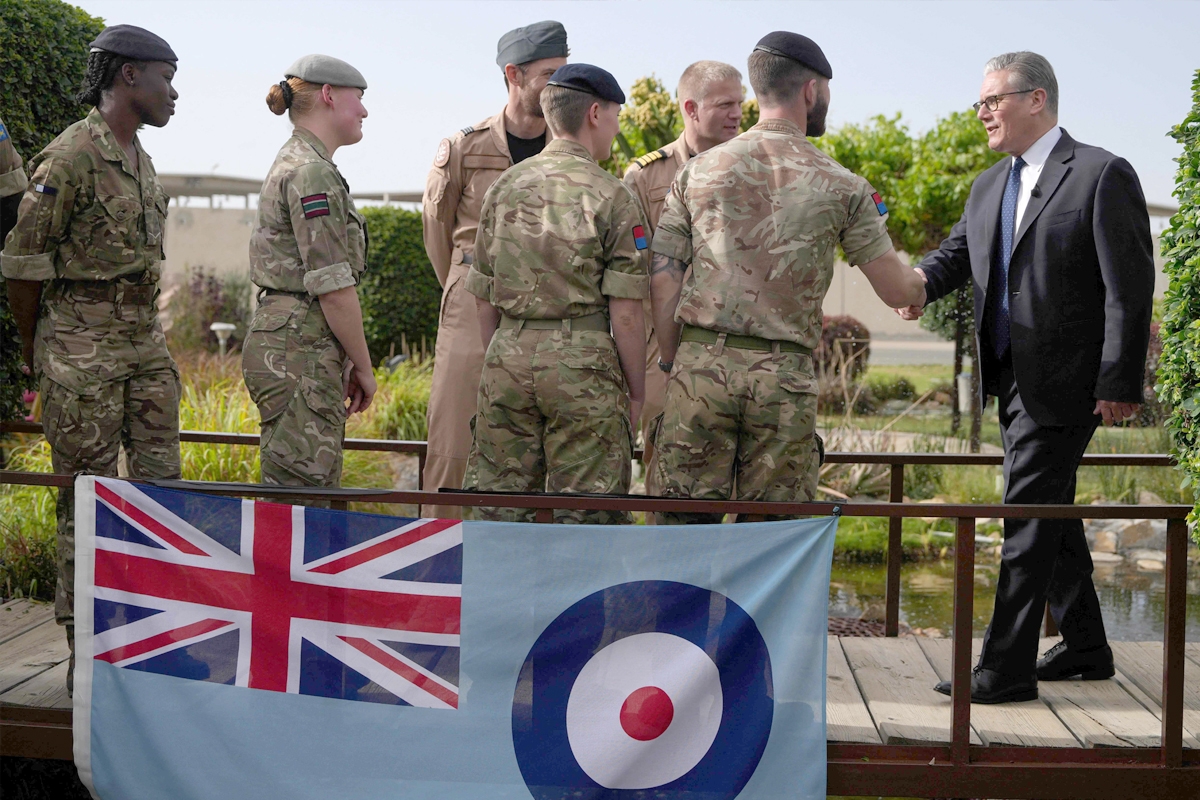
Meanwhile, British Prime Minister Keir Starmer announced his intention to visit the region to meet with Gulf leaders, aiming to support the temporary ceasefire between the United States and Iran, advance a diplomatic solution to the crisis, and ensure the permanent reopening of the Strait of Hormuz.
According to a statement from his office, Starmer will reaffirm during his meetings with leaders Britain’s steadfast support for de-escalation efforts and the necessity of building on the ceasefire to reach a long-term agreement ensuring regional stability.
The statement added that Starmer’s talks would also address ensuring the continued reopening of the Hormuz Strait to international navigation, considering it vital for energy security and global trade movements, noting that London continues to lead international efforts in this direction.
Starmer’s office clarified that reaching the ceasefire represents a moment of relief, particularly for affected Gulf states and the international community.
Following talks with his American counterpart, Marco Rubio, regarding diplomatic measures to ensure the reopening of the Hormuz Strait, British Foreign Secretary Yvette Cooper stated yesterday that Britain would work with shipping, insurance, and energy sectors in an attempt to restore confidence in the Strait of Hormuz “as soon as possible.”
Meanwhile, China welcomed the ceasefire, which it participated in alongside Pakistan and encouraged Iran to support, calling on all parties to enable the resumption of navigation in the Strait of Hormuz at the earliest possible time.
Chinese Foreign Ministry spokesperson Mao Ning stated that China is working toward a ceasefire and the resolution of disputes through diplomatic channels, and has supported mediation efforts undertaken by Pakistan and other countries. She added that the Strait of Hormuz is a vital route for international trade in goods and energy, and that maintaining its security, stability, and freedom of navigation serves the common interests of the international community.
For his part, Kremlin spokesperson Dmitry Peskov said, “We received news of the truce with satisfaction. We welcome the decision not to proceed down the path of armed escalation.”
