Trump Threatens to Send Iran Back to the Stone Age as War Enters Destruction Phase
Trump threatens military strikes against Iran if no agreement is reached, while Ebrahim Dzhafarqoli responds with military threats.
Translated by Alqyas from Al-Jarida — Original source
The joint US-Israeli war against Iran has entered a new phase focused on destroying infrastructure, alongside ongoing assassinations of political and military leaders and the destruction of industrial facilities. This escalation comes hours after President Donald Trump threatened to launch further powerful strikes within the next two or three weeks to “send them back to the Stone Age where they belong” if no agreement is reached to resolve the conflict.
Trump said in a televised address to the nation regarding the “Epic Rage” operation yesterday: “I can say that we are close to completing all US military objectives, very soon. However, the war could escalate if Iranian leaders do not comply with the terms of an agreement during the ongoing negotiations.”
He added: “If no agreement is reached within the next two or three weeks, we will target all power and energy stations,” possibly simultaneously, emphasizing that the coming hours mark the “beginning of the end of Iran’s aggressive evils and the specter of nuclear blackmail that has threatened the world.”
He noted that the United States would not target Iranian oil facilities “to give the people a chance,” referring to his withdrawal of a deadline set for the following Monday, which had given Tehran the opportunity to reopen the Strait of Hormuz without threats and reach a diplomatic understanding, or face a concentrated bombing campaign aimed at destroying all power plants, oil wells, and possibly desalination plants.
Trump considered that Iran “no longer holds any cards” at this stage, stressing the “complete defeat of Tehran, which is now militarily, economically, and in every other respect, devastated.” He affirmed that the military operation was necessary to prevent Iran from acquiring nuclear weapons.
He stated that the US military had destroyed key Iranian military capabilities, adding that “the navy no longer exists, the air force has been destroyed, most leaders have been killed, and the command and control system of the Islamic Revolutionary Guard Corps has been dismantled.”
He pointed out that Washington’s goal was never to change the regime in Iran, but he considered that targeting leadership figures had indirectly led to a “change in the regime.”
Amid uncertainty regarding his commitment to reopening the strategic strait, which is partially blocked by the “Revolutionary Guard,” Trump noted that Washington does not need the oil passing through the waterway, saying: “We don’t need it. Countries that obtain oil via Hormuz must take responsibility for its protection. They must control it and appreciate its value, and they can do so easily.”
He claimed that the United States possesses oil reserves exceeding those of Russia and Saudi Arabia combined, and no longer needs Middle Eastern oil now or in the future. He also believed that NATO countries could easily control the strait.
On another note, Trump said: “I would like to thank our allies in the Middle East: Israel, Saudi Arabia, Qatar, the UAE, Kuwait, and Bahrain. They have been wonderful, and we will not allow them to suffer any harm or failure in any way.”
He noted that “the US military targeted Iran, the world’s number one state sponsor of terrorism,” emphasizing that his country continues to provide defensive support to its regional allies.
In response, Iranian officials issued a speech insisting on resisting Trump’s pressures. Spokesman for the “Seal of the Prophets” headquarters, Ebrahim Zolfaghari, threatened to launch even more severe, broader, and more destructive strikes. Addressing Americans and Israelis, he said: “Your information about our military capabilities and equipment is incomplete.” He added, “Do not hope that you have destroyed our strategic missile production centers and attack drones; such an assumption will only sink you deeper into the quagmire you have trapped yourselves in.”
While Army Commander Major General Amir Hatami stressed that “if the enemy attempts a ground operation, not a single one of them should survive,” Parliament Speaker Mohammad Bagher Qalibaf said, “We are armed, prepared, and steadfast; let the enemy advance, for we are waiting for them.”
Diplomatically, Foreign Ministry spokesperson Esmail Baghaei stated, “As long as the war continues, Iran will continue to resist,” adding that Iran will not accept “a vicious cycle of war, negotiations, ceasefire, and then repeating the same pattern.” Baghaei described the ongoing conflict as “catastrophic not only for Iran but for the entire region and beyond.”
Baghaei said, “Do not expect me to go into details. We do not negotiate publicly. As I mentioned, there are currently no negotiations between Iran and the United States. However, it is clear that the messages we have received through intermediaries reflect maximalist and unreasonable demands, which is why Iranians are treating them with extreme caution.” He noted that Iran is studying these messages and that when a response is decided upon, it will be conveyed through intermediaries.
In a development that places Tehran at odds with most countries in the world and the region, Deputy Foreign Minister Kazem Gharibabadi claimed that his country is currently preparing a navigation system and imposing service fees in cooperation with the Sultanate of Oman. He indicated that the new system will be implemented after the war ends and has reached its final stages for execution. He added, “It is possible that our region will face another military aggressive act after this war ends. The aggressors are always present, and unfortunately, war is a tool and policy for some of these countries and regimes.”
He further stated, “Iran controls the strait by exerting its power, and a Hormuz Treaty must be declared. This would be a treaty under which Tehran acts as the operator, and European, Asian, and Arab countries would sign contracts with Tehran as the contracting party to allow it to use the passage.”
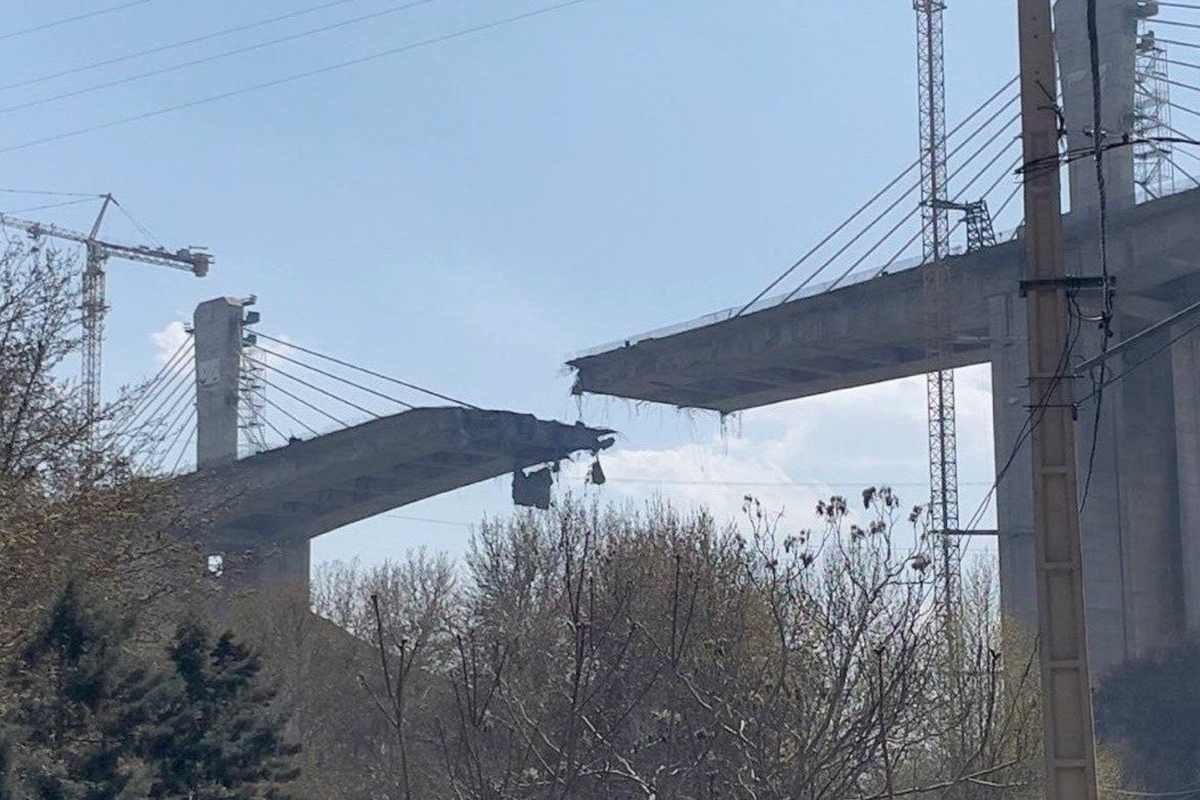
On the ground, strikes targeting infrastructure in Iran have escalated. An airstrike destroyed a strategic bridge connecting Tehran to the city of Karaj, which was reported to have suffered widespread power outages following the attacks.
Israeli and American aircraft also attacked fuel tanks in Kurnak in the Iranian capital and several airports in major cities, including Mashhad and Tabriz.
In a major blow to diplomatic efforts, reports indicated that Kamal Kharrazi, the Iranian government’s advisor to the negotiations mediated by Pakistan between Tehran and Washington, suffered serious injuries in an airstrike believed to be Israeli that targeted his home two days ago.
US Central Command (CENTCOM) Commander Brad Cooper considered the fifth week of the campaign to have seen “undeniable” progress, noting that no signs of movement by Iranian naval forces or flight of Iranian fighter jets had been detected. He confirmed that air defense and missile systems had been largely destroyed.
While the Israeli military announced the destruction of an Iranian army ground base, Israeli intelligence estimates indicated that more than 200 mobile missile launch platforms had been destroyed since the beginning of the war.
Regarding diplomatic efforts to contain the crisis, a spokesperson for the Pakistani Foreign Ministry stated that Islamabad is actively communicating with US leadership and Iranian authorities to find a resolution to the war, adding that there has been no confirmation yet of any US delegation arriving to hold talks.
The Axios website quoted three US officials as saying that reaching an agreement through ongoing talks between Tehran and Washington, which focus on securing a ceasefire in exchange for reopening the Strait of Hormuz, remains “uncertain.”
In Moscow, the Kremlin confirmed its readiness to mediate in order to find a settlement for the conflict, while the Russian company Rosatom announced that “Moscow will ask the United States and Israel to guarantee a ceasefire while we evacuate our staff from the Bushehr nuclear site.”
Reports had indicated that Hassan Rouhani and his Foreign Minister, Mohammad Javad Zarif, were placed under a form of house arrest following protests that took place in the country on the eve of the war. Notably, Rouhani’s return to expressing his views coincided with tweets from Zarif in recent days, suggesting that the regime is bringing out its “moderate reserve” amid renewed talk of negotiations.
