Washington prepares a decisive strike... Trump urges Iran to be serious before it's too late
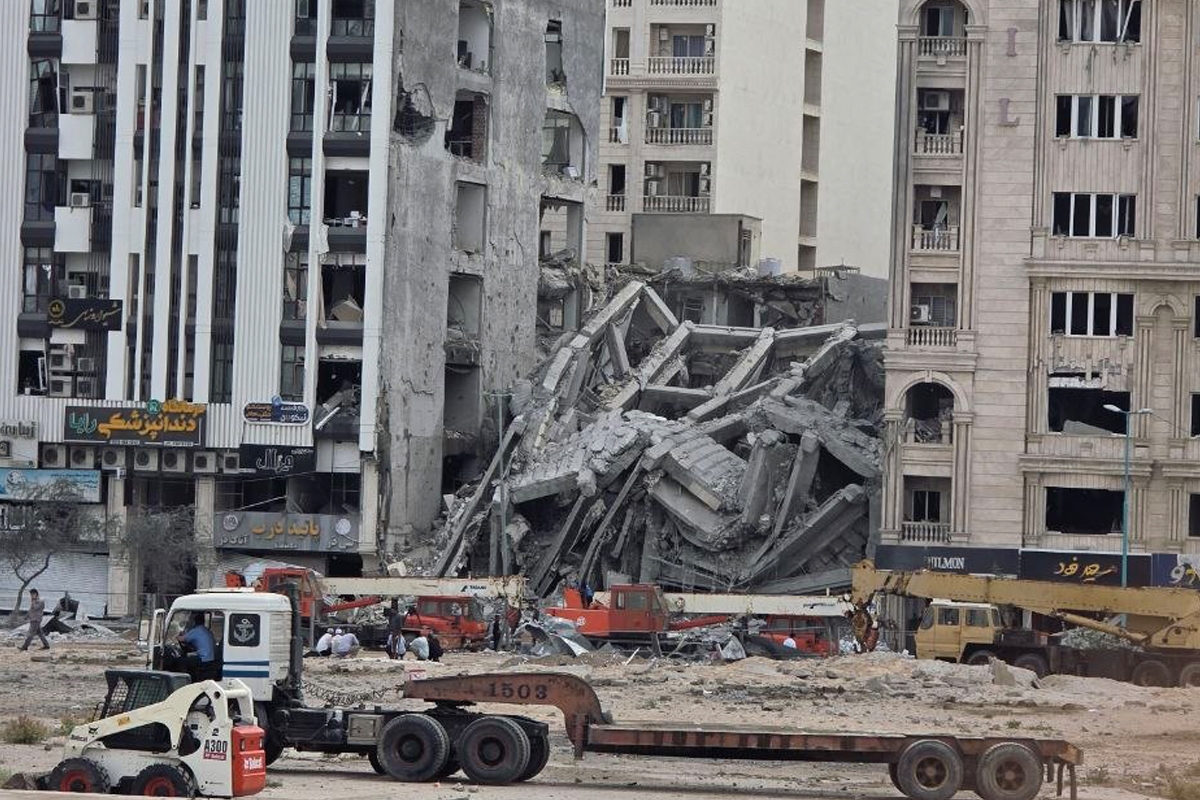
Washington is preparing a decisive military strike against Iran following the failure of negotiations, with threats from both sides to escalate the war.
Translated by Alqyas from Al-Jarida — Original source
As the extended deadline granted by U.S. President Donald Trump for Iran to reopen the Strait of Hormuz without restrictions approaches its midnight Friday-Saturday cutoff, amid public back-and-forth over the terms to end the war that has been raging between the two sides for 27 days, U.S. officials and informed sources reported that the Pentagon is preparing a “decisive strike” against Tehran that could involve ground forces and a wide-ranging bombing campaign if diplomatic efforts involving regional actors to contain the crisis engulfing regional security and global energy supplies collapse.
Axios reported yesterday, citing officials and sources, that there are four main options for the “final strike” from which Trump may choose. These options are as follows:
Third: Taking control of Abu Musa Island and two smaller islands near the western entrance to the strategic strait through which approximately 20% of global oil exports pass. The islands are under Iranian control but are claimed by the United Arab Emirates.
Fourth: Intercepting or detaining ships carrying Iranian oil on the eastern side of the strait. Meanwhile, the U.S. military has drawn up plans for deep ground operations inside Iran to secure highly enriched uranium located in heavily fortified nuclear facilities.
Instead of these complex and dangerous operations, Washington might resort to widespread air strikes to prevent Iran from accessing these materials, which are believed to be sufficient to produce 11 nuclear bombs if their enrichment level is increased.
According to the plan, a major military escalation—which would become more likely if no progress is made in the diplomatic track, particularly if Tehran continues to close Hormuz—would serve as a overwhelming display of force to end the war launched by the United States, with Israel’s participation, against Tehran. This could grant Washington greater leverage in subsequent peace negotiations, or simply provide Trump with an achievement he could declare a victory to put an end to the crisis threatening regional security and global energy supplies.
Although the U.S. president has not made a final decision on any scenario, sources noted that the potential escalation could begin by carrying out his threat to bomb power plants and energy facilities, particularly if Tehran continues its policy of partially closing the strait, claiming it allows all ships to pass while blocking those belonging to “hostile” states and their collaborators.
As an indicator of the possibility that the White House might resort to an extreme scenario of escalating and prolonging the war, Bloomberg reported that officials in the Trump administration are studying the potential impacts and repercussions of a massive shock to the global economy in the event oil prices rise to levels reaching $200 per barrel.
He stated that “the Iranians are begging for a deal, which they must do after their overwhelming military defeat, despite their public statement that they are only considering U.S. proposals,” and stressed that “the Iranians must take this seriously,” warning that once this point is crossed, there will be no turning back and things will not be easy.
Earlier, Trump indicated that he did not want to use the word “war” to describe the “overwhelming military operation” against Iran, because the label of war requires legislative approval, emphasizing that America is now winning the war and that news of its defeat in the Middle East is false.
In separate remarks on his platform Truth Social, Trump attributed Tehran’s denial of participation in peace talks to “the fear of Iranian negotiators that they will be killed by their own group.”
The U.S. president also criticized NATO alliance countries yesterday, saying they “have done absolutely nothing to support the United States in facing the crazy nation, which has now become militarily invulnerable in Iran despite suffering overwhelming destruction.”
He emphasized that his country, which had previously called for assistance including the deployment of mine-clearing vessels from coalition nations to secure navigation in the Strait of Hormuz, “does not need anything from NATO,” issuing a stern warning not to forget this “pivotal historical point.”
This came after White House spokesperson Karoline Leavitt warned Iran that President Trump is prepared to strike it with “unprecedented force” if no agreement is reached.
Leavitt said, “Peace has always been the President’s preferred option. There is no need for further death and destruction. But if Iran does not accept the reality of the current moment, and does not come to terms with its military defeat, President Trump will ensure it faces a stronger blow than ever before.”
She added, “The President is not bluffing, and he is prepared to unleash hell. Iran must not miscalculate again. Any escalation after this stage will be due to the Iranian regime’s refusal to reach an agreement.”
Meanwhile, amid reports of internal U.S. restlessness over the handling of the crisis, the Wall Street Journal cited officials saying that Trump urged his advisors to adhere to a timeline of four to six weeks to end the costly war. However, officials noted that Trump lacks easy options to achieve this goal, given that peace negotiations are still in their early stages and differences with Tehran persist, as Iran has so far refused to hold direct talks with Washington.
With the potential for containing or escalating the war hinging on Tehran’s behavior, an Iranian source threatened to “open new fronts” if the United States attempts to occupy its islands or any part of Iranian territory, or through naval movements that “impose costs” on the country in the Gulf and the Sea of Oman.
An Iranian military source told the official Tasnim News Agency that the Bab el-Mandeb strait, which connects the Arabian Sea and the Red Sea, is one of the world’s strategic chokepoints, and that Iran possesses the will and capability to create a credible threat against it. The source warned that any U.S. attempt to deal with the Strait of Hormuz through reckless moves could create a new crisis similar to one at Bab el-Mandeb, an area under the control of the Houthi group “Ansar Allah,” which is allied with Tehran.
Iranian Army Ground Forces Commander Major General Ali Jahanshahi also warned that any potential land war against his country “would be more dangerous and costly for the enemy in an irreplaceable manner.”
Yesterday, it was reported that Iran is actively preparing to counter a potential U.S. invasion of Kharg Island, including setting up ambushes. An Israeli source indicated concerns that Iran might respond immediately using its diverse arsenal of weapons, including shoulder-fired missiles and drones, if U.S. Marine forces seize strategic Kharg Island, located only 20 miles from mainland Iran. The source noted that hope rests on avoiding such risks and instead targeting oil fields.
Earlier, Iranian Parliament Speaker Mohammad Bagher Qalibaf claimed there were intelligence reports suggesting the possibility of an invasion of an Iranian island “with the support of a regional state,” which he did not name. He threatened, “Our forces are monitoring all enemy movements, and if they take any step, the critical infrastructure of that regional state will be targeted with relentless, continuous attacks.”
Amid conflicting Iranian signals regarding the approach to diplomatic efforts to de-escalate the crisis, an Iranian agency reported that Tehran had formally responded to a 15-point U.S. proposal, delivered via Islamabad, aimed at stopping the war.
Meanwhile, Iranian Ambassador to Japan Peyman Saadat stated that the United States cannot unilaterally impose a peace plan on Tehran.
This development followed the announcement by an Iranian source that Tehran had rejected the US draft agreement, which it had received from Pakistan. The draft contained 15 loose points, including a preliminary one-month ceasefire, restrictions on Iran’s nuclear program and ballistic missile arsenal, halting support for allied groups in the region, ensuring free passage through the Strait of Hormuz, and a statement by Foreign Minister Abbas Araghchi that his country does not intend to negotiate with Washington at present and seeks to end the fighting on its own terms, adding that “talking about negotiations now is an admission of defeat.”
Amid conflicting signals from both sides regarding potential peace talks, Pakistani Foreign Minister Ishaq Dar confirmed yesterday that indirect talks mediated by Islamabad are taking place between the United States and Iran.
With a direct meeting between the two sides proving elusive, and as mediators push for such a meeting to prevent the conflict from escalating further, Dar, who also serves as Deputy Prime Minister, wrote on the “X” platform that “speculation about peace talks is unnecessary.” He added, “In this context, the United States has presented 15 points that are being discussed by Iran, while sister countries such as Turkey and Egypt, among others, are supporting this initiative.”
On the Israeli side, Defense Minister Israel Katz announced the assassination of Ali Reza Tangsiri, commander of the Navy of the Islamic Revolutionary Guard Corps (IRGC), along with several senior naval command officers, in a precise airstrike on the Bandar Abbas area. Prime Minister Benjamin Netanyahu hinted at US assistance in the strike.
Netanyahu stated that Tangsiri’s “hands are stained with much blood” and that he led the operation to close the Strait of Hormuz. He added that the assassination “is another example of cooperation between Israel and the United States in achieving war objectives.” This came as Israel removed the names of Iranian Foreign Minister Abbas Araghchi and Parliament Speaker Mohammad Bagher Qalibaf from its targeting list, after Pakistan requested Washington not to target them, according to a Pakistani official speaking to Reuters. The official added, “The Israelis had their coordinates and wanted to eliminate them. We told the United States that if they are also eliminated, there will be no one left to talk to. Therefore, the US asked the Israelis to back down.”
Amid anticipation of additional US reinforcements, including fighter squadrons and thousands of Marines and paratroopers from an elite airborne division comprising approximately 2,500 soldiers, arriving in the region in the coming days, US Central Command (CENTCOM) reported that a sailor aboard the aircraft carrier USS Abraham Lincoln was injured in a non-combat incident while the carrier was sailing in the Arabian Sea. CENTCOM noted that it continues to target Iranian threat sources, stating that it has struck more than 10,000 targets so far.
Meanwhile, an Israeli military spokesperson said that Israel’s current mission is to further weaken Iran’s capabilities, pointing to a “wide wave” of airstrikes on several areas targeting “Iranian regime infrastructure sites, with a focus on military industries and war production.”
Yesterday, the Washington Post reported that three informed sources stated that the US Department of Defense (Pentagon) is considering diverting weapons originally intended for Ukraine to the Middle East, as the war with Iran depletes some of the most critical US military ammunition stocks.
The Pentagon had previously informed Congress of its intention to use part of the funding allocated through this initiative to replenish its own stockpiles, rather than sending additional aid to Ukraine.
The US military has previously transferred some air defense systems from East Asia, particularly from South Korea, to the region.
Rehim Nad Ali, the Cultural Assistant of the Iranian Revolutionary Guard in Tehran, announced the launch of a project titled “For Iran,” calling on citizens to register to provide voluntary assistance to the Iranian military forces. He added that the minimum age for participation in some sectors has been lowered to 12 years, urging teenagers aged 12 and 13 to register in these fields.
According to Nad Ali, the project covers a variety of areas, including intelligence and operational patrols, Basij checkpoints, support and logistics, organizing “epic convoys,” preparing food for military forces, caring for war wounded, and serving households damaged by military operations.
