Al-Badawi: Gulf States Must Be Included in Any Negotiations or Agreement to Resolve the Regional Crisis
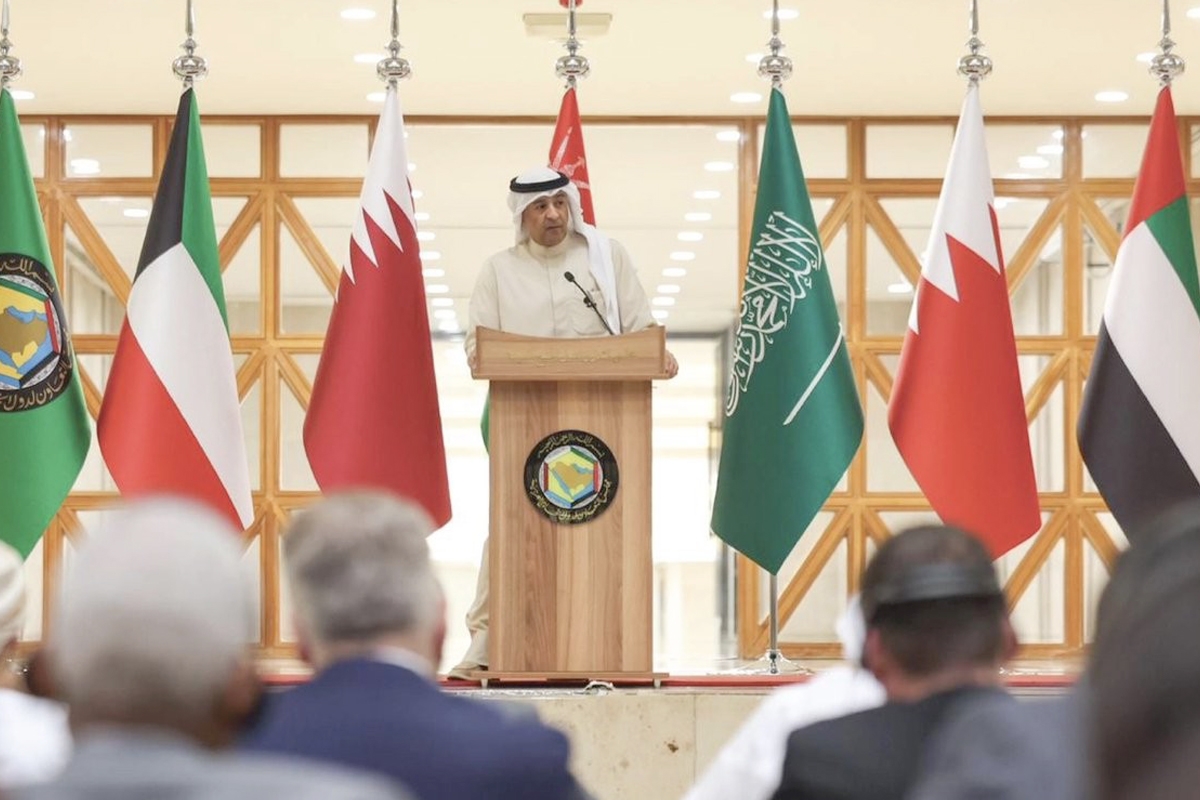
Al-Badawi emphasized the importance of Gulf states' participation in any negotiations to resolve the crisis caused by Iranian attacks, stressing Iran's responsibility and rejecting any initiatives to alter the map of the Middle East.
Translated by Alqyas from Al-Jarida — Original source
Amid widespread international relief at the UN Human Rights Council’s condemnation of Iran’s despicable attacks on regional states and its demand that Tehran be compelled to compensate for the damages and losses it has caused since February 28, Secretary-General of the Gulf Cooperation Council (GCC) Jassem Al-Bedaiwi stressed today the importance of GCC states’ participation in any talks or agreements aimed at resolving the regional crisis, in a manner that contributes to enhancing security and stability and ensuring that such attacks do not recur.
In a comprehensive briefing in Riyadh regarding the Iranian attacks, Al-Bedaiwi emphasized that any frameworks, initiatives, or regional arrangements intended to redraw the map of the Middle East in the aftermath of this crisis are categorically rejected.
He noted that the toll of Iranian attacks on GCC states over 25 days exceeded 5,000 ballistic missiles and drones, most of which were intercepted, but some struck civilian targets, resulting in casualties and property losses. He clarified that Iran’s attacks on GCC states accounted for 85 percent of the total missiles launched during this war.
He pointed out that the Iranian attacks resulted in civilian casualties and injuries among citizens and residents, with the latest being Iran’s treacherous attack on the city of Abu Dhabi earlier today, which caused deaths and injuries. The Iranian attacks on GCC states also inflicted severe damage on civilian infrastructure, including energy facilities, water desalination plants, hotels, government institutions, embassies, residential buildings, and airports, leading to the suspension of air navigation at several airports in GCC states.
He noted that the air defense systems in GCC states performed well, responding to these attacks with a high degree of professionalism that mitigated their repercussions. However, this does not diminish the scale of the aggression, nor does it absolve Iran of full responsibility for it.
He highlighted the global economic repercussions of these attacks, noting that GCC states produce 16 million barrels of oil per day, representing 22 percent of global production, and export 27 percent of total global crude oil exports, equivalent to 11.5 million barrels per day. Additionally, they hold 33 percent of global oil reserves, which amount to 512 billion barrels, and 21 percent of global natural gas reserves, totaling 44 trillion cubic meters, producing 442 billion cubic meters of natural gas annually, equivalent to 10 percent of global production.
Al-Bedaiwi affirmed that these substantial figures make the Gulf region an indispensable pillar of the global economy, as any disruption there immediately impacts international energy security and threatens economic stability worldwide. The stability of oil and gas supplies from this region is not a luxury but an imperative necessity for global energy markets.
He added that Iran’s destabilizing behavior in the Arabian Gulf has crossed all boundaries, as it closed the Strait of Hormuz, blocked the passage of commercial vessels and oil tankers, and imposed fees for transit through the strait, which constitutes a violation of the UN Convention on the Law of the Sea.
He clarified that the damage from the suspension of navigation extends beyond GCC states to many countries worldwide, which are now experiencing shortages in their oil and gas needs. He explained that sea lanes and straits are governed by international agreements, and no party can disrupt navigation, control who passes through, or impose conditions for transit. Such actions are unacceptable and must cease.
Al-Badawi stated that the GCC states were surprised by the US and Israeli strikes on Iran, clearly declaring that they would not participate in any military operations and would not allow their territory to be used for any operations against Iran. He emphasized the Council’s commitment to exercising maximum restraint to avoid expanding the conflict, while continuing to call for diplomatic dialogue.
He noted that GCC states have worked diligently, professionally, diplomatically, and transparently over the past years to de-escalate tensions in the region. Since their inception, they have served as a cornerstone of stability, playing a positive role in international relations with sister and friendly nations, allies, and partners. They act as mediators in numerous regional and international reconciliations, reliable partners in commercial and economic relations, and suppliers of energy sources such as oil and gas, which are the lifeblood of the global economy.
He clarified that the GCC states’ position is based on international legitimacy and international law, including Article 2, Paragraph 4 of the UN Charter, the right of self-defense under Article 51, and UN Security Council Resolution 2817. He also highlighted the unanimous adoption by the Human Rights Council of a draft resolution on the impacts of Iranian aggression, affirming that any attack on a member state constitutes an attack on all member states under the GCC Collective Defense Agreement.
Meanwhile, UAE Presidential Advisor Anwar Gargash stated today that the continued aggression only further isolates the Iranian regime. He emphasized that “targeting civilians and infrastructure, and threatening energy security and navigation, will not go unanswered, and the right to self-defense is guaranteed.”
Gargash wrote on the X platform: “The unanimous condemnation by the Human Rights Council in Geneva of Iran’s blatant aggression against Gulf states and Jordan represents a clear international position that underscores the severity of these attacks and their blatant violation of international law and state sovereignty.”
For his part, UAE Ambassador to the United States Youssef Al Otaiba called for a “decisive outcome” in the conflict with Iran, arguing that a ceasefire alone is insufficient to address the threats posed by Tehran.
In an article published in The Wall Street Journal, Al Otaiba wrote: “A simple ceasefire is not enough; we need a decisive outcome that addresses the full spectrum of Iran’s threats, including its nuclear capabilities, missiles, drones, proxies, as well as its threat to international sea lanes.”
He affirmed that the UAE did not desire war and had conducted intensive diplomatic efforts to prevent it “from Tehran to Washington” until the final hours before the first strike. He added, “We knew we would be Iran’s primary target,” noting that Abu Dhabi had informed Tehran that its territory and airspace would not be used to launch attacks against it.
The Ministry of Defense stated that it intercepted and neutralized 15 ballistic missiles and 11 drones coming from Iran, noting that since the start of Iranian attacks, it had dealt with 372 ballistic missiles, 15 cruise missiles, and 1,826 drones.
The Saudi Ministry of Defense announced today that it intercepted and destroyed 33 drones, the latest of which targeted the Eastern Province, bringing the total number of missiles and drones targeting the Kingdom since the start of Iranian aggression to 58 missiles (51 ballistic and 7 cruise) and 769 drones.
In Bahrain, the Defense Forces Command announced today that air defense systems successfully intercepted and destroyed 154 missiles and 350 drones targeting the Kingdom since the start of Iranian aggression.
Bahraini authorities have also decided to refer 14 defendants to trial on charges of conspiring with the Iranian Revolutionary Guard, after it was established that they committed crimes involving seeking to carry out hostile and belligerent acts against the kingdom and providing assistance to it in its hostile activities.
Meanwhile, the US Fifth Fleet announced that one member of the Navy aboard the aircraft carrier Abraham Lincoln was injured during operations in the Arabian Sea on March 25, clarifying that the incident was not combat-related and was not serious.
In another development, French President Emmanuel Macron reiterated to his Iranian counterpart Masoud Pezeshkian yesterday the necessity of halting unacceptable attacks on countries in the region, protecting energy and civilian infrastructure, and restoring freedom of navigation in the Strait of Hormuz.
Earlier, Jordanian Foreign Minister Ayman Safadi rejected the extension of residency for an Iranian diplomat in Amman and refused to grant accreditation to another. He explained that the kingdom had been subjected to more than 240 Iranian missiles and drones, and had filed a complaint with the United Nations to preserve its right to respond to these attacks and demand compensation for damages, as well as to affirm its right to self-defense.
In Iraq, the US Embassy accused “Iran-backed militant militias” today of launching widespread attacks on US-linked targets across the country, including in Kurdistan, and attempting to target and kidnap its citizens.
Following an airstrike on a military clinic that left seven dead, the US State Department stated that “any claims” that Washington targeted Iraqi security forces were “categorically false and inconsistent with the US partnership.”
For its part, Abu Mahdi al-Jaafari, spokesperson for “Saraya Sayyid al-Shuhada,” announced that the attacks targeting the Popular Mobilization Forces and the Ministry of Defense were launched from US bases in some Gulf countries and Jordan. He noted that “the Islamic Resistance in Iraq targets exclusively the US presence in these countries.”
In Israel, the military announced that Iranian missile attacks targeted several sites in the greater Tel Aviv area, injuring six people in the predominantly Arab town of Kafr Qasim.
Britain and France are chairing talks involving around 30 countries this week, aimed at forming a coalition tasked with reopening the Strait of Hormuz, which Iran has blocked since the outbreak of its war with the United States and Israel, and the commencement of its unjust aggression against Gulf states.
A British defense official stated that “another meeting is expected to be held, a military one between the chiefs of defense staff of the broader group that signed the agreement later this week.”
The British official indicated that other countries might also be invited. He said, “We recognize our role in shaping this coalition and in leading the world to develop a plan that ensures the reopening of the Strait of Hormuz as soon as possible,” adding that Norton was working “in close coordination with Fabien Mandon,” chief of staff of the French Armed Forces.
The Times reported that the United Kingdom offered to host a subsequent summit in Portsmouth or London to agree on details and establish the coalition that would ensure the reopening of the strait “as soon as conditions are appropriate.”
The Guardian quoted a Ministry of Defense official as saying that a meeting of chiefs of staff would be held later this week. The source said, “I expect that at some point in the near future, some kind of security conference regarding the Strait of Hormuz will be held.”
A French military official clarified that the meeting would not be related to the US position on the issue and would remain within a defensive framework.
