Mojtaba Khamenei Insists on Aggression Against Regional States and Closing the Strait of Hormuz
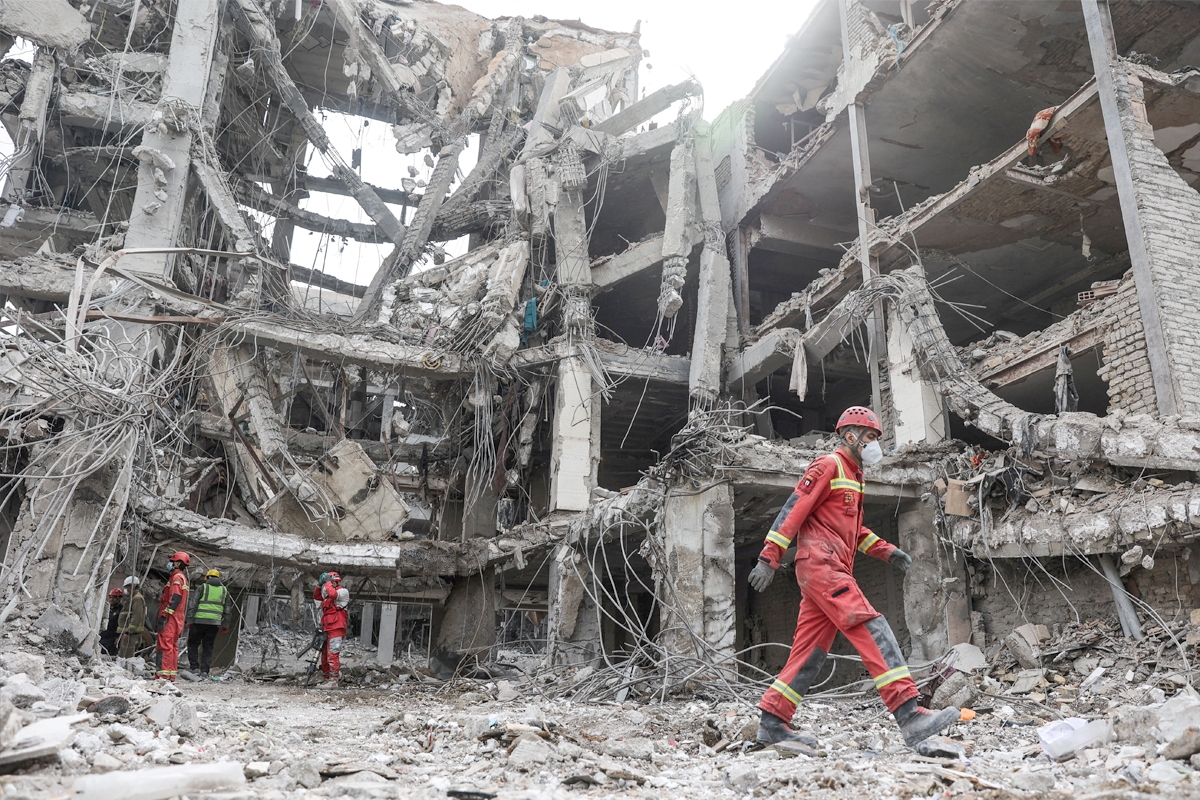
Khamenei calls for closing the Strait of Hormuz and retaliating against US bases, while Trump threatens to strike Iran's power grid.
Translated by Alqyas from Al-Jarida — Original source
In his first address since being appointed Iran’s Supreme Leader, Mojtaba Khamenei issued high-level threats, insisting on continuing Iran’s unjust aggression against regional states and calling for the continued closure of the Strait of Hormuz, while hinting at opening new fronts.
In a speech reflecting a hardline tone, Khamenei Jr. repeated Iran’s baseless claims that the attack on Iran came from “enemy bases in neighboring countries,” asserting that Iran was “forced to respond,” and urged regional states to “determine their stance toward the aggressors and the killers of our people’s sons.”
Khamenei stated, “We believe in friendship with neighboring countries, but we are compelled to continue targeting US bases there,” emphasizing the need to “immediately close all US bases in the region.”
Mojtaba added, in a statement read on Iranian state television without audio or video recording, that “the closure of the Strait of Hormuz must continue as a pressure tool,” adding that “Iran will demand compensation from its enemies, or it will destroy their assets to the same extent.”
The Leader, described as close to the Islamic Revolutionary Guard Corps (IRGC), warned that “if the war situation continues, fronts will be activated in which the enemy has no experience.” He paid tribute to what he called the “Resistance Front,” considering it “an integral part of the values of the Islamic Revolution,” specifically mentioning Hezbollah in Lebanon, Iraqi factions, and the Houthi Ansar Allah group in Yemen.
Minutes after the speech was broadcast, a senior commander in the IRGC Navy stated that the Strait of Hormuz would remain closed following Mojtaba Khamenei’s directives.
In response, US President Donald Trump said that “preventing the empire of evil from obtaining a nuclear weapon is far more important than oil price stability.”
In this context, Ali Larijani, Secretary-General of the Supreme National Security Council, threatened to plunge the region into darkness “within half an hour” if Iran’s electricity infrastructure were targeted. Trump had said two days prior, “I could destroy Iran’s electricity within an hour, but I haven’t done so.”
This came as Tehran, on the thirteenth day of the war, escalated its broad assault on energy facilities and civilian infrastructure in Gulf Cooperation Council (GCC) countries and the wider region, after Trump declared that Iran was on the verge of defeat.
On the thirteenth day of the Iranian war, Tehran escalated its wide-ranging attacks on energy facilities and civilian infrastructure in GCC countries and the region, after US President Donald Trump stated that Iran was on the verge of defeat, while simultaneously warning that US forces were capable of escalating their strikes to the point where rebuilding the country would become “almost impossible.”
Iran focused its treacherous attacks on commercial ships in the Gulf in an attempt to halt navigation in the Strait of Hormuz, one of the world’s most critical maritime passages, through which about one-fifth of global oil supplies pass daily, amid growing international fears that the conflict could escalate into a broader regional confrontation threatening the global economy and energy security.
In the latest developments, six ships were attacked or damaged in Gulf waters and the Strait of Hormuz in recent hours, raising the total number of ships targeted or damaged since the war began on February 28 to at least 16, according to maritime security firms and international shipping authorities.
In a separate incident, a container ship off the coast of the United Arab Emirates was hit by an unidentified projectile, causing a small fire on board. Other ships sustained minor damage near Ras Al Khaimah and northwest of Dubai.
In the northern Gulf, the Iranian Revolutionary Guard claimed it targeted an American oil tanker in Gulf waters after it failed to comply with warnings from the Iranian Navy, a move observers considered the first direct engagement of its kind since the war began, as previous attacks had been limited to missiles and drones.
In Iraq, operations at oil ports were completely halted yesterday following attacks on two fuel tankers in territorial waters, while commercial ports continued to operate. Iraqi authorities confirmed that rescue teams managed to pull more than 50 sailors from the crews of the two ships, one body was found, and searches for missing persons are ongoing.
In Bahrain, the Ministry of Interior announced it had gained control of a fire that broke out in fuel tanks in Muharraq Governorate after they were targeted in an Iranian attack, confirming that civil defense teams contained the blaze.
While Reuters reported that smoke columns rose from the Kingdom’s International Airport, the General Command of Bahrain Defense Force stated that air defense systems had intercepted and destroyed 112 missiles and 186 drones since the start of Iranian attacks.
The UAE announced its defenses dealt with six ballistic missiles, seven cruise missiles, and 39 drones coming from Iran, one of which targeted a residential building in the Badia area of Dubai without causing injuries. In Abu Dhabi, civil defense managed to control a fire that broke out at Abu Dhabi’s old airport due to falling debris.
In Saudi Arabia, the Ministry of Defense announced yesterday the destruction of several Iranian drones heading toward vital targets, including the Diplomatic Quarter in Riyadh and the Shaybah oil field in the Empty Quarter. It also intercepted 18 drones in the Eastern Province during the night of Wednesday-Thursday.
In Oman, Iran targeted the fuel tanks at Salalah Port for the second time, leading to a temporary suspension of operations there, while emergency teams worked to contain and secure the fire, amid Iranian claims that it was not responsible for targeting the sultanate.
In Iraq, Italy announced that its military base in Erbil was attacked, clarifying that a drone exploded near a military vehicle inside the base, suggesting the incident was accidental after the drone lost altitude control.
For its part, the “Islamic Resistance in Iraq” factions, affiliated with Iran, announced carrying out 13 missile and drone bombing operations within 24 hours against what it described as enemy bases inside and outside the country.
Meanwhile, approximately 30 Popular Mobilization Forces (PMF) fighters were killed and more than 16 others injured in an unexplained airstrike targeting the headquarters of the 19th Brigade in the Akashat area of Anbar Governorate. Factions aligned with Iran accused the United States and Israel of carrying out the attack, while the government and the PMF authority considered the strike an assault on an official state security force.
Meanwhile, Iranian Parliament Speaker Mohammad Bagher Qalibaf threatened that any attack on Iranian islands “would shatter all forms of restraint,” adding, “We will abandon all forms of restraint and make the waters of the Gulf run with blood,” and continued, “The blood of American soldiers is President Trump’s personal responsibility.” Al-Jarida was the first to report on plans for a landing on Iranian islands, likely referring to the UAE islands occupied by Iran located in the Strait of Hormuz.
CNN reported the day before yesterday that control over these three islands could be the key to winning the war, following previous speculation that Washington would strike Kharg Island, from which about 90 percent of Iran’s oil is exported.
The Islamic Revolutionary Guard Corps (IRGC) warned two days ago that it would launch wide-ranging retaliatory attacks if Iran’s ports were bombed. This warning came after the U.S. Central Command (CENTCOM) cautioned civilians that Iran was using civilian ports along the Strait of Hormuz for military operations, stating that civilian ports used for military purposes lose their protected status under international law and become legitimate military targets.
The Israeli and U.S. militaries launched fierce airstrikes on Tehran and other Iranian cities, targeting security force headquarters, weapons and missile depots, and missile launch pads. CENTCOM released high-definition videos showing strikes on Iranian warplanes in their hangars and others targeting what is believed to be storage facilities in a mountainous area, commenting: “We are stripping Iran of its ability to threaten U.S. forces and regional partners with precision and lethality.”
The Fars News Agency reported yesterday that Ismail Dehghan, a senior commander in the IRGC’s Aerospace Force, was killed in an airstrike on Arak. Meanwhile, the Israeli military announced it had struck Iran’s Parchin nuclear site, stating it was being used for sensitive experiments to develop a nuclear weapon.
Late the day before yesterday, armed clashes lasting several hours broke out in the capital, Tehran, particularly in its western districts, between armed militants and Iranian security forces, resulting in the deaths of 10 security personnel in an incident of its kind.
Fars News Agency reported that drones, which it claimed were Israeli, carried out strikes on several locations in the city, coinciding with movements and clashes on the ground between armed elements and Iranian security forces.
A well-informed source was quoted saying these attacks constituted a “terrorist operation” coordinated between the Mossad and “royalist elements” (i.e., loyalists to the former Shah), aimed at infiltrating and carrying out sabotage inside the country, adding that the attempt “will fail.”
ABC News quoted Donald Trump as saying he was not concerned about any Iran-backed attacks on U.S. soil, while the Federal Bureau of Investigation (FBI) had warned of potential Iranian drone attacks on California on the U.S. West Coast.
Later, at a campaign rally, Trump stated: “We know where the Iranian sleeper cells are and we are watching all of them.” In response, Ali Larijani, Secretary of Iran’s Supreme National Security Council, threatened to eliminate Trump.
