Iran under pressure from the 'second phase' of US-Israeli attacks
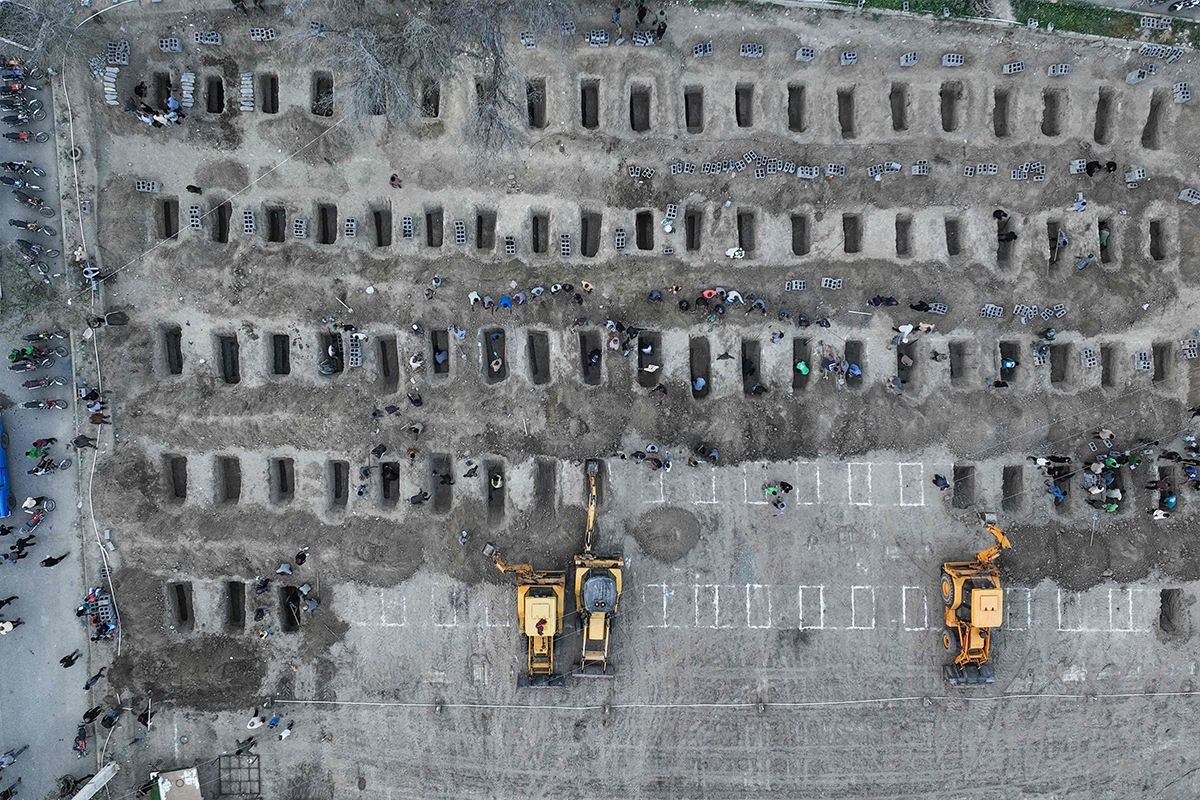
Airstrikes were launched on Tehran and Iranian provinces, with threats to target nuclear facilities and reports of a collapse in Iran's leadership.
Translated by Alqyas from Al-Jarida — Original source
The scope of the US-Israeli air war against Iran expanded yesterday as the bombing drew closer to nuclear facilities, following an announcement by the International Atomic Energy Agency (IAEA) that the Natanz facility, struck during the 12-day war in June, had sustained recent damage without posing a radiation leak risk. Meanwhile, the Russian nuclear company Rosatom warned that the threat to the Bushehr nuclear power plant on the Gulf was escalating.
The Israeli military announced yesterday that it had targeted the Iranian Presidential Office and the Supreme National Security Council building in Tehran, describing them as “the most central and important hubs of the regime.” US President Donald Trump affirmed that his country would respond “soon” to the killing of six US soldiers and to attacks on US embassies in Gulf states, a day after he hinted that a “wave of major strikes” on Tehran had not yet occurred—a point echoed by Secretary of State Marco Rubio.
A senior US official told CNN that the United States is preparing for a major escalation in attacks, noting that the first round of bombing “achieved its goal of weakening Iranian defenses.”
Trump’s statements on the timeline of the war were contradictory. He told CNN he did not want a long war, adding that he had expected operations to last four weeks but that they were proceeding “faster than planned.” Later, appearing to respond to Ali Larijani, Secretary of Iran’s Supreme National Security Council, who stated that Iran, unlike Washington, had prepared for a long war, Trump said the US had the capacity to continue for much longer than five weeks, adding that he would not get bored of the war as some observers had predicted if it dragged on.
The day before, Trump told the New York Post that he did not rule out sending US ground forces to Iran “if necessary.” The newspaper had revealed an Israeli plan involving the deployment of US forces on one of Iran’s islands to convert it into an operations center to provide logistical support for any military movement by the opposition inside Iran.
Trump described Iranian attacks on several Arab countries as “the biggest surprise.” Regarding the leadership succession in Iran, Trump added, “We don’t know who the leadership is now, and we don’t know who they will choose. Maybe they’ll be lucky and choose someone who knows what he’s doing.” He noted that the leadership situation in Tehran was currently unclear: “They don’t know who is leading them now.”
The Israeli-US air strikes targeted several provinces. Tehran, the capital, saw intense bombing, with approximately 12 rockets fired at the Pardis area. The Daneshju Agency, affiliated with the Basij, reported that more than eight points in Tehran were targeted within one hour.
The raids also covered the provinces of Shiraz, Kangan, and the Bushehr region in southern Iran, as well as Karaj province west of Tehran and Damavand northeast of the capital, according to Iranian media. Meanwhile, the crisis management cell of the Kish Free Zone in southern Iran confirmed that no evacuation warnings had been issued for the island.
Isfahan province was among the targeted areas as well, with the Iranian Revolutionary Guard Corps announcing the death of three civilians and the downing of an Israeli Hermes drone.
Additionally, the headquarters of the Assembly of Experts in Qom, tasked with selecting a new Supreme Leader, was bombed and leveled, according to Reuters.
The US and Israeli militaries displayed video footage showing the targeting of missile launchers and air defense systems, as well as soldiers fleeing. The US military also stated that there were 11 Iranian warships in the Gulf of Oman, but today there are “zero.” Reports indicated extensive Israeli bombing along the Iran-Iraq border to clear the way for Kurdish Iranian opposition fighters to enter Iranian territory.
In an Israeli development, military spokesperson Nedav Shoshani told journalists that the army is prepared for a military campaign against Iran that could last for weeks, but ruled out the deployment of ground forces. Speaking at an online press conference, he said, “We have a general plan spanning weeks, and the duration of the campaign is subject to change depending on developments,” adding that progress so far has been “positive.”
US network CNN quoted Israeli officials as saying that Israel expects Iran’s ability to launch ballistic missiles to decline in the coming days.
Media outlets close to the Islamic Revolutionary Guard Corps reported the death of Defense Minister Majid al-Radha, who was appointed two days ago as a successor to the defense minister killed in the opening strike, in a move that shows Israel and the US are repeating the scenario used against Lebanese Hezbollah, where Israel assassinated Hezbollah leaders and then their successors within a short period, including Hezbollah Secretary-General Hassan Nasrallah and his successor Hashem Safieddine.
Meanwhile, the International Atomic Energy Agency (IAEA) confirmed it had detected recent damage to buildings at the entrance of Iran’s underground Natanz nuclear fuel enrichment facility following Israeli-US air strikes.
The agency added, “No radiological impact is expected, and no additional impacts were detected at the facility site itself, which was severely damaged during the June 2025 war.”
It further stated that it assessed the situation based on the latest available satellite imagery. IAEA Director General Rafael Grossi said two days ago that there was “no indication” of Iranian nuclear facilities being targeted, despite Iranian Ambassador to the Agency, Reza Najafi, informing Grossi that the Natanz facility had been attacked, without providing details. The Natanz facility was targeted in the war Israel launched against Iran in 2025, with US participation.
IAEA inspectors have not been able to access the site since then.
On his part, Alexei Likhachev, director of the Russian state nuclear company Rosatom, told the Russian news agency RIA Novosti that there is an increasing threat to the Bushehr nuclear power plant due to escalation and nearby explosions, but the plant itself is not directly targeted. The Russian company operates and supplies nuclear fuel to Iran’s Bushehr nuclear power plant.
For his part, Russian Foreign Minister Sergey Lavrov warned that the global nuclear threat is intensifying due to the conflict in Iran.
On the level of Iran’s domestic politics, Al-Jarida learned from a high-ranking source in Iran’s Supreme National Security Council that Mojtaba Khamenei, the son of the late Supreme Leader Ali Khamenei, remains the most likely candidate to succeed his father, particularly because he enjoys the support of Larijani and is viewed by many as the only person capable of controlling the Islamic Revolutionary Guard Corps and security apparatus, while Iranian President Masoud Pezeshkian and his government complain that military decision-making has slipped out of their control. However, the source revealed to Al-Jarida that Mojtaba was injured in the “opening strike” on the first day of the Israeli bombardment, and that his supporters are waiting to see whether he will recover from his injuries to proceed with his campaign to be elected Supreme Leader. The source cast doubt on whether Ali Reza Arfaei, head of the Qom Seminary, who was appointed to the interim leadership council alongside Pezeshkian and Chief Justice Gholam-Hossein Mohseni-Ejei, would be able to control the military and security apparatus if chosen to assume the position.
Arfaei had previously predicted, in his first speech after being selected by the Guardian Council to represent it in the interim leadership council, that the new Supreme Leader would be elected through a “smooth and swift” process, while Foreign Minister Abbas Araghchi suggested that a new Supreme Leader would likely be chosen within a few days.
