Broad US-Israeli Attack on Iran... Kuwait and Gulf States Counter Iranian Aggression
The US and Israel attacked Iran; Iran retaliated against Kuwait and Gulf states
Translated by Alqyas from Al-Jarida — Original source
The Middle East has entered an open war, after U.S. President Donald Trump chose to exercise the military option he had long threatened against Iran, following a round of inconclusive negotiations held in Geneva late Thursday evening.
In a major regional development, U.S. and Israeli forces launched a joint attack against Iran yesterday morning. Trump stated that the operation aimed to destroy Iran’s naval forces and missile program, and to ensure Iran does not acquire nuclear weapons. Israeli Prime Minister Benjamin Netanyahu described the objective as “eliminating the existential threat posed by Iran’s terrorist regime.”
The operation, dubbed “Massive Retaliation” by the Pentagon and “Lion’s Roar” by Israel, began precisely as Trump’s 10-day deadline for Iran to reach an agreement expired.
Israel’s Ministry of Defense was the first to announce the start of a “preemptive attack” against Iran, shortly after an initial wave of intense airstrikes targeted the Iranian capital, Tehran. According to reports, the strikes targeted political and military officials, including Supreme Leader Ali Khamenei and President Masoud Pezeshkian, resulting in the deaths of several of them.
About an hour later, leaks began circulating about U.S. participation in the military operation, before President Trump appeared in a lengthy address to announce the commencement of a broad U.S. military campaign against Iran. In his speech, Trump said, “Our goal is to protect the American people by eliminating the imminent threats posed by the Iranian regime, which is an evil group composed of very cruel and bad people.” He added that “the hostile activities of this regime expose the United States, our troops, our bases abroad, and our allies around the world to direct danger.”
Referencing Iran’s and its proxies’ involvement in attacks against U.S. Marines in Beirut in 1983, the U.S. destroyer USS Cole, and U.S. soldiers during their presence in Iraq, Trump affirmed: “That was large-scale terrorism, and we will no longer tolerate it.” He labeled Iran “the foremost state sponsor of terrorism” and declared that “this terrorist regime can never possess nuclear weapons.”
Addressing Iran’s hesitation during negotiations, the U.S. President said, “We repeatedly sought to reach an agreement. We tried. They wanted it. Then they didn’t. Then they wanted it again. Then they didn’t. They didn’t know what was happening. They simply wanted to perpetrate evil. But Iran refused, as it has done for decades. It rejected every opportunity to abandon its nuclear ambitions. We can no longer tolerate this.”
He accused Tehran of “attempting to rebuild its nuclear program and continuing to develop long-range missiles that can now threaten our friends and allies in Europe, our forces stationed abroad, and may soon be able to reach U.S. territory.”
He noted that “for these reasons, the U.S. Armed Forces have embarked on a massive and continuous operation to prevent this evil and extremist dictator from threatening the United States and our core national security interests. We will destroy their missiles and reduce their missile industry to rubble. It will be completely and utterly erased. We will eliminate their navy. We will ensure that the region’s terrorist proxies can no longer destabilize the region or the world or attack our forces. We will ensure that Iran does not acquire nuclear weapons. It is a very simple message: they will never have nuclear weapons. This regime will soon learn that no one should challenge the power and might of the United States Armed Forces.”
Referencing the possibility that “American heroes may lose their lives, and we may suffer losses, which happens frequently in wars,” Trump addressed members of the Iranian Revolutionary Guard, the armed forces, and all Iranian police personnel, saying: “You must lay down your arms and receive full immunity, or face certain death. Lay down your arms. You will be treated fairly and granted full immunity, or you will face certain death.”
He also addressed the “great and proud Iranian people,” stating: “The hour of your freedom is near. Stay in shelters. Do not leave your homes. The situation outside is extremely dangerous. Bombs will fall everywhere. And when we are finished, you will take control of your government. It will be yours to take. This may be your only chance in generations.”
He continued: “You have asked for the United States’ help for many years, but you did not receive it. No president was willing to do what I am willing to do tonight. Now you have a president who will give you what you want. Let’s see how you respond. America supports you with overwhelming power and immense destructive force. Now is the time to take control of your destiny and unleash a prosperous and glorious future that is within reach. This is the moment for action. Do not let it pass.”
Trump had previously told The Washington Post in a telephone conversation that his main objectives are to achieve “freedom” for the Iranian people and ensure that the country is “safe.”
For his part, Netanyahu, in a speech to Israelis, said that Israel and the United States had launched “an operation to eliminate the existential threat posed by Iran’s terrorist regime,” and thanked Trump, saying: “For 47 years, the Ayatollahs’ regime has been chanting ‘Death to Israel’ and ‘Death to America.’ It has shed our blood, killed many Americans, and committed massacres against its own people. This murderous terrorist regime must not be allowed to possess a nuclear weapon that threatens all of humanity. Our joint action will create the conditions for the brave Iranian people to take their destiny into their own hands.”
He added: “The time has come for all components of the Iranian people—the Persians, Kurds, Azerbaijanis, Baloch, and Ahwazis—to throw off the yoke of tyranny and bring freedom and peace to Iran.”
However, an Israeli military official, speaking at a press briefing, said that Israel’s focus is not on “a regime change operation,” emphasizing that its attention is directed at military targets.
In response, the Iranian Foreign Ministry stated that “the United States and Israel attacked a number of military and defensive targets, as well as civilian infrastructure, in various cities in our country.”
Iranian Foreign Minister Abbas Araghchi described the attacks as a violation of the UN Charter and “a clear crime against international peace and security,” affirming that Iran would use “all its defensive and military capabilities” in response.
Iran had previously threatened all-out war regardless of the scale of any attack it might face.
According to available information, the first wave of US-Israeli bombing targeted political and security headquarters, as well as the residences of political and military officials, including Khamenei, Beshgayan, and Ali Shamkhani, secretary of the newly established Defense Council, and Ali Larijani, secretary of the Supreme National Security Council.
Reuters quoted an Iranian official as saying that Khamenei was not in Tehran during the attack and had been moved to a safe location, and that Beshgayan and Foreign Minister Abbas Araghchi were unharmed.
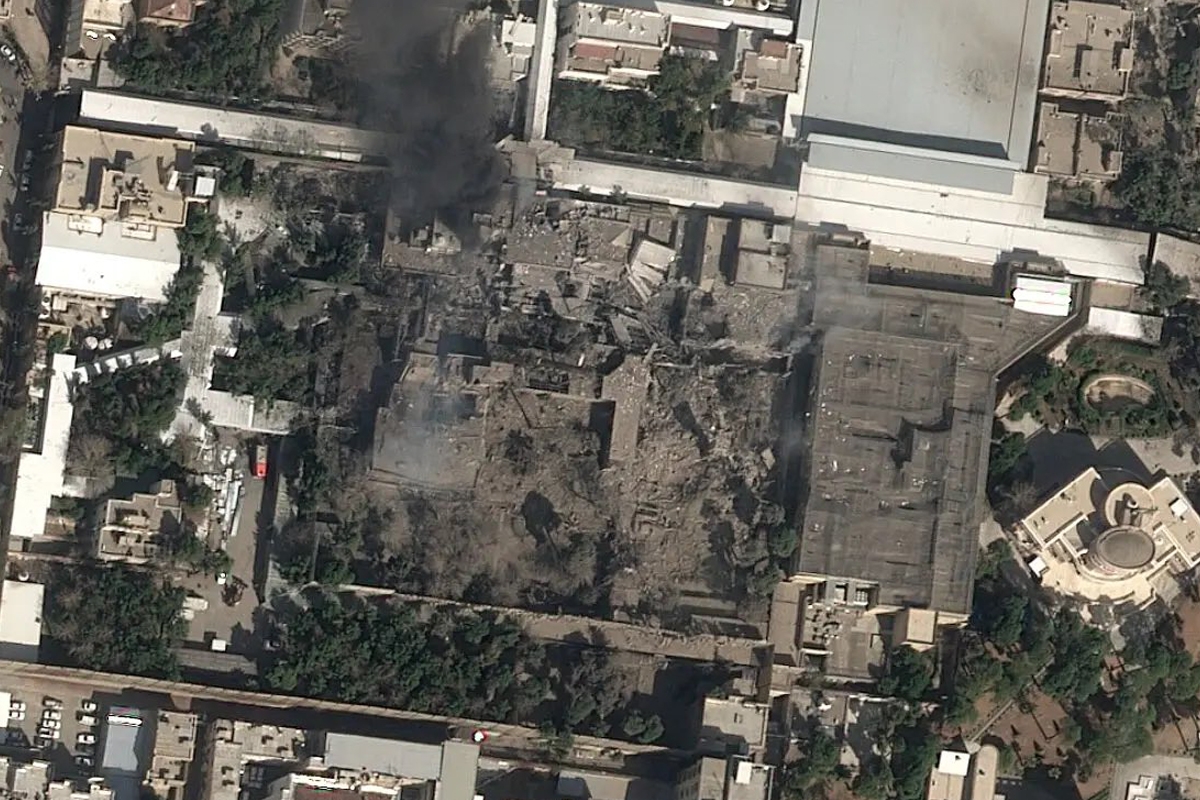
Satellite imagery showed a black column of smoke and significant damage at Khamenei’s residence and at key buildings hosting senior officials. Israeli reports claimed the death of Revolutionary Guard commander Mohammad Baqpor, as well as the ministers of defense and intelligence.
Iranian opposition sources reported severe confusion within the leadership of the Islamic Revolutionary Guard Corps following assassination operations targeting senior officials. Opposition reports indicated that leadership officials had been spending hours identifying the deceased among the regime’s senior figures and determining who remained alive. It was also alleged that some of those killed included close advisors to Iran’s Supreme Leader.
According to information from Al-Jarida, a meeting of Iran’s Supreme National Security Council survived a missile strike after the meeting was relocated at the last minute. The Israeli military stated it targeted several sites in the capital, Tehran, where senior Iranian officials were gathered, without providing details on the attack’s outcomes.
Meanwhile, the Iranian Mehr News Agency reported that 40 female students were killed in a US-Israeli attack on the Minab Elementary School for Girls in southern Iran. Obtaining information from Iran has become difficult following the suspension of internet and communication networks.
The strikes were not limited to the capital, Tehran, but also targeted locations in Qom, Kermanshah, Karaj, Isfahan, and other cities. The US Fox News network quoted a US official stating that “air raids on Iran will continue for days, not hours.” Meanwhile, CNN reported waves of escalating attacks interspersed with pauses to assess damage.
The Wall Street Journal reported that many Tehran residents fled the city amid heavy traffic congestion on major roads. Earlier, Iran’s Supreme National Security Council had urged residents to leave the capital if possible.
Authorities announced that highways used as exits from the capital experienced severe traffic jams. Iran’s official state television reported that some roads leading to northern and southern Tehran were converted to one-way traffic due to heavy congestion, while others were completely closed.
In a move with unpredictable consequences and repercussions, Iran launched an overt and unprecedented aggression against Kuwait and three Gulf Cooperation Council (GCC) countries: the United Arab Emirates, Qatar, and Bahrain.
The General Staff of the Kuwaiti Army announced that, as part of continuous efforts to protect Kuwait’s airspace, air defense systems engaged aerial missiles detected in the airspace in accordance with approved operational procedures and established rules of engagement.
Kuwait expressed its strong condemnation of the criminal Iranian attack targeting its territory, which constituted a blatant violation of its sovereignty and airspace, as well as of international law and the UN Charter.
The official spokesperson for the Ministry of Defense, Colonel Saud Al-Atwan, stated that Kuwait’s air defense force successfully intercepted ballistic missiles targeting the Ali Al-Salem Air Base.
The General Staff of the Kuwaiti Army affirmed that the armed forces continue to carry out their duties and responsibilities in defending Kuwait’s sovereignty and countering any threats to the country’s security and stability.
In a strongly worded statement, the Ministry of Foreign Affairs reaffirmed Kuwait’s full and inherent right to self-defense under Article 51 of the UN Charter in response to this blatant aggression, in proportion to the scale and nature of the attack and in compliance with international law. It emphasized that Kuwait would take all necessary measures to protect its territory, population, and residents, ensuring the preservation of its sovereignty, security, and stability.
The Ministry clarified that Kuwait’s defenses successfully countered this aggression in accordance with approved operational procedures and established rules of engagement. It added that the continuation of such aggressive military actions in the region would undermine regional security and stability.
In a second statement, Kuwait strongly condemned and denounced the Iranian attacks targeting the United Arab Emirates, Bahrain, Qatar, and Jordan, as a blatant violation of international law and the UN Charter.
The Ministry of Foreign Affairs affirmed Kuwait’s full solidarity with the sister states that were targeted by the attack, and its support for all measures they take to safeguard their sovereignty, security, and stability.
Although Tehran insists its operations target US bases exclusively, the broad scope of the strikes and their repetition in three waves across the UAE, Qatar, and Bahrain, in addition to strikes on bases in Iraqi Kurdistan and Jordan, have placed the region on the brink of open escalation, carrying the risk of a comprehensive slide into a wide regional confrontation. This comes amid official Gulf statements affirming the right to respond and warning against continued violations of state sovereignty and the undermining of regional stability.
In this unprecedented escalation, which Kuwait and the capitals of the Gulf Cooperation Council (GCC) countries viewed as a blatant violation of national sovereignty, airspace, and a clear breach of international law and the UN Charter, Iranian leadership announced the commencement of “Operation True Promise 4” to strike US bases in the region.
The Iranian National Security Council had previously deemed bases and centers used to launch attacks on Iran as “legitimate targets,” while the Islamic Revolutionary Guard Corps (IRGC) announced in an official statement a wide wave of missile and drone attacks, asserting that its operations targeted US military bases in Qatar, the UAE, Bahrain, and Kuwait, as well as sites within Israel.
It also announced the targeting of the headquarters of the US Fifth Fleet in Bahrain, emphasizing that the attacks are ongoing as part of “Operation True Promise 4.”
The Saudi Ministry of Foreign Affairs expressed the Kingdom’s rejection and strongest condemnation of the brazen and cowardly Iranian attacks that targeted the Riyadh and Eastern regions, which were successfully repelled. These attacks are unjustifiable under any pretext or in any form, despite Iranian authorities’ knowledge that the Kingdom had affirmed it would not allow its airspace and territory to be used to target Iran.
He added, “In light of this aggression, the Kingdom will take all necessary measures to defend its security and protect its territory.”
In the UAE, the Ministry of Defense announced that the country was hit by Iranian ballistic missiles in two successive waves. Air defenses efficiently handled the first wave before intercepting a subsequent second wave that targeted military sites.
The ministry confirmed that missile debris fell on a residential area in Abu Dhabi, causing material damage and the death of one person of Asian nationality. It stressed that the attack represents a “serious escalation and a cowardly act,” and a blatant violation of national sovereignty and international law, affirming the state’s full right to respond and take all necessary measures to protect its territory and citizens.
Media reports indicated that missile attacks targeted US Navy infrastructure in Abu Dhabi.
In Qatar, the Ministry of Defense announced the successful interception of three waves of Iranian missiles targeting Qatari territory, confirming that the entire wave of attacks was intercepted before reaching their targets, thanks to high readiness and joint coordination among relevant authorities, and the use of air defense systems including “Patriot.”
The ministry clarified that all missiles were shot down before reaching Qatari territory, and that security conditions remain stable and under control. Qatar strongly condemned the targeting of its territory with Iranian ballistic missiles, affirming that this is unacceptable under any justification or pretext, and that it reserves its full right to respond.
In Bahrain, the National Contact Center announced that the kingdom was subjected to missile attacks targeting sites and facilities within its borders, including the U.S. Fifth Fleet Services Center in the Juffair area, across three successive waves. The center confirmed that the attacks constituted a blatant violation of the kingdom’s sovereignty and security, and that security and military authorities immediately began implementing approved emergency plans. Air raid sirens were activated across the country, and citizens and residents were urged to move to the nearest safe locations. Bahrain emphasized its full right to respond and take necessary measures to protect its national security and safeguard its sovereignty, in coordination with its allies and partners.
The Saudi Ministry of Foreign Affairs issued a statement condemning the “brazen Iranian aggression and blatant violation” of the sovereignty of the United Arab Emirates, Bahrain, Qatar, Kuwait, and Jordan, affirming its full solidarity with these sister states and pledging to place all its capabilities at their disposal.
Riyadh warned of the severe consequences of continuing violations of state sovereignty and principles of international law, calling on the international community to take firm measures to halt the attacks threatening the region’s security and stability.
Iranian Foreign Minister Abbas Araghchi informed his counterparts from Saudi Arabia, the UAE, Qatar, Kuwait, Bahrain, and Iraq that Iran’s political leadership would employ all its defensive and military capabilities under what it termed its “legitimate right to self-defense.”
Despite the aggression, Araghchi pointed to Iran’s resolve to continue its policy based on good neighborliness and friendship with all countries in the region, and to the fundamental principle of international law prohibiting participation in any aggressive act against another state. He reminded all regional countries of their responsibility to prevent the United States and Israel from exploiting their facilities and territories to launch aggressive operations against Iran.
He stressed that “the Iranian Armed Forces, in exercising their inherent right to defend their country in accordance with international law, consider the origin and source of the aggressive operations by the United States and the Zionist entity, as well as any action aimed at countering Iran’s defensive operations, as legitimate targets.”
In Jordan, the military announced the successful interception of two ballistic missiles by air defense systems. Shrapnel from a missile fell in an uninhabited area north of Irbid, with no casualties reported.
In Syria, five people were killed when an Iranian missile struck a building in the city of Suwayda. The official news agency, SANA, reported that the Iranian missile hit a structure in the industrial zone within Suwayda as a result of the reciprocal strikes between Israel and Iran, and that the incident also caused several injuries.
Concurrently, Israel experienced waves of missiles and drones launched by Iran, with explosions heard in Tel Aviv and Jerusalem. The Iranian military confirmed the launch of dozens of drones toward Israel, while the Israeli military announced it had detected the missile launches and was working to intercept them, urging residents to comply with Home Front directives.
In Iraq, missile attacks targeted a U.S. base in the Kurdistan Region. U.S. air defenses intercepted drones over the skies of Erbil.
A statement from the Iraqi Ministry of Foreign Affairs confirmed that Araghchi informed his Iraqi counterpart, Fuad Hussein, that Tehran would target U.S. military bases in the region, clarifying that the attacks were not aimed at the countries concerned but at military sites only.
While the Joint Operations Command announced that the Jurf al-Sakhar area, south of Baghdad, came under several airstrikes that resulted in casualties, sources reported that sites belonging to armed factions loyal to Iran were targeted. In turn, the Iraqi Hezbollah Brigades, allied with Iran, announced that they would soon attack US bases in retaliation for attacks on Tehran.
In Yemen, two senior officials in the Houthi militias told The Associated Press that the group had decided to support Iran and resume its missile and drone attacks against maritime navigation routes and Israel.
One official clarified that the first attack could begin on the night of Saturday into Sunday, raising fears of a return of unrest to vital shipping lanes in the Red Sea and the Bab al-Mandab strait.
In Muscat, Omani Foreign Minister Badr Al Busaidi expressed his dismay at the US and Israeli military strikes on Iran.
Al Busaidi, who served as a mediator in talks between the United States and Iran and facilitated the exchange of messages between the two sides in Muscat and Geneva, wrote on the X platform that “active and serious negotiations have been undermined once again,” adding that these steps “do not serve the interests of the United States or the cause of global peace.”
Former Iranian crown prince Reza Pahlavi addressed Iranians in a message coinciding with the US-Israeli military operation against Iran, noting that “the assistance promised by the US president to the brave Iranian people has now arrived. It is a humanitarian intervention, and its target is the Islamic Republic, its repressive apparatus, and its killing machine—not the great homeland of Iran or its great people.”
He added: “With the arrival of this assistance, final victory will be achieved by our own hands. We, the people of Iran, will decide this final battle,” calling on military and security forces to “contribute to a stable and safe transition. Otherwise, you will go down with Khamenei’s broken ship and his regime.”
Pahlavi urged Iranians to stay home and maintain calm, adding: “Be vigilant and ready to return to the streets at the appropriate time, which I will inform you of precisely, for a decisive move.”
Maryam Rajavi, head of the National Council of Resistance of Iran (NCRI)—which serves as the political umbrella for the opposition Mojahedin-e Khalq organization—announced what she termed the “Interim Government of the National Council of Resistance of Iran to transfer sovereignty to the Iranian people and establish a democratic republic.”
Rajavi had launched a sharp attack hours before the US-Israeli strike on Iran, criticizing former crown prince Reza Pahlavi and accusing him of seeking to establish a “neo-fascist system.” She stated that “remnants of the Shah’s dictatorship are practically a major obstacle to the regime’s overthrow and are in effect allies of the current system.”
She said that “liberating Iran requires drawing clear boundaries with the Shah’s dictatorship and affirming the guiding principle: neither the Shah’s system nor the Mullahs’ system.”
An official from the European Union Naval Force (EUNAVFOR) Aspid mission said that ships were receiving messages on very high frequency radio bands from the Iranian Revolutionary Guard Corps stating that “no ship is allowed to pass through the Strait of Hormuz.”
The official, who spoke on condition of anonymity, told Reuters that Iran had not officially confirmed any such order.
Tehran has threatened for years to close the narrow waterway in response to any attack on the Islamic Republic.
The strait is the world’s most important route for oil exports, linking the Gulf’s largest oil producers, such as Saudi Arabia, Iran, Iraq, and the United Arab Emirates, with the Gulf of Oman and the Arabian Sea.
