Liberation of Kuwait in the eyes of the world.. An epic of people's resilience and leadership's acumen crowned by international consensus
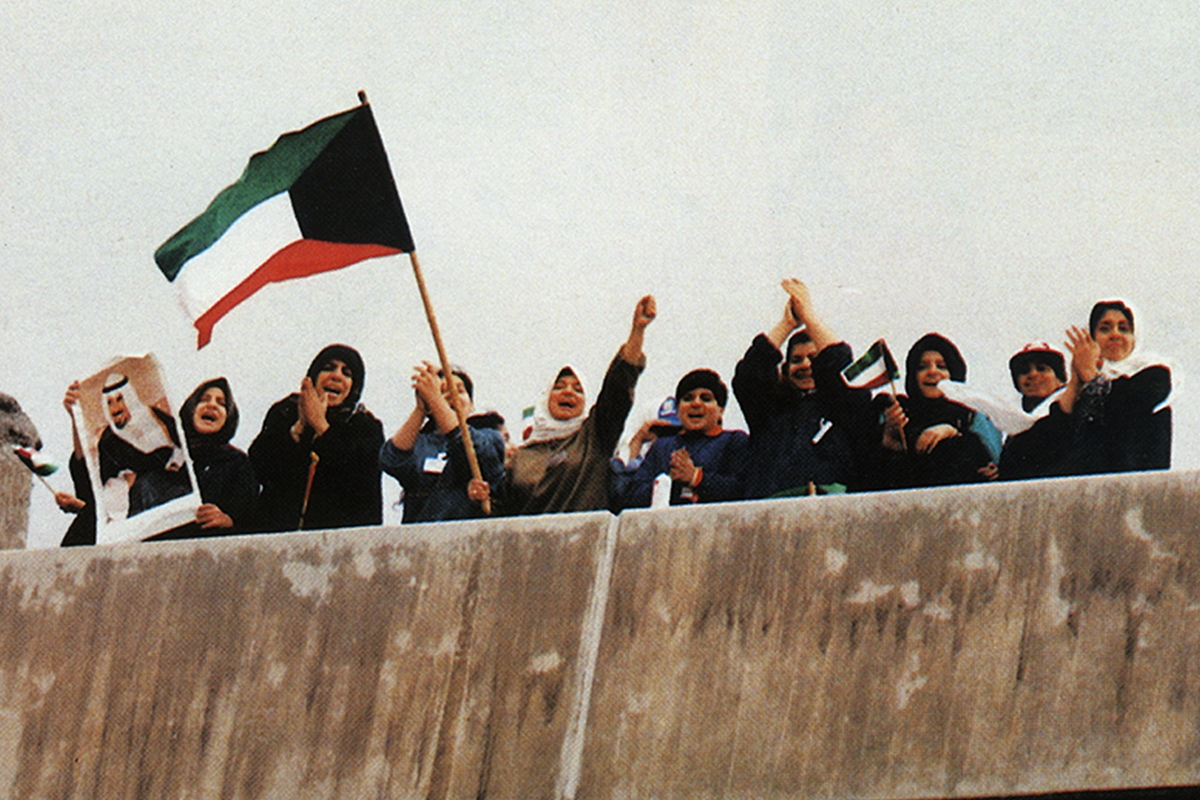
Kuwait was liberated after a global diplomatic and political battle.
Translated by Alqyas from Al-Jarida — Original source
“The Ambassador of Al-Sabah… Tonight, Kuwait is liberated.” With these words, which captured the depth of the moment, U.S. President George H.W. Bush, speaking from the floor of the U.S. Congress, declared the completion of the chapters of the epic saga of Kuwait’s liberation, gazing with eyes full of accomplishment at the country’s ambassador to the United States at the time, Sheikh Saud Al-Nasser Al-Sabah, may God have mercy on him.
Hardly had the echo of his words settled in Washington when capitals of decision-making around the world erupted in a wave of reactions, laden with exceptional praise for the resilience of the Kuwaiti people and the exceptional political acumen with which Kuwait’s political leadership conducted the struggle politically and diplomatically, as well as for the unprecedented global coalition that brought to an end one of the most dangerous crises in the history of the contemporary international system.
U.S. President George H.W. Bush stated in a televised address to the American public that the liberation of Kuwait represented a victory for international law, emphasizing that aggression could not serve as the basis for political legitimacy, and that the international community had demonstrated its capacity for joint action when a member state of the United Nations was subjected to aggression.
Margaret Thatcher praised the steadfastness and composure of the Kuwaitis in the face of occupation, considering their resilience to have played a pivotal role in maintaining the international momentum supporting liberation.
For his part, French President François Mitterrand stated in a communiqué issued from the Élysée Palace that the restoration of Kuwait’s sovereignty represented a success for the shared international will, and that respect for internationally recognized borders constituted the cornerstone of global stability.
German Chancellor Helmut Kohl, for his part, viewed the liberation of Kuwait as a step that strengthened confidence in the international system following the end of the Cold War, affirming that a unified position within the Security Council formed a crucial element in the legitimacy of the international action to liberate Kuwait and return it to its people and legitimate leadership.
In Moscow, then-Soviet President Mikhail Gorbachev affirmed that ending the occupation and restoring Kuwaiti sovereignty was an important development toward consolidating the rules of international law, emphasizing that resolving crises through international legitimacy and multilateral consensus represented the safest path to global stability.
Regionally, official statements issued by the leaders of the Gulf Cooperation Council (GCC) states followed one another, conveying sincere congratulations to Kuwait’s leadership and people, embodying a sincere expression of shared destiny and the principle that any aggression against one GCC state constitutes a complete aggression against the GCC entity as a whole.
His Majesty King Fahd bin Abdulaziz Al Saud, may God have mercy on him, affirmed that the liberation of Kuwait represented a victory for Arab rights, and that Kuwait’s security was an integral part of the security of the Kingdom of Saudi Arabia and the region, adding that Gulf and Arab solidarity played a significant role in consolidating the international position supporting Kuwait’s legitimacy.
For his part, UAE President Sheikh Zayed bin Sultan Al Nahyan, may God have mercy on him, congratulated Kuwait’s leadership and people, affirming that what was achieved was the fruit of Gulf, Arab, and international cohesion.
Sheikh Zayed called for a phase of reconstruction and stability, stressing the importance of not allowing such aggression to be repeated against any Gulf state.
For his part, Qatar’s Amir Sheikh Khalifa bin Hamad Al Thani, may God have mercy on him, welcomed the liberation, considering the return of liberated Kuwait to its people a victory for international legitimacy.
In the Sultanate of Oman, Sultan Qaboos bin Said, may God have mercy on him, expressed satisfaction with the restoration of Kuwaiti sovereignty, calling for the consolidation of regional stability through cooperation and political solutions, and strengthening the Gulf collective security system.
Meanwhile, in Manama, Prince Isa bin Salman Al Khalifa, may God have mercy on him, described the liberation as an achievement for legitimacy and international solidarity, affirming Bahrain’s full support for its sister state, Kuwait.
In Cairo, former Egyptian President Hosni Mubarak stated that the liberation of Kuwait demonstrates that the Arab system is capable of joint action when one of its member states is attacked, pointing to the participation of Egyptian forces within the coalition and noting that Kuwait’s return to its people signifies a restoration of balance in the region.
For his part, Moroccan King Hassan II sent a congratulatory message to the Kuwaiti leadership, stating that Kuwait’s resilience had entered the pages of history and that legitimacy had triumphed thanks to the convergence of international and Arab efforts.
Similarly, Syrian President Hafez al-Assad issued a statement affirming that the end of occupation restores rights to their rightful owners and closes a dangerous chapter in the region’s history.
For his part, Arab League Secretary-General Esmat Abdel Meguid emphasized that Kuwait’s return to its sovereignty represents a pivotal moment in joint Arab action, calling for lessons to be drawn and conflict prevention mechanisms to be strengthened.
In the same vein, Thomas Pickering, then President of the UN Security Council, considered Kuwait’s restoration of sovereignty as a clear implementation of the international community’s will, as reflected in the Council’s resolutions.
The UN General Assembly platform also became a global show of support, with representatives from Asian, African, and Latin American countries describing the liberation as a deterrent message to anyone considering violating state borders by force or imposing facts on the ground.
In Brussels, NATO Secretary-General Manfred Wörner issued a statement saying that the liberation of Kuwait strengthens the concept of cooperative security and underscores the importance of international partnerships in confronting major threats.
In a parallel development, parliamentary assemblies around the world convened special sessions and issued official statements to celebrate the restoration of rights to their rightful owners. The US Congress praised the success of the liberation mission, while then-Speaker of the House Tom Foley described the commitment to the international coalition as a model of burden and responsibility sharing.
The environmental dimension was not absent from the discussions, as European parliamentarians called for urgent international action to address the environmental and infrastructural damage caused by the oil well fires set by the former Iraqi regime in Kuwait.
Meanwhile, international financial institutions quickly moved to build bridges of cooperation. The World Bank announced its readiness to contribute to reconstruction programs, while the International Monetary Fund expressed its willingness to provide advice and technical support to the Kuwaiti government in the post-liberation phase.
Kuwaiti diplomacy served as the crown jewel, garnering widespread appreciation in international political circles. Its intensive movements during the occupation, continuous communications with capitals, and systematic presentation of facts played an active role in solidifying the legal and political narrative of the crisis.
Diplomats from various parts of the world described Kuwait’s diplomatic performance as steady, affirming that it was an exemplary model of crisis management for states with an active international presence.
International media also devoted extensive coverage to the moment of liberation, with major global newspapers describing the event as a victory for the rules-based international order, praising Kuwait’s ability to transform its cause into a matter of global public opinion.
At the heart of Kuwait, the most beautiful forms of national cohesion between the leadership and the people were evident. The return of the symbol of legitimacy, the late Emir of Kuwait Sheikh Jaber Al-Ahmad Al-Jaber Al-Sabah, to the homeland marked the beginning of another chapter of construction and reconstruction, cementing the liberation era in the national memory as a solid pillar in the identity of modern Kuwait and a living testament to the will of peoples when armed with determination and conviction.
