Larijani discusses Iranian proposal with US official in Muscat
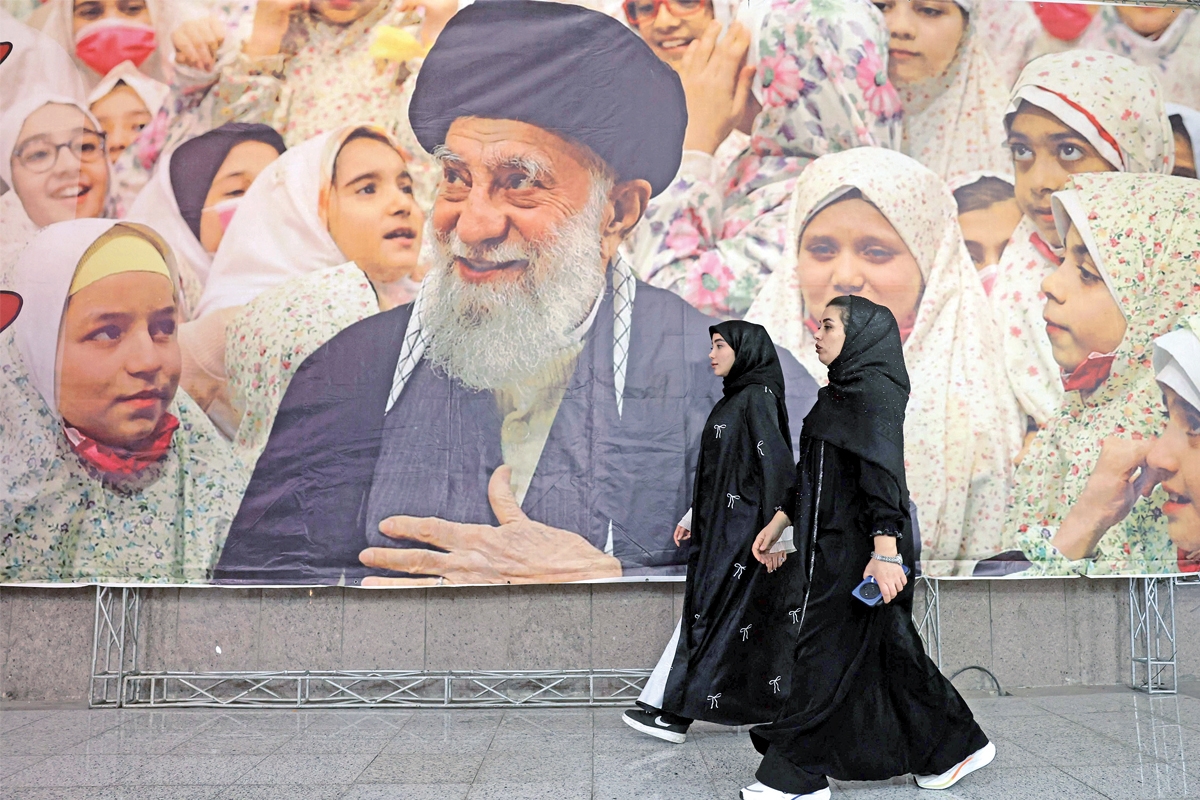
Larijani discusses the Iranian proposal with a US figure in Muscat, while Trump shows a tendency toward limited strikes if no agreement is reached.
Translated by Alqyas from Al-Jarida — Original source
With Thursday’s day after tomorrow set as the date for the third round of negotiations between the United States and Iran in a meeting that could be the last chance to avert military conflict, Al-Jarida learned that Ali Larijani, Secretary-General of Iran’s Supreme National Security Council, will discuss the Iranian draft proposal in Muscat with a U.S. figure. Meanwhile, The New York Times reported that U.S. President Donald Trump intends to adopt a phased approach, exhausting diplomatic options before moving to a limited strike targeting Iranian Revolutionary Guard Corps bases, nuclear sites in the country, and its ballistic missile program.
According to the report, if none of this leads Iran to abandon its nuclear program, Trump will consider launching a broader attack in the coming months, potentially targeting the overthrow of the Islamic regime that has ruled since 1979.
Iranian media revealed that Larijani will arrive in Muscat today, which is mediating the negotiations, carrying the Iranian proposal. The Iranian Foreign Ministry denied knowledge of any visit by Larijani, but a source in Iran’s Supreme National Security Council confirmed to Al-Jarida that Larijani is likely to make the visit, which would be the second of its kind since negotiations resumed.
The source told Al-Jarida that Larijani will meet with a U.S. figure in Muscat, either in person or via video, to discuss the Iranian proposal and U.S. amendments in order to reach understandings before Iranian Foreign Minister Abbas Araghchi meets with U.S. Presidential Envoy Steve Witkoff in Geneva on Thursday.
Al-Jarida revealed more than 10 days ago that Supreme Leader Ali Khamenei had authorized Larijani to oversee the nuclear file and granted him wide-ranging powers.
Americans are expected to receive the Iranian proposal in the coming hours. Al-Jarida revealed the day before yesterday the broad outlines of the proposal, which calls for Iran to partially suspend uranium enrichment within its borders for one year to pave the way for the formation of a regional consortium for uranium enrichment, while retaining low-level enrichment under the supervision of the UN-affiliated International Atomic Energy Agency (IAEA).
According to Al-Jarida sources, Iran will propose storing highly enriched uranium under IAEA guard until the formation of the regional enrichment consortium, which will be able to handle these quantities, including shipping them out of the country or selling them. In return, Iran expects the United States to lift sanctions against it.
The proposal offers broad headings on economic cooperation by opening Iran’s economic sectors to Washington, including oil, gas, and critical minerals that Washington is seeking. It also includes commitments that Iran will not attack the United States or Israel and will engage in any regional peace process that finds a solution to the Palestinian issue acceptable to Palestinians.
Araghchi, who leads Iran’s negotiating delegation, held telephone talks with his Omani counterpart Badr Al Busaidi yesterday, during which they discussed developments in the negotiations and arrangements for holding the next round of nuclear talks.
While Iranian officials continued to issue high-level threats to Washington in the event of an attack on Iran, security officials in the United States and other Western countries expressed concern that Iran might direct its proxies to carry out retaliatory terrorist attacks against U.S. targets in Europe and the Middle East if Trump orders a wide-scale strike against Iran.
Officials told The New York Times that they have not yet identified any specific plans under implementation, but they noted that the rise in “intelligence noise”—a term used by spy agencies to describe the interception of electronic communications—indicates a certain level of planning and coordination for attacks.
According to the report, threat sources are diverse. Intelligence and counterterrorism officials are concerned that Tehran may enlist the Houthis in Yemen to resume attacks on Western shipping in the Red Sea. Meanwhile, European officials fear that Iran might order sleeper cells of Hezbollah, or even Al-Qaeda or its affiliates, to attack American bases or embassies.
As anti-government protests continued at some Iranian universities, the Indian Ministry of Foreign Affairs requested its citizens to leave Iran yesterday, according to the Indian Embassy in Tehran.
The news of the evacuation of a number of staff members from the U.S. Embassy in Lebanon through Rafic Hariri International Airport came suddenly, though it is not disconnected from the context of regional developments, particularly the tensions between the United States and Iran, as a precaution against any security or military developments.
Notably, this step coincides with further calls from various countries for their nationals to leave Iran as soon as possible. This is accompanied by the repositioning of U.S. forces in the region, particularly in Iraq, the evacuation of officers and soldiers from several other bases, and withdrawals from Syria.
Regarding Lebanon, the issue has multiple dimensions, especially since the evacuation of staff followed the publication by the Iranian Al-Alam channel of images taken of the Hmeimim military base, where U.S. soldiers are stationed and U.S. aircraft operate. The video recording was interpreted as a message directed at U.S. interests and outposts in Lebanon, warning of their potential targeting in the event of a U.S. war against Iran.
This was accompanied by reports that the U.S. military force in Lebanon discovered a drone that had crashed near the Hmeimim base. The Americans seized the drone and are conducting necessary investigations to determine its launch site, flight path, and the elements it captured. In parallel, other information indicated that a drone was spotted flying near the U.S. Embassy a few days ago, and the drone managed to leave while retaining all the data it had recorded.
