Gold Jumps 3% Amid Rising Tensions Between US and Iran
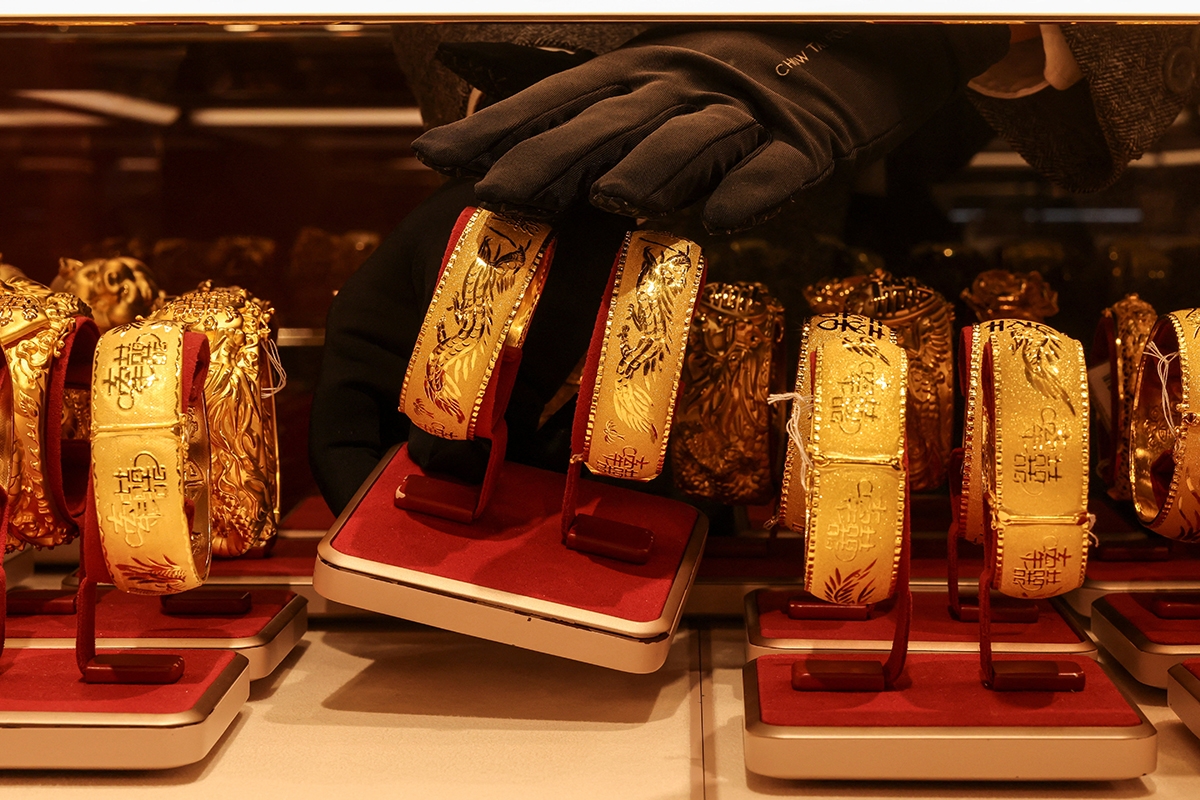
Gold prices rose after an Iranian drone was shot down by the USS Abraham Lincoln
Translated by Alqyas from Al-Jarida — Original source
Gold prices continued their gains today, driven by its appeal as a safe-haven asset, after renewed geopolitical tensions between the United States and Iran bolstered the latest rally in the yellow metal, which had recorded its best daily performance since 2008 in the previous session.
Spot gold prices rose 2.7% to $5,071.79 per ounce, following a 5.9% jump on Tuesday, marking its largest daily gain since November 2008. Gold had reached a record high of $5,594.82 on Thursday. US April gold futures surged 3.2% to $5,092 per ounce, according to Reuters.
Gigir Trivedi, chief research analyst at Endo End Securities, said: “Gold prices rose again, approaching the $5,000 level, as geopolitical tensions enhanced the metal’s appeal as a safe haven after US forces shot down an Iranian drone.”
The US military announced on Tuesday that it had shot down an Iranian drone that approached “in a hostile manner” near the aircraft carrier Abraham Lincoln in the Arabian Sea.
Barak Ravid, a reporter for Axios, reported today, citing an Arab source, that nuclear talks between the United States and Iran are expected to be held in the Sultanate of Oman on Friday.
In a separate development, US President Donald Trump signed a spending agreement into law yesterday, ending the partial US government shutdown. The January jobs report, closely watched by markets, will not be released on Friday due to the partial shutdown.
Investors are increasing their bets on rising yields for long-term Treasury bonds, amid expectations that the new Federal Reserve Chair, Kevin Warsh, will push for interest rate cuts while reducing the central bank’s balance sheet.
Investors expect at least two US interest rate cuts in 2026 and are awaiting jobs data from ADP later today for further indicators on the Federal Reserve’s monetary policy path. The non-yielding precious metal tends to rise in a low-interest-rate environment.
In other precious metals, spot silver rose 3.2% to $87.84 per ounce, having reached a record high of $121.64 on Thursday. Spot platinum rose 2.3% to $2,260.50 per ounce, after hitting an all-time high of $2,918.80 on January 26. Palladium prices increased by 3% to $1,782.85.
Dr. Hassan Obaid, a researcher in economics and international relations, stated that the gold price surges in 2024 and 2025 were logical, driven by geopolitical factors alongside central banks’ intensified gold purchases and hoarding.
In an interview with Arabiya Business, Obaid clarified that recent declines in gold prices were largely unjustified, noting that market movements were influenced by two main factors: one structural and the other technical.
He explained that the structural factor relates to market psychology, following US President Donald Trump’s endorsement of the Federal Reserve Governor, although the official appointment has not yet been made and is subject to US Senate confirmation. The technical factor involved a segment of small investors exiting the market after failing to meet margin call requirements, which temporarily increased gold supply and drove prices down.
He added that this decline prompted major investors, reserve funds, and central banks to seize the opportunity and repurchase, which contributed to gold gradually returning to an upward trajectory. He emphasized that gold, alongside real estate, remains one of the most important tools for preserving value in the long term, particularly for investors who do not monitor markets on a daily basis.
He noted that the Chinese central bank’s continued gold purchases reflect a long-term strategic orientation, and the decision to halt buying remains entirely up to China, with price levels not posing a major obstacle to this trend. He pointed out that gold’s future is inextricably linked to developments in the trade and economic war between major powers, particularly the conflict between the US dollar and other currencies, as well as the role of BRICS nations and the prospects of enhancing local currency transactions or exploring the creation of a unified currency. He considered the current landscape to be more geopolitical than technical.
Amid rapid fluctuations and geopolitical tensions, "Aqarmap" highlights the key forecasts from global expert institutions for gold prices in 2026, amid rising demand for the yellow metal as a safe haven. Global gold prices experienced sharp volatility in recent days after reaching a historic high of $5,595 per ounce on January 29, followed by several steep declines to reach $4,404 per ounce, the lowest level on February 2.
However, the yellow metal quickly recovered, surpassing the $5,000 per ounce threshold at the start of trading on February 4, marking an increase of approximately 17% since the beginning of the year. Despite these fluctuations, international institutions continue to raise their forecasts for gold prices in 2026.
According to aggregated data from several investment banks, US-based JPMorgan leads the forecasts, predicting gold prices will reach approximately $6,300 per ounce by the end of this year. Meanwhile, France’s Société Générale projected levels nearing $6,000 per ounce by the end of 2026, while Germany’s Deutsche Bank set a target of $6,000 per ounce for the year if the dollar’s weakness persists.
UBS also forecast gold prices to reach around $5,900 by the end of this year, while US-based Morgan Stanley estimated the price at approximately $5,700 per ounce during the second half of 2026.
US-based Goldman Sachs predicted prices around $5,400 per ounce in December next year. As a conservative estimate, the London Bullion Market Association forecast the average gold price for the current year to reach approximately $4,742 per ounce.
Goldman Sachs justified its forecasts by noting that private sector gold purchases have risen recently, aiming to hedge against global policy risks, and anticipating that holdings will not be liquidated in 2026, indicating that prices will remain at elevated levels. Meanwhile, JPMorgan clarified that portfolio diversification has contributed to increased gold demand, given the outperformance of real assets over paper assets.
These expert forecasts follow data from the World Gold Council showing that total global gold demand in 2025 exceeded 5,000 tons for the first time, including over-the-counter transactions, driven by purchases from exchange-traded funds (ETFs), central banks, and rising demand for bullion and coins.
