Trump Launches 'Peace Council' and Backs Down on Annexing Greenland
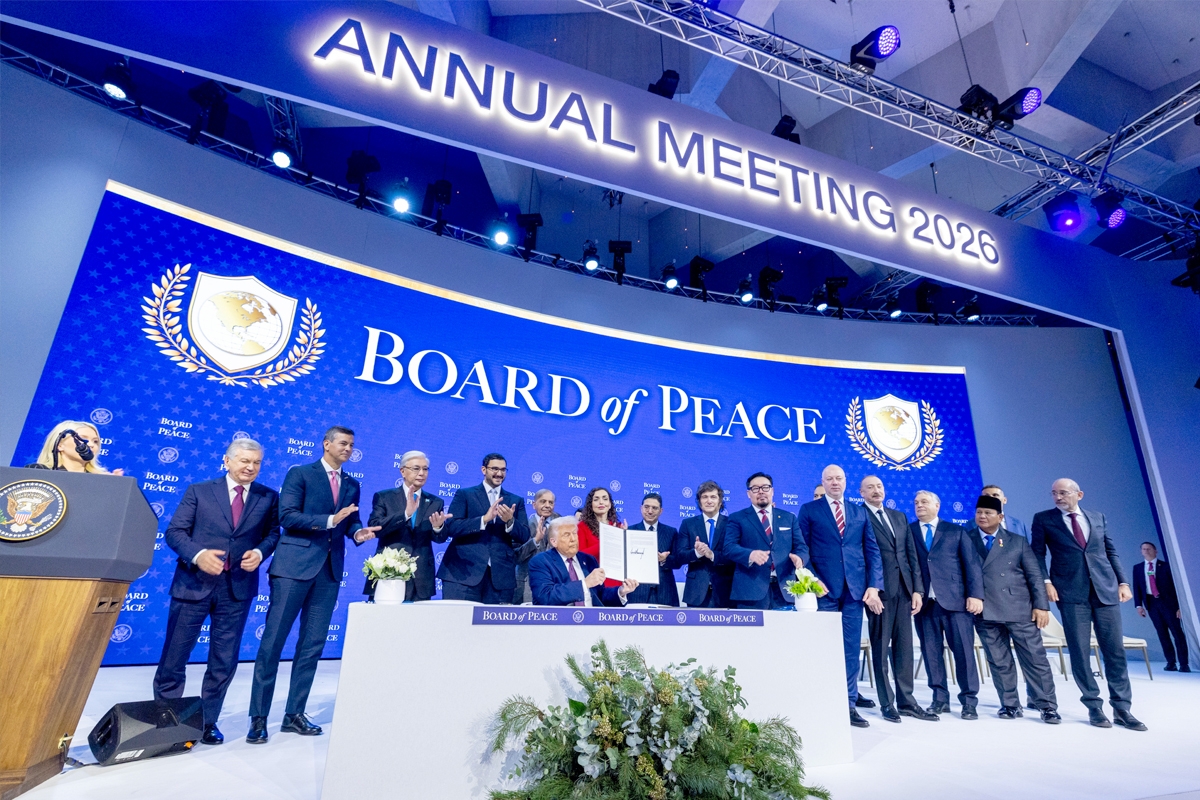
Trump announced his withdrawal from plans to annex Greenland and the establishment of a Peace Council to resolve conflicts, with Danish negotiations on security without ceding sovereignty
Translated by Alqyas from Al-Jarida — Original source
US President Donald Trump launched the “Peace Council” yesterday on the sidelines of the Davos Forum, initially establishing it to oversee the transitional process in Gaza, and later expanding its mandate to seek solutions to conflicts worldwide. This move coincided with his apparent retreat from the idea of acquiring Greenland, a polar island under Danish sovereignty, in exchange for “full and permanent access” to the resource-rich polar territory.
About 22 countries participated in the inauguration ceremony out of approximately 35 that had agreed to the charter, amid near-total European boycotts. Concerns were raised that the new council could undermine the work of the United Nations, whose charter designates it as the body responsible for maintaining global peace and security.
In a lengthy speech, Trump sought to focus on Gaza, pledging cooperation with the UN, which he had long criticized. He argued that the council had the potential to become the most important international body ever created, stating, “We will succeed in Gaza, and we will do other things once the council is fully established. We will be able to do almost anything we want, and we will do so in cooperation with the UN and its immense capabilities.”
Israel was absent from the event. Ali Shua’a, head of the Palestinian committee formed to manage the transitional phase in Gaza under the auspices of the “Peace Council,” announced that the Rafah crossing would open in both directions next week as a first step in his efforts to restore institutions.
Meanwhile, shortly after his speech at the Davos Forum, where he had insisted on acquiring Greenland, the US president surprised everyone by revealing, following a meeting with NATO Secretary General Mark Rutte, a “framework agreement for a future deal” focused on security and defense in the Arctic. At the same time, he announced the cancellation of his threats to impose tariffs on allies who had rejected his idea.
Trump stated yesterday that the agreement grants Washington “full and permanent access” to Greenland. US and European media reported that the deal includes granting the United States sovereign bases, which it could use for military purposes without consulting Denmark.
On her part, Danish Prime Minister Mette Frederiksen announced her readiness to negotiate on “everything” related to security, investments, and the economy, emphasizing that “sovereignty is not on the table” and that “this principle has been communicated to the US side.” She confirmed that any infringement on the territorial integrity of Denmark “is no longer an option.”
Frederiksen told Danish media that although Denmark had coordinated with several partners, including Rutte, to address challenges facing Greenland, Rutte was not authorized to negotiate on behalf of Denmark or Greenland.
The US shift received cautious welcome from Europe. German Chancellor Friedrich Merz described Trump’s retreat from the option of forced annexation as “the right choice,” warning that any threat to European territories or imposition of tariffs would undermine the foundations of transatlantic relations. He affirmed Europe’s readiness to respond with a unified and firm stance if necessary.
Conversely, diplomats said that EU leaders would reconsider their relations with the United States at the emergency summit held yesterday, despite Trump’s reversal.
Reuters reported that EU governments remain concerned about Trump’s potential to change his mind again, noting that his policies are characterized by volatility. He is increasingly viewed as relying on bullying tactics, and Europe must take a stand, focusing on developing a longer-term strategy for dealing with the US under the current administration and possibly future ones as well.
Shortly after his speech at the Davos Forum, where he insisted on the United States’ acquisition of Greenland, a Danish sovereign territory in the Arctic, US President Donald Trump, known for his erratic positions, surprised everyone by revealing a “framework agreement for a future deal” focused on security and defense in the Arctic, while simultaneously announcing the cancellation of his threats to impose tariffs on allies who had rejected his idea.
Trump stated that he had reached this agreement with NATO Secretary General Mark Rutte.
He declined to specify whether the new framework grants the United States any form of ownership, contenting himself with saying that “the matter is complicated” and that the negotiations “are not about money,” but he emphasized that the understanding “achieves everything Washington wants, particularly regarding national security and genuine international security.”
For her part, Danish Prime Minister Mette Frederiksen announced her readiness to negotiate “everything” related to security, investments, and the economy, stressing that “soignty is not on the table.”
Before meeting with her British counterpart, Keir Starmer, Frederiksen clearly emphasized yesterday that this principle had been communicated to the US side, and that any infringement on the territorial integrity of Denmark “is no longer up for discussion.”
She explained to Danish media that although Denmark is coordinating with several partners, including Rutte, to address the challenges facing Greenland, Rutte is not authorized to negotiate on behalf of Denmark or Greenland.
She stated that NATO can only negotiate on issues concerning it and related to its operations in the Arctic, adding that all parties agreed on the need to enhance cooperation among Arctic nations and maintain a long-term presence in the region.
For his part, Rutte confirmed that the issue of Danish sovereignty was not discussed during his talks with Trump, clarifying that the focus was on how to protect the Arctic region amid increasing Russian and Chinese activity.
Reuters, citing sources, revealed that the proposed agreement focuses on renegotiating the defense agreement signed in 1951 between the United States, Denmark, and Greenland, which grants US forces broad authority to operate on the island with prior notice to local authorities.
According to the British Telegraph and the US Axios website, the agreement designates certain areas on the island as “sovereign bases,” allowing the United States to conduct military and intelligence operations without consulting or seeking permission from Denmark, as well as permitting it to invest and extract certain rare minerals.
The US shift received cautious welcome in Europe. German Chancellor Friedrich Merz described Trump’s retreat from the option of forced annexation as “the right choice,” warning that any threat to European territories or imposition of tariffs would undermine the foundations of transatlantic relations, while affirming Europe’s readiness to mount a unified and firm response if necessary.
Conversely, diplomats said that EU leaders would reassess their relations with the United States at the emergency summit held yesterday, despite Trump’s retreat.
Reuters reported that EU governments remain concerned about Trump changing his mind again, noting that his policies are characterized by volatility, and that he is increasingly viewed as relying on bullying. Europe must take a stance on this, focusing on developing a longer-term strategy for dealing with the United States under the current administration and possibly future ones as well.
The agency quoted a diplomat from the bloc as saying, “We need to discuss the red lines, how to deal with this coercion from the other side of the Atlantic, and what our strengths are.”
He added, “Trump says there are no tariffs today, but does that mean he won’t impose others tomorrow? Or that he will quickly change his mind? We need to discuss what we will do in that case.”
Regarding the US president’s reversal, another diplomat told Reuters, “Nothing significant has changed. We still need to review the details of the Greenland agreement. We are somewhat tired of all this coercion, and we must take action on several issues: strengthening the resilience and unity of our position, and clarifying our thoughts on the internal market and competitiveness. And not accepting further coercion through tariffs.”
The European Parliament decided yesterday to halt the ratification of the agreement signed by Brussels and Washington last summer in the trade sector, following Trump’s threats to impose tariffs on European countries.
European countries had hinted at using an anti-coercion mechanism, which likely prompted US warnings. In a statement reflecting concerns about financial repercussions, Trump said yesterday, “If Europeans start selling US securities, there will be a retaliatory response.”
