Regional Alert to Counter the Fallout of Iran Strike
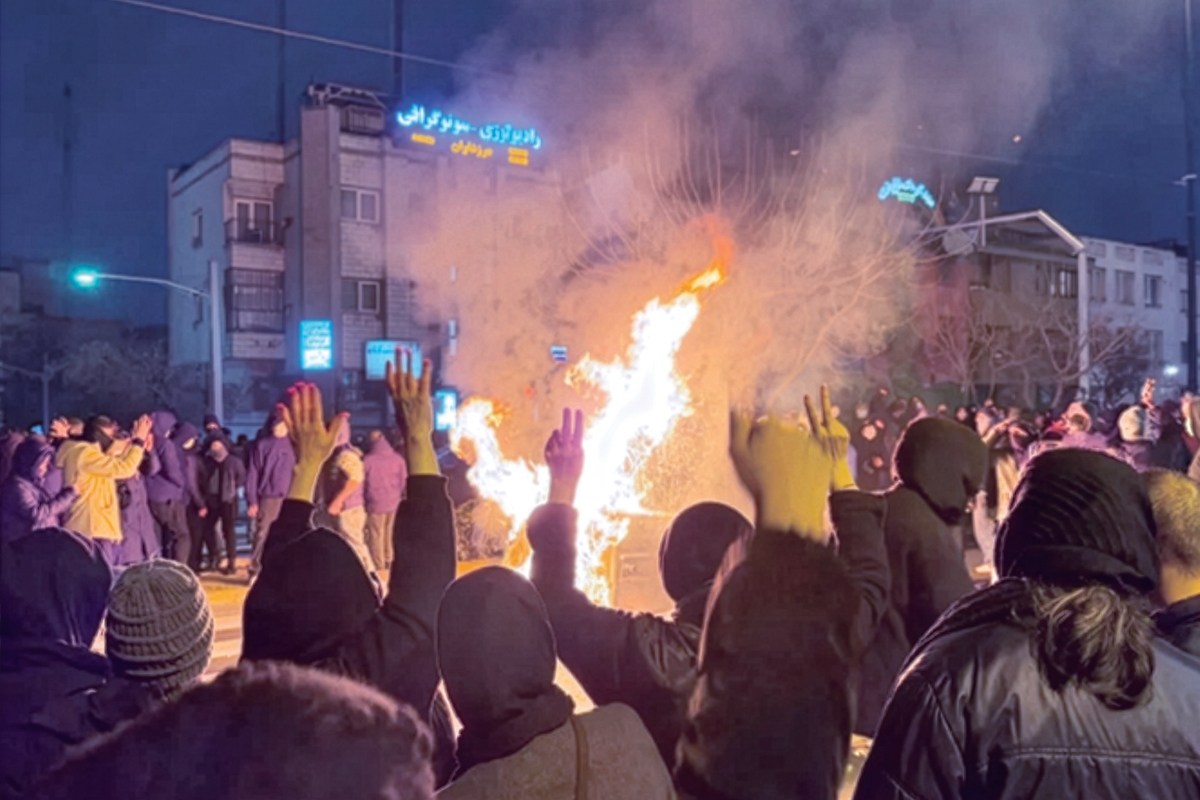
The US considers a potential military strike against Iran, amid heightened alert in the Gulf and intense protests in Tehran.
Translated by Alqyas from Al-Jarida — Original source
The region is on high alert as the United States prepares for a potential strike against Iranian authorities, who continue to confront an unprecedented wave of protests that have persisted for 18 days.
Diplomatic sources told Reuters and Agence France-Presse that some members of the U.S. military stationed at Al Udeid Air Base in Qatar, the largest U.S. air base in the Middle East, were advised to leave. Doha announced that this measure is linked to regional tensions, adding that it is taking steps to protect citizens and residents.
Reports also indicated GPS interference in Iranian and Iraqi airspace. A U.S. official confirmed that “the United States is withdrawing forces from its main bases in the Middle East,” a precautionary step Washington had previously taken before joining the 12-day war against Tehran.
Reports mentioned the sighting of large destroyers in the Gulf region, while satellite images showed the disappearance of a B-2 bomber from Diego Garcia, believed to be the base Washington used to strike Iran’s nuclear program last June.
Meanwhile, Turkey joined Gulf efforts led by Saudi Arabia, Qatar, and Oman to prevent escalation in the region and dissuade the U.S. president from launching a strike that could have negative impacts on the global economy and oil supplies through the Strait of Hormuz. Israeli media reported that the Israeli military “is not part of the attack plan against the Islamic Republic,” but is “preparing defensively and offensively, including raising the readiness level of its air defense system.”
Reuters quoted a senior Iranian official as saying that Tehran warned regional states it would bomb U.S. military bases in those countries if they were attacked by the United States, and asked these states to prevent Washington from attacking Iran.
The Daily Mail leaked information suggesting Trump received a map listing 50 sensitive targets inside Iran potentially subject to bombing, including strategic centers and vital infrastructure, such as headquarters of the Revolutionary Guard.
For its part, The New York Times reported that the strike is imminent. Information circulated by Iranian opposition circles indicated the attack might occur on Friday, which coincides with the date in 1979 when Shah Mohammad Reza Pahlavi and his wife Farah Diba left Iran on January 16.
A European official told Reuters that U.S. intervention could happen within 24 hours, though the scope and timing of the strike remain unclear.
Estimates in U.S. newspapers and media varied regarding how far Trump might go. The Washington Post reported that, unlike previous times, the focus is shifting toward a goal of completely overthrowing the Islamic regime that has ruled since 1979.
In Beirut, diplomatic sources stated that Trump decided to launch military strikes against power centers within the Iranian regime to pave the way for internal change, adding that negotiations are underway with officials inside the regime to initiate steps for change to save the country from the worst-case scenario.
According to the information, what the Americans are proposing is radical change, even if gradual, involving figures from within the regime. This would include abolishing the position of the Supreme Leader of the Islamic Republic and removing Ali Khamenei from that post, as well as ending the role of the Revolutionary Guard in favor of the regular army—measures that could open the door to broader understanding with the United States.
The region is in a state of unannounced alert as the United States prepares to launch a potential strike against Iranian authorities, who continue to suppress an unprecedented wave of protests that have been ongoing for 18 days against deteriorating living conditions and the Islamic Republic’s system, while firing warning shots that threaten to ignite the entire region.
The day after identical reports emerged that the US military was preparing for a potential attack, with giant destroyers deployed in the Gulf region and satellite images showing the disappearance of a B-2 bomber from Diego Garcia base near Iran, diplomatic sources told Reuters that some US military personnel at Al Udeid Air Base in Qatar, the largest US air base in the Middle East, were advised to leave by Wednesday night.
In a precautionary move previously undertaken by Washington before joining the 12-day war against Tehran, a US official confirmed that “the United States is withdrawing forces from its main bases in the Middle East.”
Later, Reuters quoted Qatari authorities as saying that the departure of some personnel from the base was in response to current regional tensions, adding that Doha continues to implement all necessary measures to ensure the security and safety of citizens and residents.
Despite the region’s countries officially remaining silent regarding events in Iran, the Wall Street Journal claimed that Saudi Arabia, Qatar, and Oman are diplomatically pressuring the US administration to refrain from launching the strike to avoid its potential impact on the global economy and oil supplies through the Strait of Hormuz, as well as the risk of destabilizing regional stability. The newspaper reported that the three countries informed Tehran that they would not allow the United States to use its assets to target their territories.
In a separate development, NBC News quoted Israeli and Arab officials as saying they had advised the Trump administration to delay the strike for now, believing that the Islamic Republic may not yet be sufficiently weakened to be toppled by a US air attack.
They advised Washington to wait until the system is further weakened by the protests, unrest, and intense pressure exerted by its own administration, with the addition of major Western powers, including Germany and France.
Meanwhile, a source in the Turkish Ministry of Foreign Affairs stated yesterday that Foreign Minister Hakan Fidan emphasized during a call with his Iranian counterpart Abbas Araghchi the importance of holding talks to resolve current regional tensions, while a separate Turkish diplomatic source noted that Ankara continues its communications with US officials.
On Tuesday night into Wednesday, US President Donald Trump pledged to take “a very strong action” if Iranian authorities execute individuals arrested during the protests. He reiterated his encouragement for Iranian protesters to continue their movement until the authorities are toppled, promising to provide them with assistance.
Trump said upon leaving Andrews Air Force Base: “I will return to the White House, and we will review the situation in Iran,” adding, “We will get accurate numbers related to the killing of protesters,” noting that even if one protester is killed, that is significant.
Responding to a question about reports suggesting the possibility of some protesters being executed, and whether this constitutes a red line for the United States, Trump said, “I am not aware of any execution incident, but if they execute them, you will see some things in return, and if such a situation occurs, we will take very harsh measures.”
He pointed out that there are many ways the United States can help the protesters, clarifying that this does not include only military options but also economic and other options.
He expressed his belief that matters are not moving in the right direction, adding, “We do not want what is happening in Iran to occur. Protests are one thing, but when they begin killing thousands, the situation changes, and now you are talking about executions. We will see how this phase ends for them, and it will not end well.”
In Tel Aviv, Israeli officials informed their American counterparts of their strong support for regime change in Iran and for U.S. efforts to achieve it, according to Israeli reports that confirmed “the military is preparing defensively and offensively, including raising the readiness of its air defense system, although this is not part of a plan to attack the Islamic Republic.”
Information highlighted that Benjamin Netanyahu’s government views a U.S. strike as a matter of time and advised the Trump administration to resort to other means to destabilize the regime and support the protesters, who might be able to make further efforts to undermine the Islamic Republic before strikes play a decisive role.
The list includes strategic centers and vital infrastructure, such as Islamic Revolutionary Guard Corps (IRGC) headquarters, particularly the “God’s Revenge” (Intiqam-e Allah) headquarters, both its command and branches, as well as headquarters for hidden infrastructure across Tehran that coordinate intelligence, police, and psychological operations.
The list of potential targets for bombing also includes 23 bases belonging to the Basij Popular Resistance Force. The U.S. newspaper The Washington Post quoted European officials as saying that Washington had asked European countries to share information on potential targets inside Iran, and that officials and forces involved in suppressing and killing protesters could be targeted.
In response, a senior Iranian official told Reuters that Tehran had warned regional countries that it would bomb U.S. military bases in those countries if they were attacked by the United States.
The official said: “Tehran has informed regional countries, from Saudi Arabia and the UAE to Turkey, that U.S. bases in those countries will be attacked. It has asked these countries to prevent Washington from attacking Iran.”
He clarified that U.S. threats are undermining diplomatic efforts, and that any potential meetings between officials to find a diplomatic solution to the decades-old nuclear dispute have been canceled.
On the domestic Iranian front, sparse reports mentioned nighttime protests in several cities, including Tehran, Mashhad, Zahedan, and Kermanshah, amid the authorities’ continued near-total internet shutdown since last Thursday.
While crowds gathered to mourn dozens killed in clashes in Tehran, the Hrana website reported that the number of protest victims had risen to 2,571 dead, while Western intelligence sources estimated that in the past two weeks, more than one million Iranians took to the streets without any single leader being identified.
Hrana clarified that among the dead were 2,403 protesters, 147 individuals linked to the government, 12 people under the age of 18, and 9 civilians who did not participate in the protests.
Judiciary head Gholam-Hossein Mohseni Ejei pledged to conduct “swift trials” for suspects detained in connection with the demonstrations, which authorities describe as “riots and terrorist warfare,” but he promised to bring different charges and penalties for those accused of murder or arson.
Meanwhile, Border Guard Commander Brigadier General Ahmad Goudarzi announced the identification and destruction of “three terrorist teams” carrying weapons and ammunition with the aim of sabotage, at the country’s borders before they could enter Iranian territory. The “Kurdistan Free Life Party” (PJAK) claimed control of an IRGC base in Kermanshah, western Iran.
As Western reactions condemning Tehran’s actions continued to mount, French Foreign Minister Jean-Noël Barrot described the crackdown on protesters in Iran as potentially the most violent in the country’s modern history, calling on the authorities to end it immediately.
While Israel’s ambassador to the United Nations criticized the international community’s slow response to the massacre of protesters in Iran, India urged its citizens to leave Tehran immediately.
Meanwhile, Moscow and Beijing separately condemned US threats against Iran, emphasizing their support for Tehran to maintain stability.
