Lebanese President: Israel has not complied with the Framework Agreement and we await its policy after forming its new government
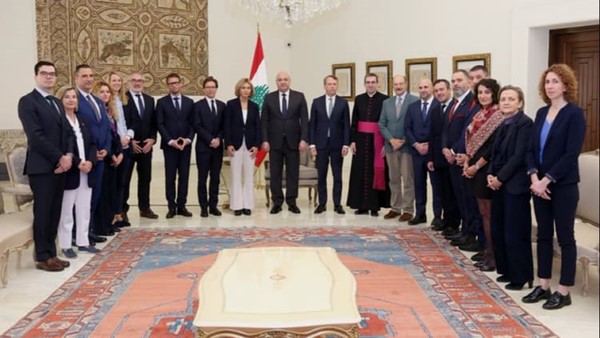
President Aoun affirmed his appreciation for French assistance and rejected Israel's compliance with the Framework Agreement. Nabih Berri met with a French delegation to discuss cooperation. Michel Suleiman criticized the non-implementation of Resolution 1701, and Bakr Al-Rafai called for internal dialogue.
Translated by Alqyas from Al-Anba — Original source
Beirut - Mansour Shaaban
Lebanese President General Joseph Aoun expressed his appreciation for “any French assistance to Lebanon,” commending France’s efforts to find a solution for the post-UNIFIL phase and its constant support for Lebanon during its various crises.
During a meeting at Baabda Palace with a delegation from the Île-de-France region led by Valérie Pécresse, Aoun affirmed that “Lebanon’s security is also France’s and Europe’s security,” noting that “the reforms Lebanon is undertaking are primarily in its own interest.” He pointed out that “Israel has not yet complied with the framework agreement, and we are waiting to form the new Israeli government to see what policy it will adopt.”
For her part, Pécresse announced that the Île-de-France region had decided to provide school grants to three thousand students distributed across eight schools in southern Lebanon. She noted that mayors from both sides would sign twin-city agreements to meet the needs of the areas and involve the French people in this solidarity effort.
From Baabda, Pécresse moved to Aintoura, where she met with Speaker of the Parliament Nabih Berri. The meeting discussed the general situation in Lebanon and the region, the latest developments, and bilateral relations between Lebanon and France, as well as ways to strengthen them. Pécresse also presented cooperation projects between the Île-de-France region and Lebanon, particularly with several southern areas, especially in the fields of education and twin-city partnerships between the French region and southern villages.
On the ground, as soon as talk emerged about the anticipated resumption of Lebanese-Israeli negotiations under US auspices, the Israeli army resumed its military raids in the south, targeting the area between the towns of Zoutar al-Sharqiya and Mifdoun, as well as the outskirts of Kafr Kanna. It also targeted the area between the towns of Al-Qantara and Al-Ghandouriyeh. Israeli artillery shelled Zoutar al-Sharqiya in the Nabatieh District, Wadi Zibqin, and Al-Mansuriya, as well as the areas of Yahmar Al-Shaqif and Arnon, with phosphorus shells. Heavy artillery also bombarded the Al-Mansuriya coast from occupation positions in Al-Bayada and Sham’a south of Sidon, while reconnaissance and drone aircraft hovered over the skies of the western sector, particularly over Sidon, Beirut, and the Southern Suburb.
The newspaper Haaretz quoted an Israeli source as saying that “the United States, Lebanon, and Israel are planning to hold an eighth round of talks before the end of this year.” This comes within the framework of Washington’s efforts to revive negotiations that stalled alongside the failure of the plan for the Israeli army’s withdrawal from areas in southern Lebanon, with no government officials from either side participating since last August.
According to the newspaper, the round will focus on finding a third party to oversee the implementation of any agreement resulting from the talks and to verify the execution of the pilot program calling for the gradual withdrawal of the Israeli army from areas in the south, thereby allowing the Lebanese army to deploy there. It noted that the previous military round in Tampa did not achieve the desired results.
In a related stance, former President General Michel Suleiman stated that “Resolution 1701 has not been implemented seriously; rather, the movement of the International Emergency Forces was intercepted and obstructed by locals.”
He added, “A novelty of underground weapons and above-ground weapons has emerged, and there has been a rejection of commitment to the parameters of Resolution 1701, particularly Resolution 1559, according to an à la carte principle.”
He continued, “When the then-Army Commander asked the Council of Ministers, on the eve of the army’s deployment in the south, for clarification regarding those objections and reservations, some considered that he wanted to disarm the victorious resistance in the July 2006 war.”
Sulaiman argued that it is in Lebanon’s interest to maintain Resolution 1701 in its entirety, with amendments that ensure the aforementioned objections and deviations are not repeated, and in a manner consistent with the developments stemming from the wars of proxy and retaliation.
Meanwhile, Friday preachers focused on the accelerating transformations and overlapping conflicts, amid divergent stances on the issue of the monopoly on arms. Baalbek-Hermel Mufti Sheikh Bakr al-Rifai said, “In Lebanon, where crises are accumulating and fears are growing, internal disagreements must not become open doors to collapse and fitna. This stage requires wise leaders who unite rather than divide, an open and responsible dialogue, and domestic solutions that preserve the state and its institutions and safeguard civil peace.”
He added, “It is unwise to wait for external actors to resolve our differences, and it is unpatriotic to allow heightened emotions and tense positions to push the country into a precipice with dire consequences. Conceding for the sake of the nation is not defeat, and dialogue is not weakness; rather, it represents the pinnacle of responsibility and courage.”
