Research Develops Technology to Improve Soil, Boost Vegetable Yields, and Cut Irrigation Water Use by 40%
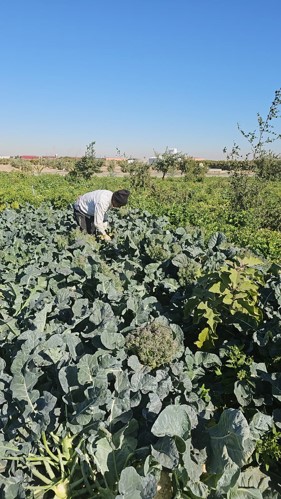
New technology from the institute improves soil, increases production, and saves 40% of water
Translated by Alqyas from Al-Anba — Original source
The Kuwait Institute for Scientific Research (KISR) announced the development of a technology to improve the properties of sandy soil and increase the productivity of vegetable crops by using an organic soil amendment, while reducing irrigation water consumption by 40% compared to full irrigation.
Dr. Hanaa Boursaq, a scientific researcher at the Institute’s Center for Environmental and Life Sciences Research, told KUNA that the research project, titled “Reclaiming farm soil using organic soil amendments to conserve water, thereby increasing vegetable production,” aims to enhance soil properties and boost yields under regulated irrigation conditions, thereby supporting sustainable agriculture and food security in the State of Kuwait.
Boursaq explained that the project was implemented at the farm owned by Al-Inma’ Company in the Al-Wafra area to address two major challenges facing the local agricultural sector: the poor water and nutrient retention capacity of sandy soil, and the scarcity of irrigation water.
She noted that the study involved applying the organic soil amendment at a rate of 10 tons per hectare and using drip irrigation, while providing only 60% of the crops’ water requirements. The results were compared with crops grown in soil without the amendment under the same irrigation conditions.
The results showed significant increases in productivity: cabbage by 406%, cauliflower by 275%, broccoli by 226%, okra by 122%, lettuce by 85%, and tomatoes by 17%, compared to crops grown in soil without the amendment.
She pointed out that using the organic amendment with regulated irrigation contributed to improving the water productivity of crops. Water productivity for tomatoes rose from 6.12 to 14.36 kilograms, for lettuce from 3.72 to 13.79 kilograms, and for eggplant from 2 to 4.60 kilograms per cubic meter of irrigation water.
Boursaq emphasized that the results demonstrate the potential to increase agricultural production while reducing irrigation water consumption, thanks to the organic amendment’s ability to enhance soil moisture and nutrient retention and improve conditions around plant roots.
Regarding the recycling of agricultural waste, she stated that the project proved the feasibility of converting crop residues, damaged vegetables, and sheep and camel manure into high-quality organic compost through a controlled aerobic decomposition process involving humidity regulation and periodic turning.
Laboratory analyses revealed that the produced compost contained 55% organic matter and 30% organic carbon, along with high levels of essential nutrients for plant growth and low concentrations of heavy metals, enhancing its suitability for agricultural use.
She concluded that combining soil improvement with organic amendments, regulated irrigation, and the recycling of agricultural waste represents a promising approach to addressing agricultural challenges in Kuwait, improving the efficiency of natural resource use, rehabilitating soil, and promoting the principles of the circular economy in the agricultural sector.
