3.546 billion dinars fair value of Kuwait's gold.. against 31.7 million dinars book value
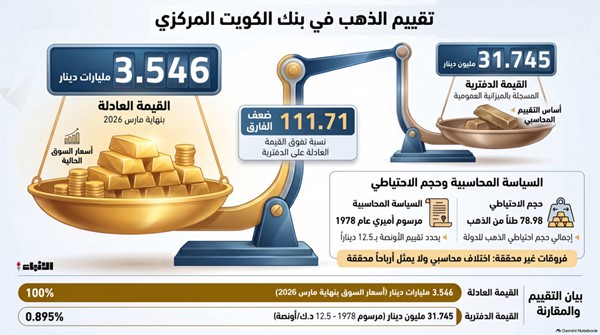
The fair value of gold at the Central Bank of Kuwait reached 3.546 billion dinars against 31.7 million dinars book value, reflecting an accounting gap resulting from the Amir's Decree of 1978
Translated by Alqyas from Al-Anba — Original source
Ahmed Maghrabi: The Central Bank of Kuwait announced that the fair value of gold held in its assets reached approximately 3.546 billion Kuwaiti dinars by the end of March 2026, compared to a book value of 31.745 million dinars, reflecting a difference of 3.514 billion dinars between the two values.
Financial data from the Central Bank of Kuwait’s 54th annual report for the fiscal year 2025/2026 showed that the fair value of gold equals approximately 111.71 times its book value recorded on the bank’s balance sheet, amid the continued application of the accounting valuation mechanism in place for 48 years.
The Central Bank clarified in the notes to the financial statements, specifically under the “Significant Accounting Policies” item, that based on the Emiri Decree issued on July 4, 1978, gold is valued at 12 Kuwaiti dinars and 500 fils per ounce of pure gold. Its fair value stood at 3.546 billion dinars as of March 31, 2026.
A comparison between the data in the balance sheet and its accompanying notes reveals a widening gap between the accounting valuation and the fair value of gold, with its book value representing only 0.895% of its fair value. This is linked to the continued adoption of the valuation price set by the aforementioned Emiri Decree.
It is worth noting that the difference between the fair value and the book value of gold does not represent realized profits, but rather reflects the discrepancy between the accounting valuation basis applied and the fair value at the date of preparing the financial statements.
According to World Gold Council data, Kuwait holds gold reserves amounting to 78.98 tonnes. Physical gold constitutes one of the components of the state’s official reserve assets, alongside foreign currencies, deposits, and securities abroad, special drawing rights, and the reserve position with the International Monetary Fund.
