Minister of Health: Combating infectious diseases is integral part of national health security system
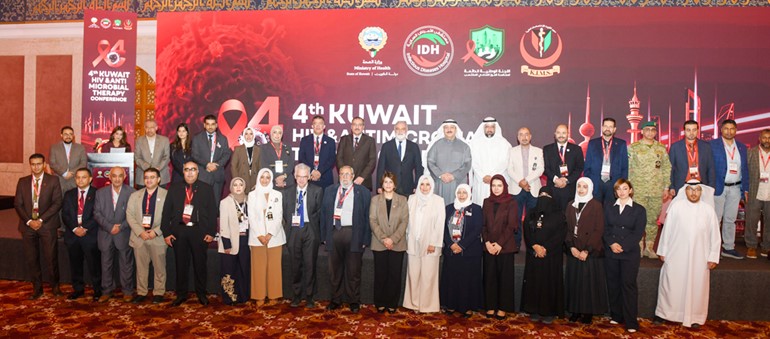
Minister of Health confirms combating infectious diseases is part of national health security, conference chair outlines challenges of AIDS and antibiotic resistance
Translated by Alqyas from Al-Anba — Original source
AbdulKarim Al-Abdullah: Health Minister Dr. Ahmed Al-Awadi inaugurated yesterday Kuwait’s Fourth Conference on HIV/AIDS and Antimicrobial Therapy, emphasizing that combating infectious diseases and antimicrobial resistance have become integral components of the national health security framework. He stressed the importance of enhancing prevention, early preparedness, epidemiological surveillance, and scientific research, as well as developing the capacity of health institutions to detect and respond to risks efficiently.
In his opening address, Dr. Al-Awadi reaffirmed Kuwait’s commitment to supporting a more resilient health system capable of safeguarding public health and addressing current and future health challenges.
Regarding HIV, he pointed out the Ministry of Health’s ongoing efforts to develop specialized diagnostic, treatment, and care services, strengthen continuity of care, and improve patients’ quality of life. He highlighted the significance of the global “95-95-95” targets, which aim for 95% of people living with HIV to know their status, 95% of those diagnosed to receive treatment, and 95% of those on treatment to achieve viral suppression.
He stressed that caring for people living with HIV extends beyond providing treatment; it also involves protecting privacy, combating stigma and discrimination, and ensuring safe healthcare that upholds human dignity. He warned of the dangers posed by antimicrobial resistance, which threatens the effectiveness of treatments across various medical specialties. He noted that its impact is not limited to treating infections but also jeopardizes the safety of complex surgeries, organ transplants, cancer treatments, and critical care.
Dr. Al-Awadi emphasized that preserving the effectiveness of antibiotics requires their prudent use, strengthening prescription oversight programs, combating infections, developing laboratory surveillance, raising public awareness, expanding Gulf and international cooperation, leveraging modern diagnostic technologies and artificial intelligence, and operating under the “One Health” concept, which links human, animal, and environmental health.
For his part, Conference Chairman Dr. Osama Al-Baqshmi stated that the conference addresses a crucial medical paradox: the transformation of HIV from a condition associated with fear and death into one that can be managed thanks to scientific and therapeutic advances, contrasted with the growing challenge of antibiotics losing their efficacy against resistant microbes.
Dr. Al-Baqshmi explained that the number of people living with HIV globally reached approximately 41 million in 2025, while that same year saw around one million new infections and 570,000 AIDS-related deaths. More than 32 million people are currently receiving antiretroviral therapy. He affirmed that achieving sustained viral suppression prevents sexual transmission of the virus.
He noted that one in six laboratory-confirmed infections worldwide showed antibiotic resistance in 2023, while the rate in the Eastern Mediterranean Region rose to one in three reported infections. He pointed out that estimates published in the scientific journal The Lancet in 2024 indicated that bacterial resistance directly caused approximately 1.14 million deaths in 2021, with projections of more than 39 million direct deaths between 2025 and 2050 unless efforts to address this challenge are strengthened. He highlighted that the latest report issued by the World Health Organization on November 16, 2026, revealed that 173 countries had developed national plans to combat antimicrobial resistance, yet only 22% of these countries reported adequate funding and full implementation of those plans. He also addressed the pivotal role played by the Infectious Diseases Hospital in safeguarding national health security, noting its relocation last February to its new building in the Andalusia area, along with comprehensive upgrades that included expanding infectious disease and isolation wards and enhancing molecular diagnostic laboratory capacities.
