Rana Al-Faris: 'Nizaha' exercises its competencies with full independence and we aspire to be stronger and more effective
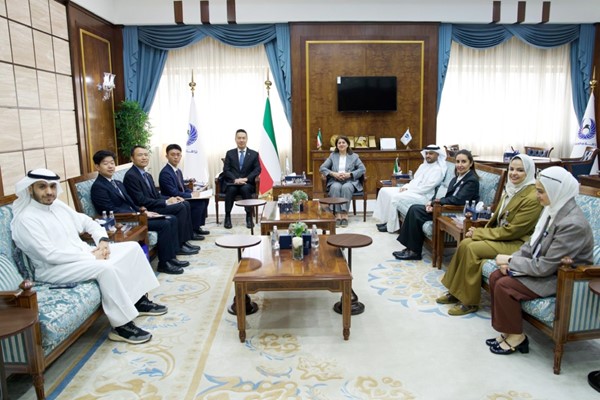
Head of the Public Authority for Combating Corruption receives the Chinese ambassador to discuss enhancing the partnership in fighting corruption and oversight
Translated by Alqyas from Al-Anba — Original source
Nada Abu Nasr received Dr. Rana Al-Faris, Chairperson of the Public Authority for Combating Corruption (Nazaha), along with Yang Xin, Ambassador of the People’s Republic of China to the State of Kuwait. The meeting was attended by Dr. Majed Al-Daihani, Vice Chairman of the Authority, members of the Authority’s Board of Directors, the Acting Director of the International Cooperation Department, and representatives from the Chinese side, including the Deputy Head of the Mission and several embassy officials.
Dr. Al-Faris emphasized the robust strategic partnership between the two countries, particularly in the construction sector, while outlining the Authority’s mandates and sectors, notably corruption detection, financial disclosure, and prevention, as well as the channels for receiving complaints and the preventive programs implemented by the Authority in partnership with the public and private sectors and civil society.
She discussed the issuance of Decree-Law No. 69 of 2025 amending the provisions of Law No. 2 of 2016, and the legislative amendments being pursued by the Authority, affirming that the Authority exercises its mandates with full independence, and that the current Board of Directors aspires to make Nazaha stronger and more effective.
Dr. Al-Faris expressed her interest in learning about Chinese practices, experiences, policies, and legislation governing anti-corruption efforts, and in benefiting from the expertise of specialists in this field.
For his part, the Chinese Ambassador expressed his deep appreciation for the political leadership in Kuwait, headed by His Highness the Amir Sheikh Meshal Al-Ahmad, commending their full support for Nazaha’s efforts.
He emphasized that the leaderships of both countries are committed to combating corruption despite the challenges facing the region, and that Kuwait and China share this goal. He added that fighting corruption is a fundamental pillar of economic and social development, noting that China was among the first countries to sign the United Nations Convention against Corruption (UNCAC).
He outlined the 55-year history of diplomatic relations between the two countries, stressing the importance of enhancing trade exchanges and their role in consolidating integrity, while also highlighting the contribution of Chinese projects to the economic development of Kuwait. The Chinese ambassador extended an invitation to the Authority to visit Chinese supervisory bodies and learn from their experiences, welcoming intensified mutual cooperation.
For his part, Dr. Majad Al-Daihani, Deputy Chairman of the Authority, thanked the Chinese ambassador for his praise of Kuwaiti efforts and emphasized the importance of leveraging China’s advanced applications in artificial intelligence to enhance digital supervision and corruption risk analysis. Al-Daihani revealed an ongoing project to computerize financial disclosure statements and convert them into electronic submissions, pending the enactment of necessary legislative amendments.
He noted Kuwait’s and “Nizaha’s” aspiration for a leadership role in international organizations, highlighting the adoption of two pioneering resolutions on the transparency of beneficial ownership and beneficial interest—one Arab resolution within the framework of the Arab League, and another Islamic resolution within the framework of the Organization of Islamic Cooperation.
For her part, Anwar Al-Qadiri, Acting Director of the International Cooperation Department at the Authority, outlined existing communication channels with Chinese counterpart bodies. She praised China’s role in international forums and congratulated China on securing a seat on the Steering Committee of the GlobE Network, the operational network of anti-corruption law enforcement authorities, which is hosted by the United Nations Office on Drugs and Crime (UNODC). She affirmed the Authority’s aspiration to obtain membership in the Network, particularly given that the Authority currently chairs two of the three thematic working groups within the Network.
At the conclusion of the meeting, both sides emphasized the importance of enhancing cooperation and information exchange in combating corruption, including transnational crimes, in accordance with relevant international conventions and while respecting the national legislation of both countries.
