Rana Al-Faris: We are working to develop the law establishing 'Nizahat' to make it stronger, more effective, and better equipped to combat corruption and protect public funds
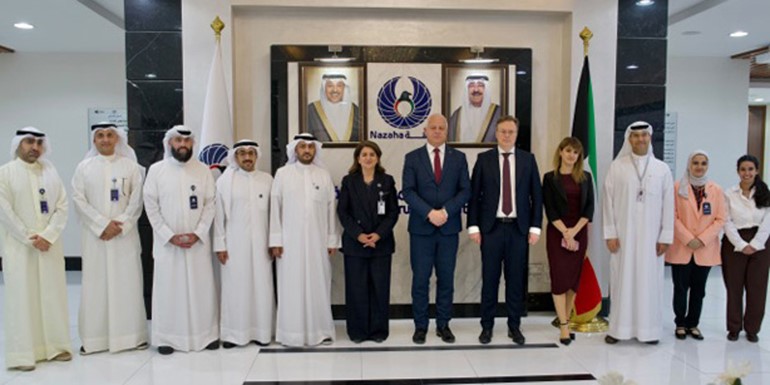
The Public Authority for Combating Corruption receives a delegation from the International Academy for reviewing the establishment law
Translated by Alqyas from Al-Anba — Original source
Nada Abu Nasr received the General Authority for Combating Corruption (Nizahat), chaired by Dr. Rana Al-Faris, a delegation from the International Anti-Corruption Academy (IACA), led by Dragos Kos, Dean of the Academy. The two sides discussed ways to benefit from specialized international expertise and the technical and academic support provided by the Academy, particularly in the field of reviewing and developing the law establishing the Authority, in order to enhance the effectiveness of its competencies and institutional capacities in accordance with the best international standards and practices.
Dr. Rana Al-Faris emphasized that the Authority is working on reviewing and developing its founding law, No. 2 of 2016 and its amendments, as part of a strategic orientation aimed at enhancing the effectiveness of the national anti-corruption system. She stressed that “developing the Authority’s founding law is not merely about amending legislative texts, but comes within a broader vision to strengthen Nizahat’s ability to perform its duties with efficiency, independence, and effectiveness, and to develop the necessary legal and procedural tools to prevent, detect, and combat corruption.”
Al-Faris clarified that the Authority is keen to benefit from comparative legislative experiences of countries that have achieved tangible progress in combating corruption, adapting them to align with the provisions of the Constitution and the specificity of Kuwait’s legal system, and in harmony with the State of Kuwait’s obligations under the United Nations Convention against Corruption.
For his part, Deputy Chairman of the Authority, Dr. Majad Al-Daihani, affirmed that leveraging international expertise constitutes one of the key pillars in the project to review the Authority’s law. He stated that “benefiting from international expertise does not mean copying legislation or transferring experiences literally, but rather employing best practices and legal solutions that have proven successful internationally, and adapting them to be consistent with the nature of Kuwait’s legal system.”
For his part, Dean of the International Anti-Corruption Academy, Dragos Kos, affirmed that “Kuwait has been a valued partner in the Academy for over a decade, and Nizahat has been at the core of this relationship. Its commitment to international standards and openness to cooperation make it a natural partner for the Academy’s work.”
Kos added, “During our visit, we reviewed the anticipated legislative amendments that will enhance Nizahat’s effectiveness. These amendments align with international standards and follow best practices worldwide. I am confident that, if enacted, they will positively impact the effectiveness of anti-corruption efforts in the country and elevate Nizahat to a higher rank among effective anti-corruption agencies globally.”
Regarding effectiveness measurement, he clarified that the Academy is implementing a project to measure the effectiveness of anti-corruption agencies, which is essential for evidence-based policy-making. He said, “We have previously measured Nizahat’s activities, and we will continue to do so in the future. I can confirm now that Nizahat exceeds global standards in the performance of anti-corruption agencies today.”
Kos emphasized that “investing in human capital is the most sustainable investment in integrity,” welcoming broader participation of Kuwaiti talents in the Academy’s academic and training programs, including those related to emerging technologies and artificial intelligence. He said, “We have concluded that corruption cannot be successfully combated without leveraging the latest scientific advancements.”
The discussions addressed several priority topics:
- Exchanging international expertise to enhance the effectiveness of anti-corruption agencies and develop their legislative and institutional frameworks.
- Leveraging scientific methodologies to measure corruption and evaluate the effectiveness of policies and institutions involved in combating it.
- Utilizing modern technologies and artificial intelligence tools for data analysis and monitoring corruption risks.
- Expanding the participation of national cadres in specialized academic and training programs.
