Diplomatic Institute launches program to qualify national leaders in crisis management
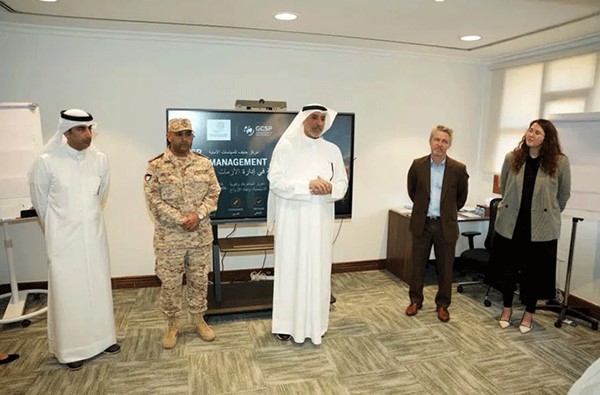
Launch of a joint training program with the Aman team and the Geneva Center to develop government leadership skills in emergencies
Translated by Alqyas from Al-Anba — Original source
The Saud Al-Nasser Al-Sabah Kuwaiti Diplomatic Institute launched today, Sunday, a training program to qualify national leaders and cadres in crisis management and enhance the readiness of government entities to respond to emergencies, in collaboration with the Aman Team and the Geneva Centre for Security Policy (GCSP).
The program, titled “Basic Crisis Management and Leadership – Level 1,” features representatives from various government entities and covers pre-planning and preparedness, risk assessment, information management, decision-making, and coordination among relevant parties during emergencies.
Deputy Assistant Minister of Foreign Affairs for Institute Affairs, Minister Plenipotentiary Dr. Mubarak Al-Hajjar, told the Kuwait News Agency (KUNA) that organizing the program aligns with the Institute’s commitment to leveraging its capabilities and relationships with specialized international training centers to develop the skills of government leaders and cadres in areas that meet the needs of state institutions.
Al-Hajjar added that cooperation with the Aman Team contributes to designing training programs focused on leadership skills, decision-making, and institutional coordination under exceptional circumstances, praising the Geneva Centre for Security Policy for providing participants with the opportunity to learn from and benefit by international crisis management experiences.
For his part, Colonel Muaid Al-Shamroukh, head of the Aman Team, told KUNA in a similar statement that human resource qualification is a fundamental pillar in crisis and disaster management, emphasizing the importance of training leaders to quickly assess situations, make timely decisions, and coordinate responses among relevant parties.
Colonel Al-Shamroukh clarified that the participation of representatives from various government entities helps unify concepts and procedures for crisis management, develop information-sharing mechanisms, and clarify roles and responsibilities, underscoring the importance of continuous training and joint exercises to test readiness and enhance response efficiency.
He expressed his hope to continue collaborating with the Institute to organize specialized programs that meet the needs of government entities and align with international practices in crisis and emergency management.
