Cliffs rising 209 meters on Mars reveal potential glacial rivers under rocks
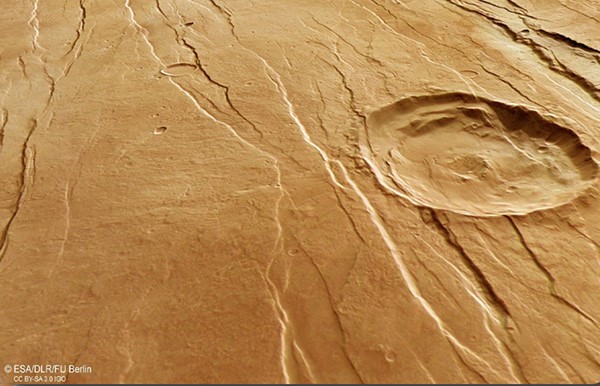
Researchers from the University of Nantes identify 29 geological formations near Alba Mons volcano indicating ancient glacial rivers protected under rocks and dust
Translated by Alqyas from Al-Anba — Original source
Ancient volcanic craters on the surface of Mars may conceal a reservoir of ice preserved beneath rocks and dust, according to a new scientific discovery that could help elucidate the Red Planet’s climatic history and identify potential water sources for future astronauts.
An international team of researchers identified 29 geological formations near Alba Mons, a volcano in the northern hemisphere of Mars, characterized by steep cliffs reaching heights of up to 209 meters—equivalent to a building of approximately 60 stories.
According to Science Alert, scientists analyzed images of 738 craters captured by American and European spacecraft and created three-dimensional models that revealed deposits extending up to 3 kilometers.
The team, led by researcher Noé L. P. from the University of Nantes in France, suggests that these formations represent ancient glaciers covered by rock layers that protected them from sublimation, the direct transition of ice into vapor.
These formations resemble debris-covered glaciers in Iceland and may have formed during a climatic period when Mars’s axial tilt was greater.
The study was published in the journal Earth and Planetary Science Letters, but the researchers emphasize that the presence of ice remains a scientific interpretation of the images and models and has not yet been confirmed by direct observation.
