'Environment': Kuwait targets a 15% reduction in emissions by 2035
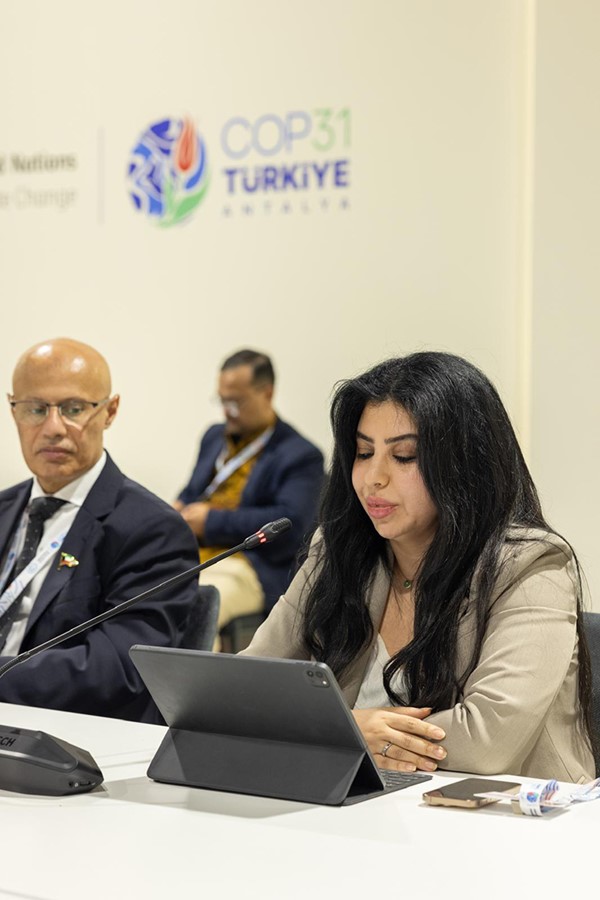
The Public Authority for Environment confirms Kuwait's commitment to reducing emissions and enhancing mangrove projects at the Antalya conference.
Translated by Alqyas from Al-Anba — Original source
The Public Authority for Environment confirmed that Kuwait’s participation in the 31st Conference of the Parties (COP31) to the United Nations Framework Convention on Climate Change, held in the Turkish city of Antalya, underscores its commitment to international efforts to combat climate change and achieve sustainable development.
Nouf Bahbahani, Acting Director General of the Authority and head of Kuwait’s delegation to the conference, told KUNA that Kuwait presented its National Low-Carbon Development Roadmap to 2060, approved by the Council of Ministers in 2025, which aims to build a low-emission economy and strive for carbon neutrality in key sectors by 2060.
Bahbahani explained that achieving this goal involves expanding renewable and solar energy, gradually replacing heavy fossil fuels with natural gas in electricity generation, improving energy efficiency, managing waste, and enhancing natural carbon sinks, including mangrove trees. She added that Kuwait is working on developing its third Nationally Determined Contribution (NDC), targeting an unconditional emissions reduction of up to 15% of total emissions by 2035, based on national projects and measurable, verifiable scientific methodologies. This effort continues to adopt a circular carbon economy approach focused on reducing, reusing, recycling, and removing emissions, while leveraging modern technologies in line with national development priorities.
She noted that Kuwait also participated in the Fourth Ministerial Meeting of the Mangrove Alliance for Climate (MAC), held on the sidelines of the conference, where it showcased achievements of the national mangrove reforestation project launched in 2018 and implemented in nine phases. The project has resulted in the planting of over 8,000 saplings and thousands of seeds, the rehabilitation of approximately 3,800 square meters in the Jahra Nature Reserve, and the implementation of planting trials in other coastal sites, with trees successfully producing seeds locally since 2022.
The project has seen regional cooperation with the United Arab Emirates, leading to the planting of approximately 4,000 seeds during 2025 and 2026. Bahbahani praised contributions from the Sultanate of Oman, the Kingdom of Bahrain, and the Kingdom of Saudi Arabia. She highlighted ongoing efforts to enhance national capacities for mangrove propagation through the marine nursery in the Jahra Reserve, expand the use of local seeds, and study new planting sites to strengthen climate adaptation and preserve biodiversity and coastal ecosystems.
The Authority has adopted a unified system for environmental sustainability reporting by government entities, based on measurable national indicators to enhance transparency and accountability, and to embed sustainability in government planning and decision-making. She emphasized the importance of balancing climate ambitions with energy security, economic stability, development priorities, and fulfilling international commitments related to climate finance, technology transfer, and capacity building. This approach enables developing countries to implement mitigation and adaptation programs without compromising their right to sustainable development, while respecting each country’s right to choose appropriate pathways and technologies according to its national circumstances, based on the principles of equity, justice, and common but differentiated responsibilities.
She highlighted the developmental and international humanitarian role of the Kuwait Fund for Arab Economic Development, which, since its establishment in 1961, has contributed to financing 1,043 developmental projects in 108 countries with a total exceeding $22 billion, embodying Kuwait’s approach to international solidarity and support for development. She affirmed Kuwait’s and the Public Authority for Environmental Affairs’ commitment to continuing cooperation and exchanging expertise with sister and friendly countries, and strengthening partnerships to protect the environment and address climate change, expressing hope that the conference’s outcomes will contribute to the transition from commitments to implementation through balanced decisions and practical, applicable solutions that ensure a more sustainable future.
