UN Security Council Renewed Support for 'UNIFIL'... Lebanon Invokes Sovereignty on Independence Anniversary
UN Security Council supports UNIFIL and Lebanon calls for Israeli withdrawal and restoration of sovereignty
Translated by Alqyas from Al-Anba — Original source
The announcement by the UN Security Council, during a closed session dedicated to Lebanon on the night of Thursday into Friday, renewing its support for the United Nations Interim Force in Lebanon (UNIFIL), coincided with the upcoming Flag Day on Saturday and the 83rd anniversary of Independence on Sunday.
The Council discussed developments in Lebanon and the possibility of implementing International Resolution 1701, and received briefings from Under-Secretary-General for Peace Operations Jean-Pierre Lacroix and the Acting Head of the Office of the UN Special Coordinator for Lebanon, Jean Arnaud. These briefings covered the Secretary-General’s periodic report on the implementation of the resolution for the period from June 21 to October 20, 2026.
Council members urged all parties in Lebanon and Israel to take necessary measures to ensure the safety of UN personnel, calling on them to refrain from any actions that might endanger peacekeeping forces. They reaffirmed their firm commitment to Lebanon’s sovereignty, independence, territorial integrity, and unity.
In parallel, political positions converged on the view that independence remains incomplete without the withdrawal of the Israeli army from the areas it occupies in southern Lebanon.
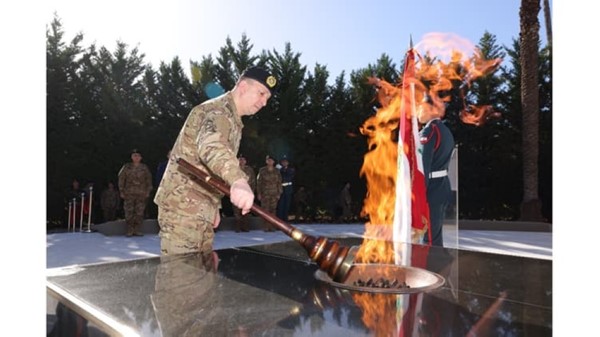
In the spirit of the occasion, Army Commander Lt. Gen. Rodolphe Heikel laid a wreath at the Army Martyrs’ Monument at the Ministry of National Defense and lit its eternal flame, in the presence of the General Staff and several officers, in honor of their spirits.
Ahead of Independence Day, President of the Republic Lt. Gen. Joseph Aoun received the UAE Minister of Health and Community Prevention, Ahmed bin Ali Al Sayegh, at Baabda Palace. Aoun emphasized that “priority remains the rehabilitation of hospitals and health centers in the south damaged in the recent war, and Lebanon welcomes any UAE support in this field, looking forward to cooperation in the digital transformation of the health sector and the training of Lebanese personnel.”
For his part, Minister Al Sayegh affirmed “his country’s readiness to provide the necessary support to health and hospital institutions,” stating that “discussions with Minister Rakan Al Nasser Al-Din focus on identifying the needs of the health sector, in addition to caring for the Children’s Cancer Center.”
At the Ministry of National Defense, Defense Minister Major General Michel Mounse discussed with the US Ambassador to Lebanon, Michael Issa, political and security developments in Lebanon and the region, the progress of the trilateral meetings and negotiations related to the Framework Agreement, as well as trends concerning the future of UNIFIL after the end of its mandate and proposed formats for the next phase.
According to a statement issued by Mounse’s office, the meeting also covered the atmosphere of the visit of US UN Representative Ambassador Mike Waltz to Lebanon and the topics discussed. Mounse stressed “the necessity of implementing the provisions of the Framework Agreement, starting with stopping daily Israeli attacks, followed by withdrawal from Lebanese territory, thereby enabling the Lebanese Army to complete its deployment and extend state authority over its entire territory.”
He also emphasized the importance of making the necessary efforts to consolidate stability and avoid further escalation, in order to safeguard Lebanon’s rights and preserve its sovereignty. For his part, Ambassador Issa offered congratulations on Independence Day, reaffirming “the United States’ commitment to continuing its support for Lebanon and the Lebanese Armed Forces.”
From Baabda Palace, MP Ibrahim Kan’an, head of the Finance and Budget Committee, said after meeting with President Aoun that “sovereignty begins with the independence of national decision-making, free from allegiance to external axes, and what is required today is rallying around the state, its institutions, and the Lebanese Army.”
For his part, Major General Hassan Chkair, Director General of General Security, stated that “the recovery of occupied Lebanese territory in the south, the withdrawal of the Israeli enemy beyond internationally recognized borders, and the consolidation of the state’s authority and its legitimate institutions across its entire territory all constitute requirements inseparable from the true meaning of independence.” He added: “The south is not a border zone, but an integral part of the national identity; its security is Lebanon’s security, and its stability is the state’s stability, because Lebanon’s peace depends on the peace of its south, and there is no complete sovereignty as long as its land is occupied or its national decision-making is not exclusively vested in its constitutional institutions.”
In this context, Grand Mufti of Lebanon Sheikh Abdul Latif Derian, in a statement, called for “fortifying independence through unity and adherence to the state and its institutions,” saying: “Independence cannot be achieved without realizing the state’s sovereignty and extending its authority across the entire national territory, and maintaining a unified stance.” He expressed hope that “efforts and diplomatic initiatives would be intensified to secure the withdrawal of the Israeli enemy from the south, in order to preserve Lebanon’s independence and Arab identity.”
