Kuwait's gold and jewelry imports reach KD 544.84 million in 6 months
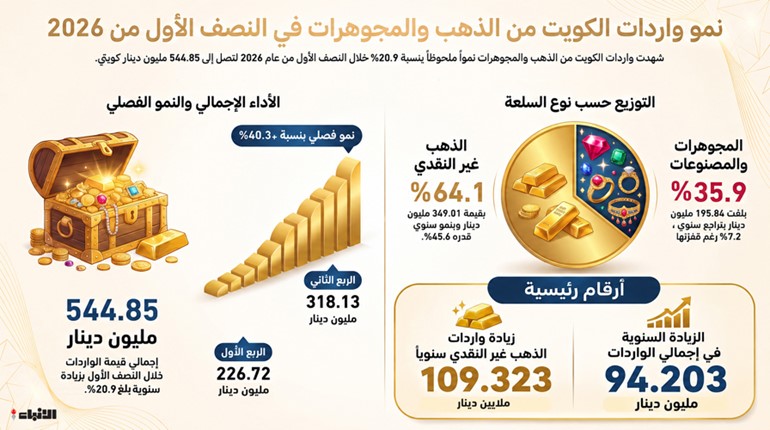
Kuwait's gold and jewelry imports rose to KD 544.84 million in the first half of 2026, driven by a significant increase in non-monetary gold, while jewelry imports declined slightly.
Translated by Alqyas from Al-Anba — Original source
Kuwait officials revealed that official data showed an increase in the value of Kuwait’s imports of gold, jewelry, and products made of precious metals to 544.848 million dinars during the first half of 2026, an increase of 94.203 million dinars, or 20.9%, compared to 450.645 million dinars during the same period in 2025, indicating an expansion in the trade value of imported goods under these two categories, which include raw and semi-finished gold, jewelry, and products made of precious metals.
Data on foreign trade issued by the Central Statistical Bureau showed that imports of these products reached 226.721 million dinars during the first quarter of the year, before rising to 318.127 million dinars in the second quarter, an increase of 91.406 million dinars, or a growth rate of 40.3%, making the months from April to June account for the largest share of total imports during the first half.
Gold Leads the Increase
Details of the data revealed that non-monetary gold accounted for the largest share of total imports, with a value of 349.011 million dinars during the first six months of the year, equivalent to 64.1% of the total value recorded for the two categories, compared to 195.837 million dinars for jewelry and items made of precious metals, accounting for 35.9%.
Imports of non-monetary gold recorded an annual increase of 109.323 million dinars, or 45.6%, compared to 239.688 million dinars during the first half of 2025, while imports of jewelry and products made of precious metals declined by 15.120 million dinars, or 7.2%, compared to 210.957 million dinars during the corresponding period last year.
This comparison shows that the annual increase in total imports of the two categories was driven by the rise in the value of non-monetary gold, whose increase exceeded the decline recorded in jewelry imports, reflecting different trade movement trends between the two groups during the period.
Quarterly Import Trends
At the quarterly performance level, imports of non-monetary gold reached 155.494 million dinars during the first quarter of 2026, before rising to 193.517 million dinars during the second quarter, an increase of 38.023 million dinars, or 24.5%.
Conversely, imports of jewelry and products made of precious metals rose from 71.227 million dinars in the first quarter to 124.610 million dinars during the second quarter, an increase of 53.383 million dinars, or 74.9%. These figures reveal that jewelry recorded the highest quarterly growth rate among the two categories, and contributed the largest share of the total increase of 91.406 million dinars between the two quarters, despite non-monetary gold continuing to lead in absolute value.
Thus, imports of non-monetary gold exceeded those of jewelry and products made of precious metals by 153.174 million dinars during the first half, highlighting the difference between the two groups in terms of their relative weight in total recorded imports.
Diversity of Imported Products
Imports of non-monetary gold, listed under the Central Statistical Bureau’s category, include gold, including platinum-plated gold, whether in its raw, unworked form, in semi-finished shapes, or in powder form. Additionally, another statistical category includes items, jewelry, and their parts made of precious metals or metals clad with a layer of precious metals, excluding watches and watch cases. Therefore, its value is not limited to gold items alone, but extends to other products made of precious metals.
This diversity highlights the nature of trade recorded under these two categories, which includes products at various stages of manufacturing, ranging from unworked gold and semi-finished forms to jewelry and finished goods. Trade and Price Movements The recorded values reflect total goods imports according to the adopted statistical classification, and do not necessarily represent the volume of consumer purchases or final sales in the Kuwaiti market, nor do they directly provide an indicator of the actual quantities imported or average product prices. The total value of imports is influenced by both the quantities imported and their prices; therefore, an increase in import value does not necessarily imply a corresponding rise in weights or piece counts, as these indicators require independent detailed data to determine their trends accurately. The results for the first half of 2026 show a divergence in import movements between non-monetary gold and jewelry on an annual basis, while the value of imports for both categories rose in the second quarter compared to the first, with non-monetary gold accounting for approximately two-thirds of the total recorded value for these two categories.
