3.044 million people in Kuwaiti labor market by end of June 2026
Statistics data reveals decline in total employment with rise in domestic and Nepali employment
Translated by Alqyas from Al-Anba — Original source
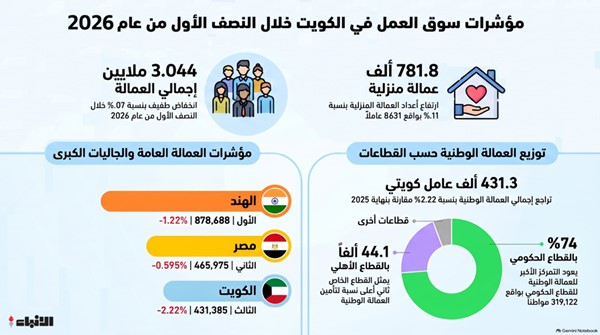
Kuwait officials: Data from the Central Statistical Bureau revealed a decline in the total number of workers in the labor market, including domestic workers, by 0.07%, amounting to 2,176 workers during the first six months of 2026. The total reached 3.044 million workers by the end of June 2026, compared to 3.046 million at the end of December 2025.
According to the data, the ranking of workforce numbers by nationality and the changes that occurred are as follows:
1. India: Indian workers topped the list of the labor force in Kuwait with approximately 878,688 workers. Their numbers declined by 1.22%, representing 10,887 workers, compared to 889,575 at the end of December 2025.
2. Egypt: Egyptian workers ranked second, with their numbers reaching approximately 465,975 by the end of June 2026. Since the beginning of the year, their numbers declined by 0.595%, representing 2,790 workers, compared to 468,765.
3. Kuwait: National workers ranked third in the Kuwaiti labor market, with the total number of citizens in the labor force reaching approximately 431,385. Kuwaiti workers declined by 2.22%, representing 9,824 individuals, compared to 441,209 at the end of December 2025.
4. Bangladesh: Workers from Bangladesh ranked fourth, reaching 301,726. This represents an increase of 0.7%, or 2,117 workers, during the first six months of 2026, compared to 299,609 at the end of December 2025.
5. Philippines: Filipino workers ranked fifth, reaching 195,190. Their numbers increased by 0.611%, representing 1,201 individuals, during the first six months of 2026, compared to 196,391 at the end of December 2025.
6. Nepal: Nepali workers ranked sixth in the Kuwaiti labor market, reaching 172,646 by the end of June 2026. They recorded an increase of 2.37%, representing 3,998 workers, during the first six months of 2026, compared to 168,648 at the end of December 2025.
7. Sri Lanka: Sri Lankan workers ranked seventh with approximately 165,871 workers. Their numbers declined by 1.55%, representing 2,612 workers, during the first six months of 2026, compared to 168,483 at the end of December 2025.
8. Syria: Syrian workers ranked eighth, reaching 75,698. They increased by 0.776%, representing 592 workers, during the first six months of 2026, compared to 76,290 at the end of December 2025.
9. Pakistan: Pakistani workers ranked ninth with 74,234 workers. Their numbers declined by 0.96%, representing 724 individuals, during the first six months of 2026, compared to 74,958 at the end of December 2025.
10. Jordan: Jordanian workers ranked tenth in the Kuwaiti labor market with 30,818 workers. Their numbers declined by 0.21%, representing 66 workers, during the first six months of 2026, compared to 30,884 at the end of December 2025.
11. Other nationalities: Their numbers increased by 8.79%, representing 20,405 workers, during the first six months of 2026. The total reached approximately 252,542 by the end of June 2026, compared to 232,137 at the end of December 2025.
781,800 domestic workers: The number of domestic workers saw an increase...
By 1.11%, amounting to 8,631 individuals during the first six months of 2026. This follows a rise in the number of domestic workers in Kuwait to approximately 781,849 by the end of June 2026, compared with 773,218 at the end of December 2025. Here they work... Kuwaitis Data from the labor market show that the total of 431,385 Kuwaiti nationals in the labor force are distributed as follows: 319,122 in the public sector, 1,251 in the oil sector, 19,930 in the state-owned oil sector, 44,099 in the private sector, 19,943 in a fifth category, and 27,040 with unspecified insurance coverage.
