Health Minister: Committed to developing the clinical virology laboratory system and expanding its services
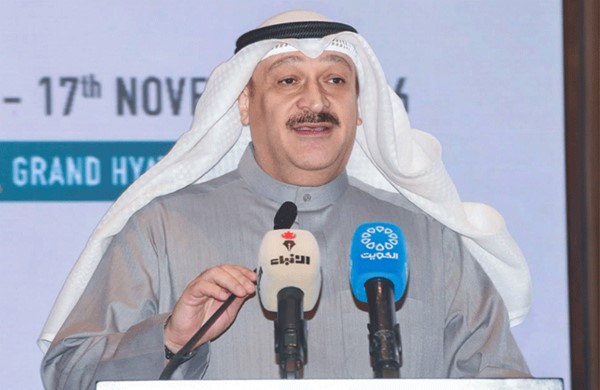
Health Minister Dr. Ahmed Al-Awadi emphasized the importance of developing virology laboratories, while Dr. Insam Juma pointed to the launch of the Kuwaiti Board in Virology.
Translated by Alqyas from Al-Anba — Original source
Kuwait’s Minister of Health, Dr. Ahmed Al-Awadi, affirmed on Monday the importance of the role of medical laboratories as a fundamental pillar and a key partner in the health system, supporting diagnostic accuracy and the selection of appropriate treatment to enhance the quality of care provided to patients.
This statement was made during Dr. Al-Awadi’s speech at the opening of the Eighth Medical Laboratories Conference, held under the theme “Recent Developments in Clinical Virology – Innovations in Diagnosis, Quality, and Laboratory Practices.” The two-day event brings together a select group of experts, specialists, and researchers to discuss the latest advancements in clinical virology and innovations in diagnosis, quality, and laboratory practices.
He noted that the rapid advancement in molecular diagnostic technologies, genomic surveillance, and data analysis opens broad horizons for laboratory work, enhancing the ability to detect diseases and their pathogens early, monitor transmission patterns, and prepare for handling epidemic events and health emergencies.
He emphasized the Ministry of Health’s commitment to developing the clinical virology laboratory system, expanding its services, and strengthening its technical and technical capabilities across various governorates to serve citizens and residents, enabling medical teams to rely on accurate results in a timely manner.
He added that the national health system includes seven clinical virology laboratories staffed by thousands of qualified specialists and technical and administrative personnel. These laboratories conduct over 744,000 tests annually on approximately 237,000 samples, reflecting the scale of efforts made to protect public health.
He expressed pride in the achievements of public health laboratories, particularly the fact that the Polio Laboratory achieved a 100% score in the World Health Organization’s proficiency testing, underscoring the competence of national cadres, their commitment to international quality standards, and their support for health security.
Dr. Al-Awadi stressed that sustainable development relies on supporting specialized training, continuous cooperation, encouraging scientific research and innovation, and translating knowledge into practical practices that have a tangible impact on community health.
For her part, Conference Chair Dr. Insam Jumaa stated in her address that the conference represents a vital scientific platform that brings together expertise and experiences to showcase the latest developments in this biomedical specialty, which is directly linked to human health and community safety.
Dr. Jumaa added that the conference’s scientific program includes eight main axes, three keynote lectures, and three training workshops covering prominent topics such as Hepatitis B and C viruses, infectious respiratory diseases in children, human papillomavirus (HPV), HIV, viral infections in immunocompromised patients, adherence to international quality and accreditation standards for laboratories according to ISO 15189:2022, as well as programs for the rational use of antimicrobials and antivirals.
She highlighted that the COVID-19 pandemic experience underscored the urgent need to invest in training specialized national cadres in clinical virology.
She pointed out that Kuwait has relaunched the Kuwaiti Board in Clinical Virology under the auspices of the Kuwait Institute for Medical Specialties to prepare a new generation of physicians capable of addressing future health challenges.
