Kuwait presents its final report on developing ALASC's performance governance system during meetings in Muscat
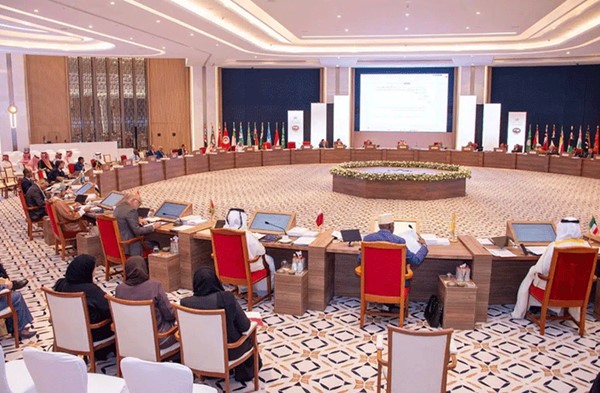
A Kuwaiti delegation led by Al-Khalidi presented the ALASC performance governance development report at meetings in Muscat.
Translated by Qiyas from الأنباء — Original source
Kuwait presented the final report of the committee for developing the governance system of the Arab League Educational, Cultural and Scientific Organization (ALECSO) today, Tuesday, as part of the agenda for the organization’s 28th General Conference, scheduled to be held on Thursday.
This came during the participation of a Kuwaiti delegation, led by Assistant Undersecretary for Administrative and Financial Affairs at the Ministry of Education, Mohammed Al-Khalidi, in the 125th ordinary session of ALECSO’s Executive Board, held in the Sultanate of Oman, with representatives of Arab member states and the General Secretariat of the Arab League.
Kuwait chaired the committee’s work from January to May 2026, with active participation from 16 Arab countries. This period saw intensive weekly meetings that yielded significant outputs, including the preparation of the first comprehensive reference framework for the organization’s performance governance, the issuance of a guide for institutional performance governance, and the adoption of an implementation plan for the years 2026–2028.
Minister of Education Sayed Jalal Al-Tabatabai had previously introduced the “Governance Committee Initiative” to establish a new phase of institutional work based on transparency, accountability, and performance measurement, in addition to enhancing resource management efficiency and ensuring effective follow-up on decision implementation.
The initiative reflects Kuwait’s pioneering role in supporting and developing institutions of joint Arab action, thereby strengthening its status and active presence at the Arab level through the launch of sustainable institutional initiatives that contribute to achieving the organization’s objectives and lofty goals.
During a visual presentation delivered by the Kuwaiti delegation, led by Assistant Undersecretary Al-Khalidi, the challenges that necessitated the formation of the committee were outlined. These included the absence of an integrated framework for the organization’s performance governance, discrepancies between textual provisions and actual practice, limited follow-up and evaluation mechanisms, and the need for standardized templates for files and reports. This underscored the importance of activating the organization’s performance governance by institutionalizing governance principles, ensuring the practical application of policies and regulations, and enhancing oversight and accountability.
According to the presentation, the committee held 14 meetings after its formation, with its work period spanning from January to May of last year. For the first time in ALECSO, a comprehensive reference framework for the organization’s performance governance and a roadmap for implementation up to 2028 were prepared.
The committee also issued a set of publications, including the general framework for the organization’s governance, an ALECSO governance guide, a proposal for developing the organizational structure, and the implementation plan up to 2028.
The presentation covered the committee’s key outputs, including the submission of a current situation study, the adoption of the general framework for the organization’s performance governance, the adoption of the ALECSO performance governance guide, the governance document for the framework of committees emanating from the Council, agreement on the continuity of the committee and follow-up on governance implementation, and a recommendation to submit the governance model to the Economic and Social Council of the Arab League as a reference model.
It highlighted the main expected transformations in the organization’s work following the committee’s outputs, including clarity of authorities, report quality, follow-up on decision implementation, digital transformation, financial discipline, accountability, and risk management.
Yesterday, Monday, the Executive Board of the Arab League Educational, Cultural and Scientific Organization (ALECSO) began its 125th ordinary session, hosted in Muscat for two days, as part of preparations for the organization’s 28th General Conference, scheduled for next Thursday.
The Executive Board discussed several topics and agenda items, most notably the Director General’s report on the implementation of the organization’s programs and activities for 2025, and strategic plans for international cooperation and partnerships.
The discussion also covered enhancing the role of media and marketing, as well as the comprehensive strategy for building the capacities of the organization’s staff and its external centers, alongside educational, cultural, and scientific conditions in Palestine and countries affected by crises, disasters, and emergencies, along with several administrative and financial topics.
It is worth noting that the Arab Organization for Education, Culture and Science (ALECSO) was established in 1970 and is one of the specialized agencies affiliated with the League of Arab States, comprising 22 Arab member countries.
Headquartered in Tunis, ALECSO aims to advance the sectors of education, culture, and science, and to strengthen coordination and cooperation among member states in these fields.
