"From Kuwait We Begin" to honor 13 national figures on Tuesday
The Supreme Organizing Committee for the National Conference launched its 26th session, with committee chairman Yousef Al-Yassin revealing the slogan and highlighting the profiles of the distinguished national figures to be honored.
Translated by Alqyas from Al-Anba — Original source
The Supreme Organizing Committee of the National Conference, under the slogan “From Kuwait We Begin… To Kuwait We Conclude,” launched the events of its 26th session, which will be held on Tuesday, the 10th of the current month, at the Crown Hall of the Millennium Kuwait Hotel and Conference Center in Salmiya.
On this occasion, Yusuf Al-Yassin, head of the Supreme Supervisory Committee for the National Conference, unveiled the slogan for the media campaign and the 26th National Conference, affirming that both are derived from a statement by His Highness the Amir Sheikh Meshal Al-Ahmad, which he regarded as a foresight and a national approach. His Highness stated: “Loyal people of Kuwait, you alone are the strongest weapon to preserve our beloved homeland through your firm unity and high spirit. National unity is a shield that protects Kuwait and its citizens, and a fortress for confronting hardships and challenges.”
Below are brief biographies of the distinguished figures:
1. The late, God willing, Fawzi Muaid Al-Saleh (1939–2025): He is considered one of the most prominent figures in Kuwait’s economy and private sector. He began his career in 1962 as a civil engineer at his family’s company, “Muaid Al-Saleh and Sons.” He combined engineering and law by obtaining a PhD in Law from Suffolk University in the United States in 1996, becoming the first Kuwaiti to achieve this distinction.
Al-Saleh played a pivotal role in the economic renaissance and the establishment and development of numerous national companies across the industrial, contracting, real estate, banking, maritime transport, and hotel sectors. Among these are Gulf Bank, United Real Estate Company, and Kuwaiti Interests Company for Development.
He represented the Kuwaiti government in the establishment and leadership of prominent regional entities, including the Suez Canal Oil Pipeline (Sumed) in Egypt and the Arab Steel Company in Mauritania. He also founded and chaired the Arab Reinsurance Group (ARIG).
2. The late, God willing, Abdulrahman Fares Al-Mutairi (1939–2026): He is among the notable figures of Kuwait who embodied the values of hard work, giving, and service to the nation. He was keen on continuing his education, completing his secondary studies in the evening before starting his professional career at Kuwait Oil Company, where he gained experience, discipline, and a sense of responsibility.
He later moved to the Ministry of Education, working in administrative roles in schools in the Jleeb Al-Shuyoukh area until his retirement in September 1984. Al-Mutairi was known for his closeness to people and his eagerness to help them. His majlis served as a gathering place for family, friends, and community members, embodying the values of solidarity and compassion that characterize Kuwaiti society.
3. The late, God willing, Najib Abdullah Al-Mulla (1941–2026): He is among the most prominent Kuwaiti businessmen who contributed to serving the national and Arab economies over several decades. He received his education at Victoria College in Alexandria, where he was the second Kuwaiti student to study there. He also studied in Britain, Switzerland, and Lebanon.
He began his professional career at the Al-Mulla Group of Companies in 1960, progressing through various positions until he became General Manager in 1966, and then Chairman of the Board of Directors in 1969. He contributed to the development and expansion of the group’s activities. Al-Mulla held several economic and commercial positions, including serving as Honorary Consul of the Norwegian Government in Kuwait.
4. The late, God willing, Saud Mohammed Al-Rabiea (1958–2026): A Kuwaiti academic and researcher specializing in Islamic economics, he graduated from the University of Kuwait with a degree in accounting. He later pursued postgraduate studies at Umm Al-Qura University in Mecca, obtaining a Master’s and a PhD in Islamic economics, focusing his research on Islamic banking and investment financing structures.
He served as a professor in the Department of Jurisprudence and Principles of Jurisprudence at the College of Sharia at Kuwait University from 1997 until his retirement in 2024. He participated in several Sharia bodies, including the General Authority for Affairs of the Court and the Sharia Supervisory Board at Boubyan Bank, and he served as editor-in-chief of the Hanbali Jurisprudence journal. His contributions extended to da’wah and charitable work, where he spent nearly 20 years founding and supporting charitable projects in Niger, Mali, and Burkina Faso.
5 - The late, by God’s permission: Ahmed Rashid Al-Arabid (1955–2026): A prominent leader in the Kuwaiti oil sector, he earned a bachelor’s degree in petroleum and natural gas engineering from the University of Pennsylvania in 1977. He joined Kuwait Oil Company (KOC) the same year as a petroleum engineer, progressing through various positions until he assumed leadership roles in production operations at the Burgan field.
His role became prominent following the Iraqi invasion of Kuwait in 1991, when he chaired the planning committee tasked with preparing a reconstruction plan for KOC’s infrastructure after the destruction inflicted on the oil sector. The plan was approved and successfully implemented. Al-Arabid later served as Deputy Managing Director for Planning and Finance and as a member of the board of directors of Kuwait Oil Company.
6 - The late, by God’s permission: Hamza Abbas Hussein (1934–2026): He received his early education at Al-Mubarakiya School, then earned a bachelor’s degree in economics from the American University of Beirut in 1958. He completed his postgraduate studies at St Antony’s College, University of Oxford, between 1960 and 1962, and also received training at the Bank of England.
He began his career at the Kuwait Monetary Agency in 1963, then was appointed as Kuwait’s deputy governor to the International Monetary Fund (IMF) until 1983. In 1968, he assumed the position of deputy governor of the Central Bank of Kuwait, before becoming its governor from 1973 to 1983. After leaving the central bank, he continued his economic contributions through board memberships in several banks and investment companies within Kuwait and abroad.
7 - The late, by God’s permission: Zaid Harbi Al-Zaid (1965–2025): He is considered one of the pillars of modern national media in Kuwait. He graduated from Kuwait University with a degree in political science and public administration, and was intellectually mentored by several prominent Kuwaiti intellectual figures, including Ghanim Al-Najjar, Ahmed Al-Baghdadi, and Ahmed Al-Rubaie. He answered the call of his country during the Liberation War, joining the ranks of the Kuwaiti Army and receiving the Liberation Medal.
He began his media career as a researcher at the Al-Watan Newspaper’s Information and Studies Center. He served as director of the Publications Department at the Kuwait Institute for Scientific Research, and as the official in charge of the electoral supplement in Al-Ra’y Al-Am. He then served as editor-in-chief of Al-Tali’a newspaper for nearly a decade, contributing to raising awareness of several important national issues. He also worked at the National Council for Culture, Arts and Letters, overseeing publishing, distribution, and the printing of the “Alam al-Ma’rifah” (World of Knowledge) series and Al-Fikr Al-Alami (Global Thought) magazine.
8 - The late, by God’s permission: Abdulaziz Ali Al-Kilab (1937–2026): He received his secondary education at Al-Shuwaikh High School, then enrolled at the Faculty of Arts at the Arab Open University in Beirut. He completed his studies at Kuwait University, where he earned a bachelor’s degree in arts with a major in history.
He spent his professional career at the Ministry of Social Affairs and Labour, progressing through various positions, including Employment Inspector, Director of the Capital Governorate Labour Department, Director of the Family Care Department, and ultimately Assistant Undersecretary for Social Development.
He also chaired and participated in numerous local and international conferences, committees, and seminars in Geneva, New York, and several Arab and Gulf countries. Throughout his career, he was known for his dedication to work, sound management, and service to citizens, as well as for his social activities, charitable works, and assistance to others.
9. The late, by God’s permission, Ali Mohammed Al-Mu’min (1938–2026): Born in the Sharq district, he received his education at Al-Sharqiya and Al-Ahmadiya schools, and was among the first cohort at Al-Shuwaikh Secondary School. He joined the Kuwaiti Army in 1954, before being sent on a scholarship to the United Kingdom in 1957 as part of the third batch of Kuwaiti officers. There, he graduated with the rank of lieutenant and underwent specialized training in tanks, armored vehicles, weapons, and staff operations.
He participated in several prominent military events, including the Abdul Karim Qasim crisis and the Samta incident. During the October 1973 War, he commanded the Jahra Force on the Golan Heights with the rank of lieutenant colonel, becoming the youngest Arab commander in the war. He progressed through various military positions, represented Kuwait in several Arab and international bodies, and served as head of the Arab Peacekeeping Forces in Lebanon.
10. The late, by God’s permission, Emad Mohammed Al-Attiyah (1956–2025): He earned a bachelor’s degree in chemical engineering with honors from Alexandria University, and a master’s and doctorate from Lehigh University in the United States. He dedicated his career to academic and research work, the oil sector, and policy-making. He served as a professor of chemical engineering at Kuwait University and held several leadership positions.
He played a pivotal role in shaping Kuwait’s oil policy for over 20 years through the Supreme Council for Petroleum Affairs, and contributed to strategic projects, including the Zour Refinery, the Clean Fuel Project, and Equiti. He held various positions, including Dean of the College of Engineering and Petroleum, Founding Secretary-General of the Council of Private Universities, and President of the American University of the Middle East, before assuming the post of Deputy Prime Minister and Minister of Oil.
11. The late, by God’s permission, Saeed Saad Al-Hajeri (1944–2026): Born in Kuwait on September 10, 1944, he lived his entire life in the Fahaheel area.
He obtained his high school diploma and began his career at the Ministry of Public Works in 1963, remaining there until his retirement in 1984. He contributed to trade union and labor activities before turning to commerce after retirement. He was among the founders of the Al-Fahaheel Cooperative Society in 1978, ran in the 2005 municipal council elections and finished second, and participated over the years in numerous social events and political forums. He was known for his good character, generosity, and initiative in helping others, which earned him widespread affection and extensive relationships with various segments of society.
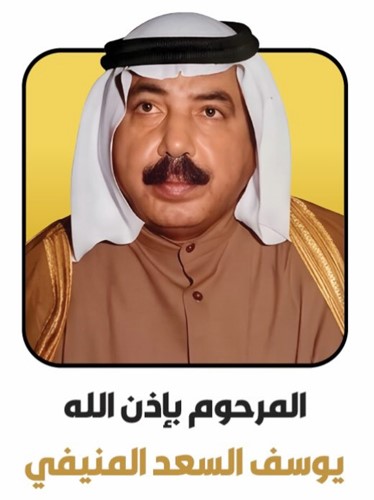
12 - The late, by God’s will, Youssef Al-Saad Al-Munaif (1927–2025): He received his early education in traditional Quranic schools (kuttab), memorized the Holy Quran, and learned reading, writing, and arithmetic. He began his professional life in the late 1940s with Kuwait Oil Company, then worked in the administration of Posts, Telegraphs, and Telephones, before moving to the “Police Administration” during the early stages of establishing security work in Kuwait. He started his career investigating traffic accidents, then established the Public Relations Department at the Ministry of Interior, launched a specialized newspaper covering security events, and contributed to the television program “The Watchful Eye.” He also played a role in developing traffic operations and transferring international expertise to Kuwait after being sent on study missions to the United Kingdom, the United States, and Egypt.
13 - The late, by God’s will, Abdulmohsen Mohammed Al-Othman (1951–2025): He graduated from the College of Law and Sharia at Kuwait University in 1982. His activism emerged early through his presidency of the National Union of Kuwaiti Students and its Executive Board, before he began his professional career as a State Attorney in the Office of Fatwa and Legislation. He progressed through government service, heading the Legal Affairs Department at the Ministry of Finance and then serving as Assistant Undersecretary at the same ministry, before becoming in 1994 the first Secretary-General of the General Secretariat of Awqaf (Endowments), a position he held until 2000. During that period, he contributed to establishing the institutional framework of the Secretariat, formulating its strategies, and setting up endowment funds in various fields, alongside developing and growing endowment assets using modern investment tools.
