Ruler of Sharjah Signs New Book "Al-Jalandi: Khalid bin Sultan Al Qasimi"
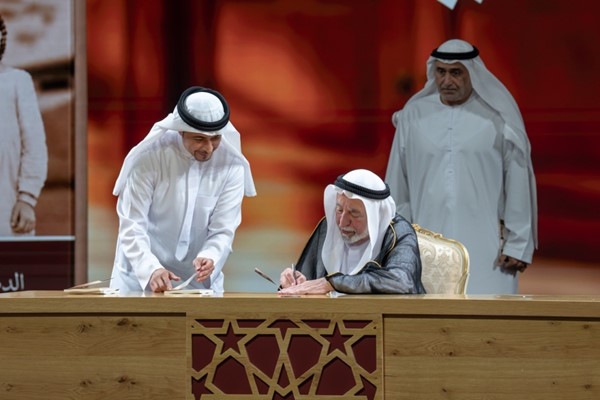
His Highness the Ruler of Sharjah launches his new novel about Sheikh Khalid bin Sultan Al Qasimi, in the presence of the Crown Prince and Chairman of the Sharjah Book Authority.
Translated by Qiyas from الأنباء — Original source
His Highness Sheikh Dr. Sultan bin Muhammad Al Qasimi, a member of the Supreme Council and Ruler of Sharjah, emphasized the importance of historical fiction and its role in conveying facts and history through a literary style. He noted that it constitutes one of the cultural pillars, complementing other projects such as scientific research, investigations, poetry, and short stories. His Highness affirmed that his short novels take into account people’s busy schedules, attracting them to read and benefit from them.
This came during a lecture delivered by His Highness on the occasion of launching his latest publication, “Al-Jalandi,” a documented historical novel by Khalid bin Sultan Al Qasimi. The event was attended by the Deputy Ruler of Sharjah, His Highness Sheikh Dr. Sultan bin Ahmed bin Sultan Al Qasimi, and the Chairwoman of the Board of Directors of the Sharjah Book Authority, Her Highness Sheikha Bodour bint Sultan Al Qasimi, on Saturday evening at the Sharjah International Book Fair.
A Continuous Contribution
The new novel reflects a sustained scientific, intellectual, and literary output. The Ruler of Sharjah’s publications have reached 219 works, spanning history, scientific research, literature, novels, and theater, forming a rich intellectual corpus that combines historical documentation accuracy, scholarly rigor, and literary creativity.
The Ruler of Sharjah explained that his new work, “Al-Jalandi,” took five days to write and half a day to print, representing a rapid production process. He pointed out that every major work is followed by diverse shorter works, such as novels, aimed at guiding readers and introducing them to the methods of writing novels, theater, and cultural works. He noted that he has been working on such endeavors for 54 years, describing his contributions over these years as modest in comparison to the nation that produced the best of humanity, the Prophet Muhammad (peace be upon him).
Real Documents
His Highness discussed the methods of novel-writing, which carry a significant mission, align with events, inspire, and offer moral lessons. He noted that most of his novels are short, making them easier to read and less time-consuming for people, given their preoccupation with daily life. Moreover, most of his novels focus on aspects of power and governance, highlighting the conflicts of those periods, and he explained his desire to reveal the softer, more nuanced side of history through them.
His Highness stressed the necessity of turning to religion and attaining true faith, citing the Quranic verse: “The bedouins say, ‘We have believed.’ Say, ‘You have not [yet] believed; but say [instead], “We have submitted,” for faith has not yet entered your hearts.’” He also advised against paying attention to the writings of some who harbor malice or envy toward Islam and the Muslim community, urging a return to correctness and self-defense in accordance with the teachings of our noble religion.
He highlighted the importance of relying on authentic documents when writing about historical events, rather than merely depending on what has already been written, as original documents correct history. He noted that he has written not just pages or books on history, but massive, well-documented encyclopedias, achieved through proper research into manuscripts and original documents.
His Highness concluded his remarks by stating that he is a researcher dedicated to transferring knowledge to scholars and readers. He called upon university students to study history using correct methodologies, particularly by examining manuscripts and historical documents, hundreds of thousands of which are in his possession, to support scientific research and studies by his sons and daughters.
“Al-Jalandi”...
Wisdom and Courage
The new book, published by Al Qasimi Publications, comprises five consecutive chapters that narrate the extraordinary life of Sheikh Khaled bin Sultan Al Qasimi, known by the nickname “Al Jalandi.” His story unfolds over thirty-eight years, filled with transformations and paradoxes that seem closer to fiction, yet are deeply rooted in reality.
Employing a narrative style that blends novelistic suspense with historical documentation, the novel evokes the social, political, and maritime dimensions of life in the Arabian Gulf during the nineteenth century. It brings to mind a chapter in the history of the Qawasim, where dreams collided with a highly volatile reality, thereby granting the author ample scope to write and creatively chronicle the history of the book’s central figure.
The novel documents one of the Qawasim sheikhs, Khaled bin Sultan bin Saqr Al Qasimi, nicknamed “Al Jalandi,” whose life witnessed events so extraordinary that one might doubt their authenticity, as if they were products of imagination. Over thirty-eight years, his life was marked by transformations and paradoxes that appeared more like fiction, yet were entirely real.
The name Khaled was not familiar among the noble Qawasim family. His mother chose it in homage to the commander Khalid bin al-Walid, the “Sword of God,” whose bravery and heroism have been immortalized in history. Thus, he bore a name uncommon in his family, evoking the legacy of one of the most prominent knights of Islamic history, before later becoming widely known by the nickname “Al Jalandi,” which eventually overshadowed his given name.
The story begins in the ruling houses of Sharjah, where a young man, Sheikh Khaled bin Sultan Al Qasimi, known as “Al Jalandi,” finds himself excluded from power. He obeys his father’s command, leaves his city, and sets out in search of a lost love, separated from him by fate, hoping to reclaim it and begin a new chapter in his life. However, the journey he believed would lead to the fulfillment of his dreams turned out to be the beginning of a series of events and adventures that would steer him toward unforeseen destinies.
Through a turbulent journey between Sharjah, Ras Al Khaimah, Khasab, Muscat, and Lengeh, and into the depths of the sea in search of pearls, as well as through exile, imprisonment, and governance, the contours of a personality emerge, torn between wisdom, courage, and emotion.
