Translators and Academics at Sharjah International Book Fair: AI Cannot Replace Literary Translators
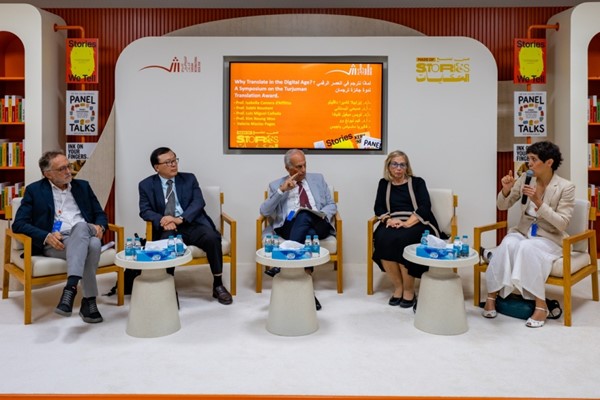
Translators, academics, and publishers emphasized that the ability of digital tools to convey meanings and produce texts quickly does not negate the role of the translator in understanding the aesthetic and cultural dimensions of creative works, nor their responsibility for translation accuracy and preserving the uniqueness of the original text.
Translated by Qiyas from الأنباء — Original source
Translators, academics, and publishers affirmed that the ability of digital tools to convey meanings and generate texts rapidly does not negate the translator’s role in understanding the aesthetic and cultural dimensions of creative works, nor their responsibility for translation accuracy and preserving the specificity of the original text. This was stated during the seminar “Why Translate in the Digital Age? – The Turuman Award Seminar,” held as part of the 45th edition of the Sharjah International Book Fair 2026, which focused on “The Future of Literary Translation in the Era of Artificial Intelligence Advancements.”
The seminar addressed opportunities to leverage artificial intelligence in translators’ work, challenges facing the translation of less widely spoken languages, the impact of modern technologies on the publishing market, and the need for transparency in disclosing AI usage and protecting the rights of translators and readers. Participants included Dr. Isabella Camara Dafeltto, Dr. Subhi Bustani, Dr. Luis Miguel Cienfuegos, Dr. Kim Nyung Woo, and Dr. Valeria Macias Pages.
Translation and Meaning Transfer
Dr. Subhi Bustani outlined the differences between human and machine translation of poetic texts, citing excerpts from Mahmoud Darwish’s poems translated into French by translator and critic Elias Sanbar. He explained that while machine translation can convey meaning according to the rules of the target language, it may cause the text to lose some of its aesthetic and rhythmic qualities. He gave the example of the repetition of the letter “waw” in Darwish’s poetry, which gives the verses an accelerated rhythm and expresses the succession and accumulation of events, whereas digital translation omitted this repetition to align with conventional French phrasing styles.
He also examined the phrase “ki nantahi” (“so that we may end”) in one of Darwish’s poems, clarifying that it carries connotations of annihilation and self-termination, whereas machine translation interpreted it as the act of finishing writing. Furthermore, he compared Adonis’s translation of the French poet Yves Bonnefoy’s poem “Against Plato” with its digital translation, considering Adonis’s version to embody the concept of “creative translation,” which reproduces the text through the translator’s spirit and poetic vision, highlighting the creative value added by human translation.
Artificial Intelligence
For his part, Dr. Kim Nyung Woo discussed his 30-year experience in translating Arabic literature into Korean, noting that he currently uses artificial intelligence to translate the book “Al-Nawadir Al-Sultaniyya wa Al-Mahasin Al-Yusufiyya” by Qadi Baha’ al-Din ibn Shaddad, which covers the biography of Sultan Saladin al-Ayyubi. He expects to complete the translation next year. He explained that he employs the technology in three areas: understanding historical contexts and archaic terminology, identifying names of weapons, cities, and figures associated with the Crusades, and selecting Korean vocabulary and refining phrasing.
He cited his use of AI to understand the description of a siege engine known as the “tank,” before seeing a miniature model of it during his visit to the Sharjah Museum of Islamic Civilization last October. He emphasized that he treats AI responses as preliminary indicators that require verification by consulting dictionaries and scientific references, stressing that literary translation is a human, intellectual, and spiritual practice that demands cultural knowledge and aesthetic appreciation, while digital technologies remain supportive tools.
Translation as a means of understanding cultures and overcoming stereotypes. For her part, Dr. Isabella Camara Dafletto affirmed that translating Arabic literature enables Western readers to become familiar with the history and social and cultural experiences of Arab societies, and that the translator’s responsibility extends beyond conveying words to include selecting works that help build a deeper understanding of other cultures. She cited translations of the works of Ghassan Kanafani and Sahar Khalifeh, which address issues of land loss, displacement, exile, and attachment to memory and identity through individual and family experiences, alongside the works of Abdul Rahman Munif, Saadallah Wannous, and Saadallah Ibrahim, which reveal aspects of Arab political and social history.
Less widely spoken languages. For her part, Dr. Valeria Macias Pages explained that the development of artificial intelligence requires literary translators to combine deep linguistic and cultural knowledge with the ability to use digital tools. She noted that literary translation demands years of reading, study, research, and interaction with different cultures, while AI tools face difficulties in handling less widely spoken languages due to the limited texts and data used to train their models, which affects their ability to perceive nuances and produce accurate translations. She also addressed other challenges related to translating gender issues and ethnic topics, amid the gap between societal transformations and the digital content available.
Transparency and translators’ rights. Dr. Luis Miguel Cienfuegos examined the impact of artificial intelligence on translation as a creative activity, a profession, and a commercial product, warning that the ability to produce and translate large volumes of text at unprecedented speeds may lead to prioritizing the economic value of books over their intellectual and cultural value. He highlighted concerns about some publishers’ reduced willingness to pay additional fees for high-quality translations, and the emergence of translated works that do not bear their translators’ names or clarify their responsibility for them, considering that publishing houses’ decisions will significantly influence the future of the profession. He cited data presented during the symposium indicating that Amazon published approximately 10 million e-books between 2020 and 2025, and that 30% of works written using AI in the “Infinity Library” database belong to the romance genre. Cienfuegos called for regulating the translation market, requiring publishers to disclose translation methods and the extent of AI usage, and placing clear labels on book covers to distinguish human translation from machine translation, along with raising readers’ awareness of their right to receive quality translations. He emphasized that AI can be a useful tool for translators, provided there is clarity regarding the limits of its use and that humans remain responsible for guiding the translation process and reviewing its outcomes.
