Sadu Cornerstones Participate in Doha Design Biennale
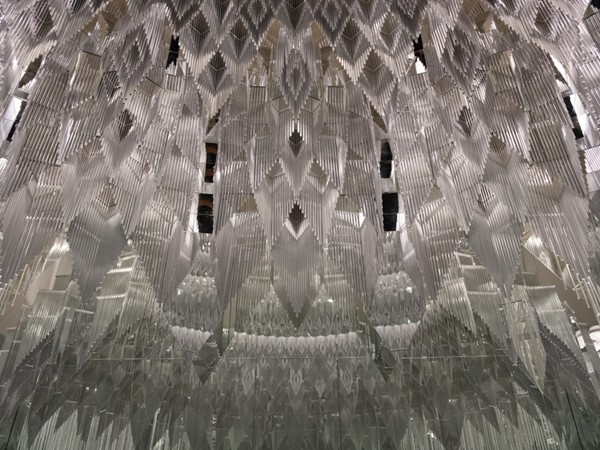
The Kuwaiti Sadu Crafts Association participated in the 2026 Doha Design Biennale in the Qatari capital with the Sadu Cornerstones work by artist Ghadeer Mohammed, attended by Honorary President Altaf Salem Al-Ali and Board Chair Bibi Al-Duwaikh.
Translated by Qiyas from الأنباء — Original source
The Kuwaiti Sadu Artisans Association participated in the Doha Design Biennale 2026 in the Qatari capital, Doha, with the presence of the association’s honorary president and patron, Sheikha Altaf Salem Al-Ali, and its board of directors chairperson, Sheikha Bibi Al-Duwaikh. In a statement to KUNA, the association said it is participating in the biennale with the work “Sadu Muqarnas” by Kuwaiti artist and architect Ghadeer Mohammed. The statement explained that the idea behind the “Sadu Muqarnas” project emerged from Ghadeer Mohammed’s participation in the Sadu for Art and Design (SADI) initiative, which is the first program of its kind in Kuwait, launched by the association to open new horizons for artists and designers to engage with Sadu heritage. It noted that in this work, the engineering of traditional Sadu weaving converges with the art of muqarnas in Islamic architecture, transforming familiar motifs into an immersive artistic experience that visitors can enter and stroll through. The “Sadu Muqarnas” takes the form of a dome inspired by the construction of muqarnas, with its sections adorned with patterns derived from Sadu engravings. The statement highlighted that Ghadeer did not limit herself to borrowing these motifs as mere aesthetic elements; rather, she reflected on the regularity, repetition, and rhythm inherent in the fabric itself, reconfiguring these relationships into a three-dimensional work that transitions Sadu from a woven surface to a space surrounding the visitor, revealing new aspects of its structure and symbolism with every change in viewing angle. The statement clarified that the work was designed using parametric modeling techniques and executed using more than 4,000 aluminum tubes and 6,000 metal connectors shaped like the letter “T,” along with acrylic elements. It pointed out that the reflection of light on its metallic parts creates shadows and reflections that change with visitors’ movements, giving the dome a different appearance from each vantage point.
