Aoun Calls for Sustainable Lebanese-Kuwaiti Partnerships: Creating Conditions to Restore Economic Confidence and Encourage Investors
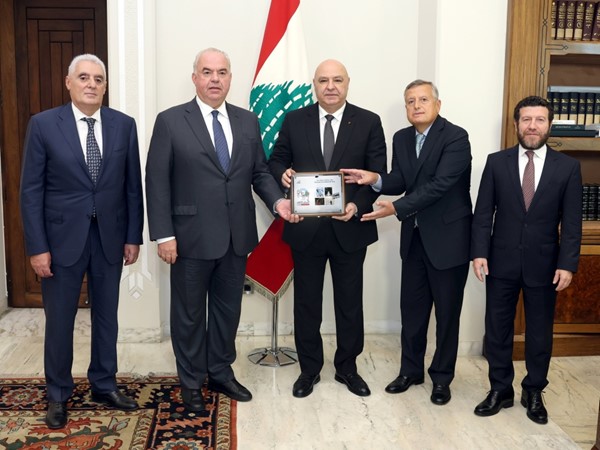
President Aoun Meets Kuwaiti Partners to Boost Investment; PM Salam Focuses on Security and Reforms; Finance Minister Jaber Warns of Delayed Support
Translated by Qiyas from الأنباء — Original source
President of the Republic, General Joseph Aoun, affirmed that Lebanon, with its human resources, professional scientific expertise, and distinctive geographical location, represents a promising land for investment. He stated that the country is working to create favorable conditions to restore confidence in the Lebanese economy, strengthen the investment climate, and provide guarantees that encourage investors to contribute to the economic reconstruction effort and the development of productive sectors.
During a meeting at Baabda Palace, Aoun received George Fayyad, Chairman of the Board of Directors of Uniterminals, a company specializing in the oil sector and oil facility storage, along with members of the board of directors representing Kuwaiti partners. Aoun said that Lebanon looks forward to enhancing cooperation between Lebanese and Kuwaiti companies, moving beyond traditional commercial relations to joint investment projects based on the exchange of expertise and complementarity of capabilities, and taking advantage of opportunities available in both countries. He added, “Kuwait has always stood by Lebanon’s side, and we want this historical relationship to be translated today into sustainable economic and investment partnerships that benefit both sides.”
President Aoun received commemorative stamps issued to mark Pope Leo XIV’s visit to Lebanon from Minister of Telecommunications Charles Al-Hajj, in the presence of General Manager of the Postal Service Muhammad Yusuf, Andre Al-Rami, Chairman and General Manager of “Liban Post,” and Vice President Shadi Moghames.
Meanwhile, Speaker of the Parliament Nabih Berri reiterated to Sandra de Waal, Ambassador of the European Union, that United Nations Security Council Resolution 1701 is the legal guarantee of Lebanon’s right to reclaim its entire territory up to internationally recognized borders, and that international emergency forces constitute an operational framework for the full implementation of the resolution’s provisions.
At the Saeb Salam Government Building, Prime Minister Dr. Nawaf Salam affirmed before a delegation from the Lebanese Cultural University in the World, led by Ibrahim Qustantin, that “Lebanese diaspora has always been a fundamental pillar of Lebanon’s resilience, given the support it has provided to its people and the successes, expertise, and relationships it has accumulated across the globe. Today, it falls upon us to enhance security and stability and to advance reforms that provide an environment protecting their rights and encouraging them to invest in their homeland.”
“We want them to be genuine partners in advancing Lebanon’s development and building its future, and to leverage their capacities, expertise, and networks across various fields.” In Canada, Minister of Foreign Affairs and Emigrants Youssef Raji met with Senate President Raymond Gagné to discuss bilateral relations, the situation in Lebanon, the trajectory of negotiations between Lebanon and Israel, and the post-UNIFIL mission scenario. For his part, Raji thanked Canada for its continuous support for Lebanon and called for “supporting the government in its efforts to end the Israeli occupation, halt aggressions, and concentrate weapons in the hands of the state.”
Locally, Friday preachers continued to warn against fitna (sectarian strife). Lebanon’s Grand Mufti, Sheikh Abdul Latif Diyyan, and MP Fouad Makhlouf led Friday prayers at the Qraytem Mosque, where Judge Sheikh Muhammad Khanji delivered the Friday sermon, emphasizing “adherence to truth, wisdom, and good exhortation, while avoiding hypocrisy and false testimony,” and calling on security forces to “curb the security chaos in Beirut and strengthen the state’s authority.”
Finance Minister Yassin Jaber continued his participation in the 17th Bosphorus Summit, held in Istanbul under the theme “Global Transformation and the Search for Stability.” In his address, Jaber stressed that “delayed support may deepen crises and raise the cost of recovery, and that announcing reforms is not a substitute for implementing them.” He noted that “the financial crisis has exposed serious deficiencies in local policies and institutions, and that the responsibility for addressing them lies with Lebanon itself.”
Meanwhile, Mirna Minnane, a central official for external relations and a member of the political bureau of the Future Movement, was elected to one of the vice-presidency positions of the Liberal International organization during the party’s general assembly in Bangkok, Thailand, and Taipei, Taiwan.
