Al-Badawi: GCC Economies Total $2.4 Trillion, Enhancing Crisis Response and Stability
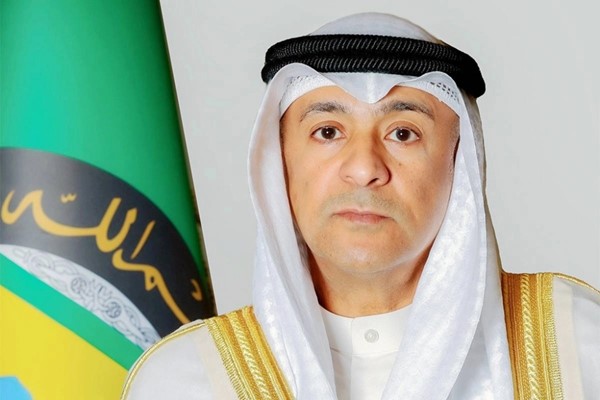
Al-Badawi affirmed that the GCC economies total $2.4 trillion, enhancing their capacity to face crises and support regional and international stability, emphasizing the importance of regional security based on international law.
Translated by Qiyas from الأنباء — Original source
Secretary-General of the Gulf Cooperation Council (GCC) Jassem Mohamed Al-Bedawi affirmed that the security of the GCC member states is indivisible, and that establishing a stable and sustainable regional security architecture requires adherence to the principles of international law, respect for state sovereignty, enhancement of collective defense, prioritization of diplomatic solutions, safeguarding the security of waterways and energy supplies, alongside promoting development and international partnerships.
This statement came during his participation in the third general session, titled “Pillars of Regional Security,” as part of the proceedings of the 22nd Regional Security Summit, “Manama Dialogue 2026,” held in the Bahraini capital of Manama.
Al-Bedawi clarified that developments in the region since February 28 have placed regional security before serious challenges, following Iranian attacks targeting GCC states and their civilian and vital facilities, despite the GCC’s non-involvement in the conflict and its diplomatic efforts to contain escalation.
He condemned the terrorist attacks launched by the Houthi militias against the Kingdom of Saudi Arabia since last July, which extended to the holy cities of Makkah and Madinah.
The Secretary-General outlined that building sustainable regional security rests on five main pillars. The first is respect for international law and state sovereignty, commitment to the principles of good neighborliness, non-interference in internal affairs, and peaceful settlement of disputes.
He noted that the second pillar consists of collective defense and GCC military integration. He pointed out that the third pillar is diplomacy and the peaceful resolution of differences. Regarding the fourth pillar, he stressed that the security of maritime navigation and energy supplies is a shared international responsibility, and that disrupting navigation in the Straits of Hormuz and Bab al-Mandab poses a threat to global economic interests. He called on the international community to halt the attacks, hold those responsible accountable, and restore normal navigation.
He explained that the fifth pillar relies on achieving stability through development and international partnerships, noting that the combined economy of the GCC states amounts to approximately $2.4 trillion, which enhances their capacity to confront crises and support regional and international stability.
He reaffirmed the GCC states’ continued support for the legitimate government in Yemen and the pursuit of a comprehensive political solution to the crisis in accordance with agreed frameworks, as well as support for the security, stability, and sovereignty of Iraq, Syria, and Lebanon. He emphasized that achieving lasting peace in the region is linked to reaching a just and comprehensive solution to the Palestinian issue based on the two-state solution, alongside enhancing water and food security and addressing climate challenges.
Al-Bedawi concluded by stressing that regional security cannot be based solely on power balances, but requires international rules respected by all parties and a security architecture co-created by the countries of the region. He reiterated the GCC states’ readiness to contribute to building such an architecture in line with the Council’s Regional Security Vision launched in 2024.
