Sahl App Wins Two Gulf Awards for Best Comprehensive Government App and Excellence in Digital Services via 'Birth Journey'
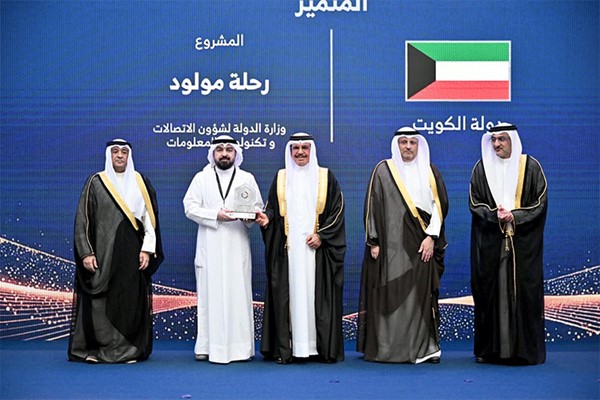
Sahl app and Birth Journey initiative crowned with Gulf awards in Bahrain.
Translated by Qiyas from الأنباء — Original source
Kuwait achieved a dual Gulf milestone as its unified government electronic services app, “Sahl,” won the award for Best Comprehensive Government App, while “Baby Journey” received the Excellence Award in the category of Best Government Digital Service at the Gulf Cooperation Council (GCC) Digital Government Awards.
The announcement of this achievement came during the seventh edition of the awards, hosted yesterday by the Kingdom of Bahrain, in a ceremony reflecting the success of Kuwait’s experience in digitizing government services, enhancing integration among entities, and improving user experience.
Colonel Bashar Al-Sayed Hashem, Chairman of the Executive Committee for the “Sahl” app, told KUNA that winning the Best Comprehensive Government App award and the excellence of “Baby Journey” reflect the success of the joint government work system, which is based on continuous coordination among government entities, reengineering procedures, developing services, and enhancing data integration and exchange.
He explained that the “Sahl” app has managed to consolidate services from 42 government entities within a single digital platform, while “Baby Journey” provided a practical model for government entities transitioning from providing separate services to working within an integrated digital journey where government procedures and systems are interconnected to serve citizens.
He added that this achievement is the result of collective efforts by government entities, technical teams, and administrative staff, and affirmed that the Executive Committee will continue to work on accelerating the digitization of services and developing new digital journeys to enhance government performance efficiency and save time and effort for users.
For her part, Fajr Al-Yassin, a member of the Executive Committee, told KUNA that the dual Gulf recognition highlights the importance of focusing on the quality of digital government services and user experience. She noted that developing the “Sahl” app is not limited to increasing the number of services but also includes improving ease of use, clarity of procedures, and the ability to meet the needs of beneficiaries.
Al-Yassin explained that “Baby Journey” represents a model of this approach, as it was designed around family needs to provide an integrated experience that facilitates completing procedures related to a newborn, rather than dealing with each government entity separately.
She added that user feedback and suggestions form a fundamental element in continuing to develop the app and its services, emphasizing that maintaining user trust requires continuous improvement in quality, ease of use, and elevating the digital experience.
Similarly, Aminah Abdulrahim, another member of the Executive Committee, stated that this achievement reflects the importance of technical integration among government systems and its role in building a unified digital platform capable of delivering integrated services efficiently and reliably.
She affirmed that the success of “Baby Journey” resulted from joint technical efforts to achieve integration and data exchange among participating government entities, thereby reducing the duplication of procedures and documents and facilitating the transfer of transactions between government systems.
She viewed the development of technical infrastructure and enhancing the readiness of government systems as a crucial foundation for the sustainability of digital services and the expansion of launching more integrated journeys, commending the efforts of technical teams in participating entities that contributed to the success of this experience and the achievement of this Gulf distinction.
This recognition comes in appreciation of the progress made by the “Sahl” app in delivering government services through a unified digital platform encompassing 42 government entities, enabling citizens and residents to complete their transactions electronically with ease and efficiency, alongside the success of “Baby Journey” in providing an advanced model of government integration that combines services and procedures from several government entities within a single digital journey centered on the needs of Kuwaiti families.
This dual achievement marks a new milestone in Kuwait’s digital transformation journey, combining excellence in building a comprehensive government platform with excellence in developing digital services and journeys that streamline procedures and simplify the user experience.
This accomplishment adds a new Gulf accolade to the record of the “Sahel” application, following its receipt of a special honor at the Arab Government Excellence Awards in 2025 and its win of the Sheikh Salem Al-Ali Al-Sabah Award for Informatics, reflecting the continued presence of the Kuwaiti experience at specialized forums on digitalization and government services.
This dual recognition underscores that the success of digital transformation is measured not only by the number of services or transactions completed, but by the ability of government entities to operate and integrate within a unified system, delivering a comprehensive digital experience that enhances service quality and facilitates the lives of citizens and residents.
Bahrain’s Minister of Interior, Chairman of the Ministerial Committee for Information and Communications Technology, Field Marshal Sheikh Rashid bin Abdullah Al Khalifa, and GCC Secretary-General Jasem Al-Budaiwi attended the awards ceremony for the Digital Government Award of the Gulf Cooperation Council (GCC) States, held yesterday evening in the Kingdom of Bahrain.
Speaking at the ceremony, the Bahraini Minister stated that practical experiences and expertise confirm that security, development, and investment in technology are two sides of the same coin. He emphasized that joint efforts and rapid coordination to adapt to the new rhythm in the concept of security and response have become an imperative, especially as technology and artificial intelligence have transcended borders, turning the digital space into an open arena for movement without permission or restrictions.
He added that securing digital infrastructure has become an integral part of national security and a country’s resilience and continuity, necessitating continued enhancement of GCC cooperation in cybersecurity, raising readiness levels, exchanging expertise and information, and ensuring the continuity of vital services under all circumstances.
For his part, the Secretary-General stressed in a similar address that the GCC Digital Government Award holds particular significance, as it is not merely an occasion to honor winning entities, but a Gulf platform for discovering outstanding ideas, stimulating innovation, and transforming successful experiences into opportunities for development and shared benefit.
He noted that “the true value of this award is not measured solely by the number of winning entities, but by our ability to disseminate successful experiences, leverage innovative solutions, and transform individual achievements into added value for joint GCC efforts.”
The ceremony featured a short film about the award, its previous stages, and its role in stimulating activities and fields of work related to digital government in GCC states. Bahrain’s Minister of Interior, Chairman of the Ministerial Committee for Information and Communications Technology, and the GCC Secretary-General presented awards to the winners of the 2026 Digital Government Award, members of the judging committee, and founders of the award from GCC member states.
