Council of Ministers: Positive Indicators Enhance Economic Resilience and Support Stability of Egypt's Credit Rating
Report on the improvement of Egyptian economic indicators and the stabilization of the credit rating by international agencies.
Translated by Alqyas from Al-Anba — Original source
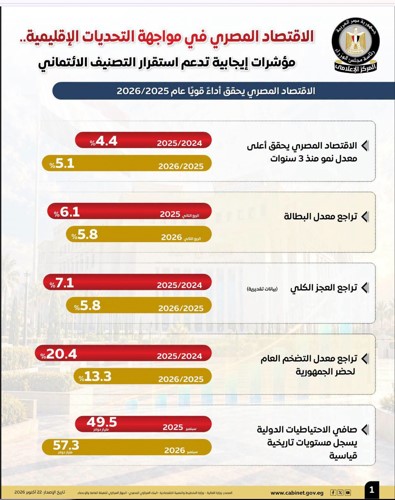
Cairo - Ahmed Saber: The Media Center of the Council of Ministers published infographics via its social media platforms, highlighting the most prominent positive indicators of the Egyptian economy and reflecting its capacity and resilience in dealing with regional challenges, alongside developments in the assessments by international credit rating agencies of the national economy and the factors supporting the stability of its credit rating.
The infographics indicated that the Egyptian economy achieved strong performance during the fiscal year 2025/2026, recording the highest growth rate in three years, with the economic growth rate rising to 5.1%, compared to 4.4% during the fiscal year 2024/2025.
The infographics pointed to a decline in the unemployment rate to 5.8% during the second quarter of 2026, down from 6.1% in the second quarter of 2025. The overall deficit also decreased to 5.8% during the fiscal year 2025/2026, compared to 7.1% during the fiscal year 2024/2025.
Regarding the assessments by international credit rating agencies of the Egyptian economy, the infographics outlined developments in Egypt’s credit ratings by Moody’s, Standard & Poor’s, and Fitch, along with the key factors these agencies relied on in their decisions regarding credit ratings and outlooks.
In this context, Moody’s upgraded Egypt’s credit rating from Caa1 to B3 in October 2026, maintaining a positive outlook, amid improvements in financial and external indicators, supported by efforts to consolidate public finances and implement structural reforms. According to Moody’s, these efforts contributed to reducing government debt as a percentage of GDP to 81.8% in June 2026, placing its interest burden on a downward trajectory, as well as increasing the primary budget surplus to 4.9% of GDP during the fiscal year 2025/2026, due to improved revenue collection and control of government spending.
The shift to a flexible exchange rate and tighter monetary policy also helped strengthen international reserves and enhance the Egyptian economy’s capacity to absorb shocks.
In a related development, Standard & Poor’s maintained Egypt’s sovereign credit rating at B in October 2026, keeping a stable outlook, given the ability of international reserves to provide a buffer against the repercussions of regional tensions, alongside the improved performance of the Egyptian economy, which recorded growth of 5.1% during the fiscal year 2025/2026, the fastest growth rate in three years.
According to Standard & Poor’s, remittances from Egyptians abroad, tourism revenues, and the recovery of Suez Canal earnings helped alleviate pressures on the trade balance caused by rising global energy prices. The agency’s stable outlook reflects a balance between medium-term growth prospects and the momentum of reforms in the face of risks from regional tensions, as well as Egypt’s success in reducing its financing needs by approximately 5% of GDP during the fiscal year 2025/2026.
Regarding the evolution of the credit rating, the period since April 2023 witnessed several adjustments. The agency downgraded the rating from B to B- in October 2023, changing the outlook from negative to stable. It then maintained the rating at B- while adjusting the outlook to positive in March 2024. The agency kept the rating at B- and maintained a positive outlook in October 2024, before reverting the outlook to stable in April 2025, coinciding with the rating remaining at B-.
For its part, Fitch maintained Egypt’s sovereign credit rating at B in October 2026, keeping a stable outlook.
The outlook is stable, supported by expectations of improvement in fiscal and external indicators, amid declining debt service burdens and tax measures that are expected to help reduce the budget deficit to less than 5% of GDP by the 2027/2028 fiscal year.
