Kuwait: Necessity to Strengthen Respect for International Humanitarian Law and Protect Civilians in Armed Conflicts
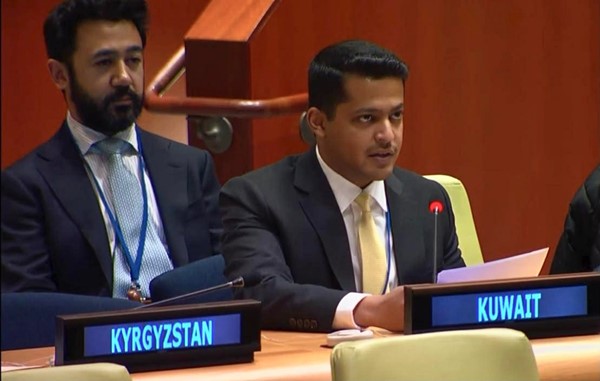
Diplomatic Attaché Mohammed Al-Mutairi emphasized before the UN the need to strengthen respect for international humanitarian law and protect civilians, condemning Iranian, Houthi, and Israeli aggressions.
Translated by Qiyas from الأنباء — Original source
Kuwait has affirmed the necessity of strengthening respect for international humanitarian law, ensuring its full and effective implementation, and safeguarding civilians and civilian objects during armed conflicts, while holding perpetrators of serious violations accountable in accordance with international law.
This was stated in Kuwait’s address delivered by Diplomatic Attaché Mohammed Al-Mutairi to the Sixth Committee (Legal) of the UN General Assembly during the discussion of agenda item 81, titled “Additional Protocols.”
Al-Mutairi reiterated the importance of the 1949 Geneva Conventions and their Additional Protocols as the cornerstone of the international humanitarian law framework, emphasizing that respect for their rules must not be selective or tied to specific conflicts.
He explained that the fundamental principles enshrined in the Additional Protocols include distinguishing between civilians and combatants, and between civilian objects and military objectives, observing proportionality, taking necessary precautions during attacks, and protecting the wounded, sick, and medical and humanitarian personnel.
In this context, Al-Mutairi outlined Kuwait’s efforts to strengthen its national legal framework to implement its international obligations in the field of international humanitarian law, highlighting the adoption of Law-Decree No. (134) of 2025 concerning the regulation of the use and protection of the Red Crescent and Red Cross emblems, which enhances the protection of humanitarian emblems and prevents their misuse.
He added that Kuwait also issued Law-Decree No. (154) of 2025 concerning the protection of missing persons, which establishes a national framework for investigating persons missing as a result of armed conflicts and guarantees their families the right to know the fate of their relatives and to obtain relevant information. He emphasized that Kuwait attaches special importance to the issue of missing persons, drawing on its national experience regarding prisoners and the missing, and its commitment to continuing efforts to determine their fate and alleviate the suffering of their families.
In this regard, Al-Mutairi reaffirmed the importance of implementing UN Security Council Resolution (2474) of 2019 concerning missing persons in armed conflicts, which was proposed by Kuwait during its membership on the Council, reflecting its belief in the humanitarian and legal nature of this issue and the necessity of international cooperation to address it.
He noted that the resolution represents a significant Kuwaiti contribution to placing the issue of missing persons in armed conflicts at the forefront of the UN Security Council’s agenda, and affirmed Kuwait’s continued cooperation with the International Committee of the Red Cross (ICRC) in this field.
He also highlighted the role of Kuwait’s National Committee for International Humanitarian Law in monitoring the implementation of relevant national obligations, coordinating among concerned authorities, raising awareness of international humanitarian law provisions, enhancing training on them, and exchanging expertise and best practices.
On the regional front, Al-Mutairi condemned Iranian attacks on Kuwait, the Gulf Cooperation Council (GCC) countries, and Jordan, affirming that they constitute a blatant violation of the principles and purposes of the UN Charter and international law, and contribute to expanding the conflict in the region.
He explained that the Iranian attacks targeted vital installations and civilian objects in Kuwait, including water desalination plants, Kuwait International Airport, and the Public Institution for Social Security, resulting in the martyrdom of several civilians, public employees, and military personnel.
He warned that targeting water desalination plants threatens access to water, a basic necessity for life, and raises concerns about potential serious violations of the rules protecting civilian objects and objects indispensable to the survival of the civilian population.
He also condemned the targeting of ships and tankers in the Strait of Hormuz, emphasizing the necessity of ensuring freedom of navigation and transit through it, and calling on Iran to comply with United Nations Security Council Resolution 2817 (2026), which was sponsored by 136 countries.
Al-Mutairi also condemned the attacks by Houthi militias on civilian targets in the Kingdom of Saudi Arabia, including King Khalid and King Fahd International Airports, which resulted in the martyrdom of several citizens and residents, endangered the lives of civilians, and violated the sovereignty and territorial integrity of the Kingdom, as well as posing a threat to the safety of air navigation.
Regarding the Palestinian issue, Al-Mutairi also condemned the practices of the Israeli occupation against the Palestinian people, including starvation, forced displacement, genocide, the construction of settlements, and the targeting of civilians and civilian objects. He stressed the necessity of respecting the obligations of the occupying power under international humanitarian law, prohibiting forced transfers, and facilitating the delivery of humanitarian aid.
He renewed the call for the urgent end of the occupation and the establishment of an independent Palestinian state on the borders of June 4, 1967, with East Jerusalem as its capital, in accordance with the two-state solution.
Concluding his speech on behalf of the State of Kuwait, Al-Mutairi reaffirmed Kuwait’s commitment to continuing its national and international efforts to enhance respect for international humanitarian law, protect victims of armed conflicts, alleviate humanitarian suffering, and strengthen the rule of law.
