Al-Badawi: Iranian attacks targeted GCC countries with over 7,000 missiles and drones
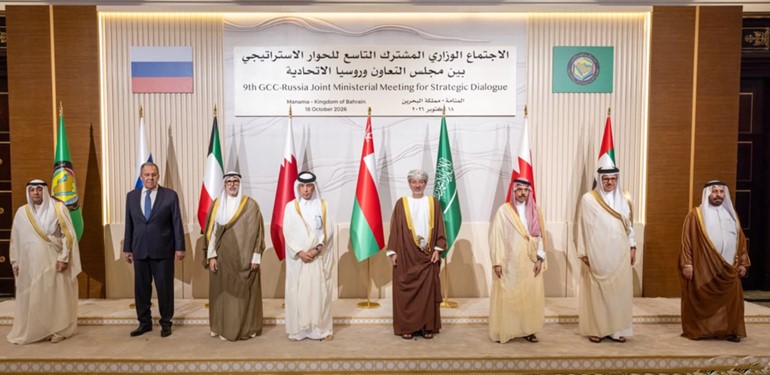
Al-Badawi affirmed during the joint ministerial meeting with Russia in Manama that Iranian attacks targeted Gulf countries with over 7,000 missiles and drones, and called on Russia to pressure Tehran to halt attacks and comply with UN Security Council resolutions.
Translated by Qiyas from الأنباء — Original source
Secretary-General of the Gulf Cooperation Council (GCC) Jasem Al-Budaiwi affirmed that GCC member states attach special importance to consolidating their relations with the Russian Federation, driven by shared interests and a mutual desire to elevate the levels of cooperation and coordination between the two sides, thereby opening broader horizons for Gulf-Russian partnership.
This statement was made during the ninth joint ministerial meeting of the Strategic Dialogue between the GCC and the Russian Federation, held in the Bahraini capital of Manama. The meeting was chaired by Abdul Latif bin Rashid Al Zayani, Bahrain’s Minister of Foreign Affairs and President of the current term of the GCC Ministerial Council, and attended by the Their Highnesses, Excellencies, and Honors of the foreign ministers of the GCC member states, as well as Russian Foreign Minister Sergey Lavrov.
Speaking during his address, the Secretary-General stated that the joint ministerial meeting takes place at a highly critical juncture for our region, where GCC countries are facing unprecedented attacks undermining their security and sovereignty, and where maritime navigation and energy supplies are under direct threat. This situation underscores the importance of the strategic dialogue between the GCC and the Russian Federation, and the need to intensify consultation and coordination between the two sides on regional and international issues of common interest, contributing to consolidating the foundations of security and stability and resolving conflicts through peaceful means, in accordance with the principles of the UN Charter and international law.
Al-Budaiwi highlighted that among the serious challenges facing our region are Iranian attacks on GCC countries, which began on February 28, 2026, involving more than 7,000 ballistic missiles and drones targeting airports, ports, power stations, water desalination plants, and oil and gas facilities. These attacks resulted in the deaths of innocent civilians in a war in which GCC states were not parties; rather, they made every effort to shield the region from its dire repercussions, despite suffering blatant attacks and violations of their sovereignty and territorial integrity. These aggressions were not limited to direct Iranian attacks but also extended to assaults by the terrorist Houthi militia, which escalated its attacks on the Kingdom of Saudi Arabia, targeting airports, civilian objects, and energy facilities. This included the brutal attack on King Khalid International Airport in Riyadh on October 10 of this year, which killed 12 people of various nationalities, including citizens and residents, and injured more than 300 others, in a blatant violation of international law and international humanitarian law.
In the same context, the Secretary-General affirmed the GCC’s unity in standing alongside the Kingdom of Saudi Arabia, expressing its full solidarity with the Kingdom and supporting all measures it takes to protect its security, sovereignty, and the safety of its citizens and residents.
The GCC also calls on the international community to take a firm and deterrent stance against attacks targeting the security and stability of the Kingdom, and to condemn what constitutes a threat to regional peace and security, as well as a violation of relevant Security Council resolutions, particularly Resolution 2722.
Al-Badawi noted that Iran’s decision to disrupt navigation in the Strait of Hormuz, through which approximately one-fifth of global oil consumption passes, along with its efforts to impose restrictions and fees on the right of transit passage, coupled with threats by its proxies to navigation in the Bab al-Mandab Strait and the Red Sea, represents a violation of the international rules governing navigation in straits used for international navigation. These actions pose a threat to energy security, global food security, and global supply chains. The GCC stresses the necessity of restoring navigation in the Strait of Hormuz to its pre-February 28, 2026 status, and emphasizes the full implementation of Security Council Resolution 2817 (2026), which strongly condemned Iranian attacks on GCC member states and the Hashemite Kingdom of Jordan, and called for an immediate halt to all Iranian attacks.
In the same context, he stated that the GCC looks forward to Russia playing an active role, as a permanent member of the Security Council, in pressuring Iran to comply with Resolution 2817 (2026), cease its attacks, respect freedom of navigation, and engage in serious dialogue with GCC states based on the principles of good neighborliness, respect for sovereignty, and non-interference in internal affairs.
Al-Badawi also expressed his hope for the continued development of joint Gulf-Russian cooperation and the enhancement of collaboration in political, commercial, cultural, educational, agricultural, health, energy, and other sectors, within the framework of the joint action plan between the GCC and the Russian Federation for the period 2023–2028. This cooperation aims to serve mutual interests and support development and prosperity pathways for both sides. In this regard, a joint technical meeting between relevant experts and officials from both sides was scheduled to take place in the Russian capital, Moscow, to discuss joint cooperation topics and review priorities, initiatives, and proposals from both sides. However, unfortunate circumstances affecting the region prevented the meeting from being held at the targeted time. Coordination will be resumed to hold the meeting in order to activate agreed-upon areas of cooperation under the action plan.
He expressed his hope that yesterday’s meeting would serve as an opportunity to deepen political and security consultations and enhance coordination and cooperation between the GCC and the Russian Federation, thereby contributing to achieving peace, security, development, and stability in the region and the world.
The Secretary-General noted that the Palestinian issue remains at the forefront of the GCC’s priorities. In this context, the GCC reaffirms its firm and supportive stance toward the legitimate rights of the Palestinian people, foremost among which is the establishment of an independent Palestinian state on the borders of June 4, 1967, with East Jerusalem as its capital, in accordance with international legitimacy resolutions and the Arab Peace Initiative. The GCC also appreciates the Russian Federation’s firm and supportive position regarding the establishment of an independent Palestinian state, as well as its recognition of it since 1988. The GCC reiterates its support for the necessity of consolidating the ceasefire in the Gaza Strip, advancing the implementation of the second phase to ensure a complete Israeli withdrawal, the unhindered delivery of humanitarian aid, the beginning of recovery and reconstruction, and the unification of Gaza and the West Bank under the umbrella of the Palestinian Authority. It also rejects any attempts at displacement or altering the legal and historical character of Jerusalem, and supports the continued operation of the United Nations Relief and Works Agency for Palestine Refugees in the Near East (UNRWA) in fulfilling its mandate.
Regarding the Syrian issue, Al-Badawi stated that the GCC reaffirms its firm and supportive position toward the sovereignty
The Arab Republic of Syria, its independence, and its territorial integrity, as well as the importance of supporting efforts aimed at enhancing its security and stability, and realizing the aspirations of the brotherly Syrian people for security, development, and prosperity, thereby contributing to consolidating security and stability in the region. Regarding the Russian-Ukrainian crisis, he stated that the Gulf Cooperation Council (GCC) reiterates its emphasis on the importance of prioritizing dialogue and diplomacy in addressing the crisis, and supports all efforts aimed at reaching a peaceful, comprehensive political settlement in accordance with the principles of international law and the United Nations Charter, thereby contributing to achieving security and stability. He also noted that the GCC takes pride in the tangible contributions made by member states to mitigate the humanitarian repercussions of the crisis, including the Emirati mediation that resulted in the exchange of thousands of prisoners between the two sides, the Saudi efforts manifested in hosting the Jeddah and Riyadh talks between the concerned parties, and the Qatari mediation that reunited more than a hundred children with their families. These efforts exemplify the steadfast approach of GCC states in supporting peaceful initiatives and building trust among the parties.
