"Judicial Studies": Kuwait's Constitution emphasized establishing fundamental rights principles and safeguarding personal freedom
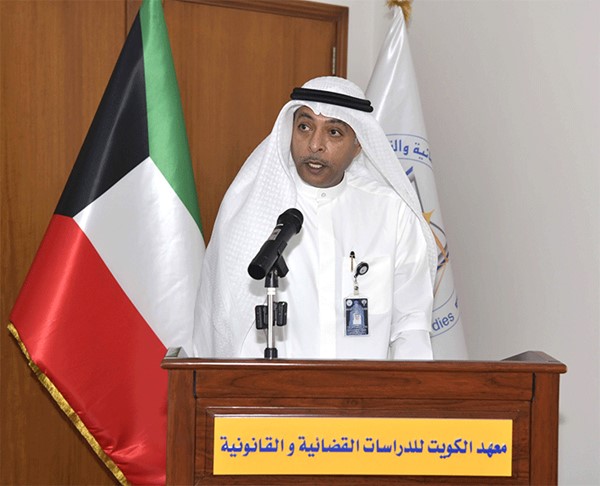
The Institute and the High Commissioner hold a workshop on international standards and human rights
Translated by Qiyas from الأنباء — Original source
Saud Al-Sanea, Deputy Director of the Kuwait Institute for Judicial and Legal Studies for Continuous and Specialized Training, said on Sunday that the Constitution of the State of Kuwait is keen on establishing the fundamental principles of rights and freedoms, safeguarding personal liberty, guaranteeing the right to litigation, and ensuring judicial independence. These principles form the foundation from which the legislative system derives.
This statement was made by Al-Sanea, speaking on behalf of the Institute’s Director, First Advisor Bader Al-Musaed, during a workshop held by the Institute with the Office of the United Nations High Commissioner for Human Rights (OHCHR), represented by its Regional Representative for the Middle East and North Africa, Mazen Shqoura. The workshop focused on international human rights standards and related legal obligations.
Al-Sanea added that the Institute believes that developing judicial work is not limited to familiarity with national legislation, but extends to deepening knowledge of relevant international standards and understanding their implementation mechanisms. He noted that the workshop embodies this approach by exploring human rights in national legislation and international instruments, and highlighting the reflection of their principles on Kuwaiti criminal justice.
He emphasized the importance of investing in the training of judges, public prosecutors, and other legal professionals, considering them the cornerstone for enforcing legislation, protecting rights, and establishing justice. He expressed confidence that the workshop would provide a platform for exchanging expertise, enriching legal knowledge, and linking international standards with practical judicial applications, thereby positively impacting the quality of judicial performance.
For his part, Shqoura, in a similar address, expressed his sincere gratitude and appreciation to the Institute for its constructive cooperation with OHCHR and its continuous efforts to enhance legal and judicial knowledge, and to provide training opportunities and platforms for exchanging experiences among judicial and legal professionals.
He congratulated Kuwait on its election as a member of the United Nations Human Rights Council for the term 2027–2029, looking forward to this membership serving as an additional opportunity to strengthen cooperation with UN human rights mechanisms and to continue efforts aimed at fulfilling international commitments and enhancing the protection of human rights and fundamental freedoms.
He stated that OHCHR places special importance on cooperation with judicial institutions and law enforcement agencies through providing technical support, capacity building, and enhancing knowledge of international human rights standards. He added that the workshop represents an important opportunity for dialogue, exchanging experiences and practices, and discussing practical challenges related to the implementation of human rights standards.
Attendees at the workshop included Ahmed Al-Maqaled, Deputy Director of the Institute for Communications, Relations, and Research, and Abdullah Abu Shiba, Assistant Undersecretary for Human Rights Affairs at the Ministry of Foreign Affairs.
The workshop, which concludes its proceedings next Wednesday, discusses ways to strengthen and build national and legal capacities in the field of human rights, exchange expertise, and raise awareness in this area, as well as address practical challenges related to human rights standards.
