President Aoun: Extension of UNIFIL or Finding an International Presence Formula in the South to Prevent a Vacuum
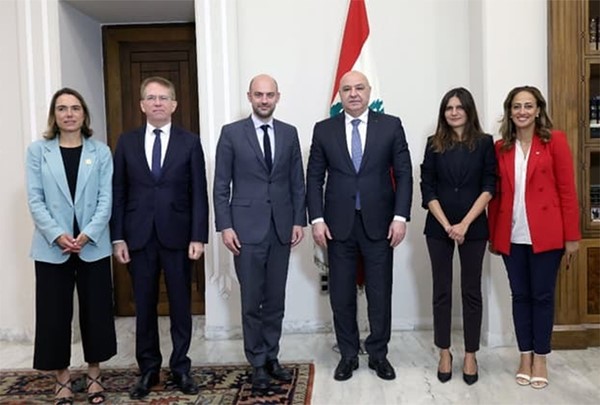
President Aoun reiterated his welcome for extending UNIFIL's mandate or establishing an international presence formula in the south during a meeting with a French ministerial delegation led by Jean-Noël Barrot.
Translated by Qiyas from الأنباء — Original source
Lebanese President Joseph Aoun renewed his country’s desire to extend the mandate of the United Nations Interim Force in Lebanon (UNIFIL) or continue its operations through 2027, as the mission’s security mandate approaches its end at the close of this year. This was stated in a statement issued by the Lebanese Presidency following President Aoun’s reception of a French ministerial delegation at Baabda Palace, led by Minister of Europe and Foreign Affairs Jean-Noël Barrot and Minister Delegate to the Minister of Armed Forces Alice Ruffo, in the presence of French Ambassador to Lebanon Patrick Doriland and accompanying officials.
President Aoun expressed his welcome for “any formula that ensures an international presence in the south to prevent a security vacuum and avoid placing the Lebanese Army in direct contact with Israeli occupation forces in occupied areas,” emphasizing his support for any French effort within the UN Security Council to reach the desired arrangement. He considered that French positions supporting Lebanon reflect the depth of the “rooted relations” linking the two countries throughout history, and he hoped that French presence in Lebanon would continue for the benefit of both friendly peoples.
President Aoun opened the meeting by thanking French President Emmanuel Macron for his decision to resume French commercial flights to Beirut, his support for the inclusion of the ports of Beirut and Tripoli in the Economic Corridor Ports Club (IMEC), and the French role in establishing a new European support mission for Lebanon that will provide advice to the army and internal security forces for three years.
The Lebanese president said that Israeli occupation forces continue their attacks, hinder farmers’ access to their lands, and refuse to implement the provisions of the Framework Agreement, thereby preventing the deployment of the Lebanese Army to the international borders. Aoun revealed that a Lebanese military delegation would participate in the upcoming trilateral meeting in Tampa, Florida, on October 20, to place Lebanon’s demands for an end to escalation on the table during US-mediated negotiations.
On domestic Lebanese affairs, Aoun affirmed that the army and security forces are implementing government decisions to extend state authority, prevent armed manifestations, confiscate weapons, and refer violators to the judiciary, stressing the importance of strengthening and equipping the army to carry out its mission. He expressed his country’s expectation “soon” for the convening of an international conference to support the army and security forces, and to follow up on the completion of economic and financial reforms, considering that “Lebanon is a strategic partner for European countries.”
For his part, French Minister of Europe and Foreign Affairs Jean-Noël Barrot affirmed his country’s support for Lebanon, its steadfast backing of its sovereignty and stability, and France’s commitment to working toward the full implementation of the ceasefire agreement signed on June 26, 2026, and UN Security Council Resolution 1701. Barrot stressed the necessity of establishing a new international framework to support Lebanon’s sovereignty and assist in the deployment of its armed forces “to avoid any security vacuum.” He reiterated France’s readiness to play its “full” role in supporting Lebanon and its stability, alongside continuing to provide emergency humanitarian aid and supporting fundamental reforms to advance the country.
