Iraqi President Reiterates Support for Lebanon's Security, Stability, Sovereignty, and National Decision-Making
&cropxunits=450&cropyunits=292&w=770)
Iraqi President Nizar Ammidi stressed support for Lebanon's stability and sovereignty during a meeting with Foreign Minister Youssef Raji, while MP Simon Abi Ramia discussed Lebanese constitutional issues and required reforms in Paris.
Translated by Qiyas from الأنباء — Original source
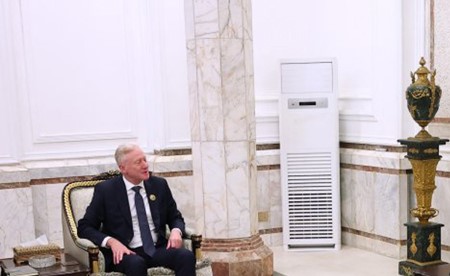
Beirut - Mansour Shaaban: Iraqi President Nizar al-Amidi, during his meeting with Lebanese Minister of Foreign Affairs and Expatriates Youssef Raji on the sidelines of the 52nd session of the Organization of Islamic Cooperation (OIC) Foreign Ministers’ Council in Baghdad, emphasized the importance of Lebanon’s stability, strengthening state institutions, extending state sovereignty, and monopolizing weapons within the state’s hands. He described Lebanon as a country rich in human resources and expertise. Al-Amidi affirmed that Iraq’s doors are open to Lebanese businessmen and companies for investment, and that his country is continuing on the path of political and economic recovery, noting that its stability is a fundamental condition for regional security.
The meeting discussed prospects for enhancing economic cooperation between the two countries, particularly in the oil sector, and the possibility of reactivating the Iraqi oil pipeline extending from Kirkuk via Baniyas in Syria to Tripoli, due to the economic integration opportunities it offers.
The Iraqi Presidency stated that al-Amidi highlighted “the importance of developing Iraqi-Lebanese relations and expanding the horizons of bilateral cooperation to serve common interests, reiterating Iraq’s support for Lebanon’s security and stability, and its respect for Lebanon’s sovereignty and national decisions.”
Minister Raji thanked Iraq for its continuous support for Lebanon, particularly in the field of fuel supplies. He affirmed Lebanon’s support for Iraq’s efforts to monopolize weapons, strengthen its sovereignty, continue reforms, and combat corruption, stressing that Iraq’s stability is a cornerstone of regional stability.
Meanwhile, the situation in southern Lebanon remains under “war pressure” ahead of the resumption of negotiations between Lebanon and Israel under US sponsorship, while the Israeli army continues its operations amidst these developments.
Amid the preoccupation of President Joseph Aoun, Speaker of the Parliament Nabih Berri, and Prime Minister Dr. Nawaf Salam with evaluating the results of the visit by Qatari Prime Minister and Foreign Minister Sheikh Mohammed bin Abdulrahman bin Jassim Al Thani, and the discussions held with UN Under-Secretary-General for Peacekeeping Operations Jean-Pierre Lacroix regarding the post-UNIFIL phase, and following the launch of the 52nd session of the OIC Foreign Ministers’ Council in Baghdad, MP Simon Abi Ramia, Chairman of the Lebanese-French Parliamentary Friendship Committee in the Lebanese Parliament, participated in a seminar organized by the French-Lebanese Parliamentary Friendship Committee in the French Senate in Paris, marking the centenary of the Lebanese Constitution, under the title: “1926-2026: Crossed French-Lebanese Visions on the Constitutional Legacy, the Rule of Law, and Prospects for Institutional Development.”
In his intervention, Abi Ramia spoke about the reality of the Lebanese Constitution, pointing to several reforms stipulated by the Taif Agreement that remain incomplete, foremost among them the abolition of political sectarianism, the adoption of administrative decentralization, addressing issues related to the electoral law and its compatibility with the spirit and provisions of the Taif Agreement, as well as the failure to establish a Senate, which constitutes one of the proposed reforms in this context. He considered that “the non-implementation of these reform milestones has kept a number of structural problems in the Lebanese political system, weakening the capacity to develop institutions as required by constitutional provisions.”
Speaking about reform prospects, Abi Ramia stressed “the necessity to review several articles of the Lebanese Constitution, particularly those that practical experience has proven difficult to apply or revealed ambiguity in their interpretation.”
He also noted that MPs seeking to enact change and reform often encounter what he described as the “deep state,” which hinders the reform process and limits the ability to bring about the required changes.
