OIC: Attacks on the Kingdom Violate the Sanctity of Holy Sites
&cropxunits=450&cropyunits=288&w=770)
Organization of Islamic Cooperation condemns attacks on Saudi Arabia and affirms regional stability during Baghdad meeting
Translated by Qiyas from الأنباء — Original source
The Secretary-General of the Organisation of Islamic Cooperation (OIC), Ismail Ould Cheikh Ahmed, strongly condemned the “outrageous attacks” on Saudi Arabia, describing them as a blatant violation of its sovereignty and the sanctity of Islamic holy sites, and as a threat to regional stability.
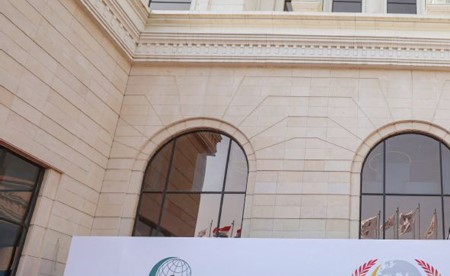
The 52nd session of the OIC Council of Foreign Ministers began yesterday, with Kuwait participating. Kuwait’s delegation was led by its Permanent Representative to the OIC and Consul General in Jeddah, Yousef Al-Tanib, alongside delegations from 54 countries, under the theme “Dialogue and Solidarity: Two Fundamental Pillars for Enhancing Peace and Sustainable Development.”
In his speech at the opening of the session in Baghdad yesterday, Ismail Ould Cheikh Ahmed emphasized that these attacks blatantly contradict the principle of non-aggression against the territories of states, as well as the rules of solidarity, Islamic and human values, the OIC Charter, and international law.
For his part, Iraqi Prime Minister Ali Al-Zaidi stressed the importance of ensuring freedom of trade and protecting international waterways, calling for increased efforts to achieve stability and peace in the region. He delivered this statement while opening the 52nd session of the OIC Council of Foreign Ministers. Al-Zaidi stated that Iraq advocates for freedom of trade, the protection of its routes, and the smooth flow of transport through international corridors, urging OIC member states to make further efforts to secure regional stability and peace.
He noted that the Islamic world is currently facing growing challenges that test its capacity for coexistence and its ability to keep pace with economic, cultural, and media transformations. He pointed out that the crises unfolding in both the regional and international arenas call for greater joint action to protect the interests of peoples, advance the causes of the Ummah, and ensure the future of coming generations.
Al-Zaidi reaffirmed Iraq’s principled stance on the Palestinian issue, describing it as the core of the conflict in the region. He stressed that justice for the Palestinian people and the guarantee of their rights are fundamental to the security and stability of the region.
Turkish Foreign Minister Hakan Fidan expressed his country’s support for the Kingdom of Saudi Arabia in the face of “Houthi” attacks, emphasizing the necessity of securing navigation in the Straits of Hormuz and Bab al-Mandab. Speaking at the meeting, Fidan said, “Recent developments in Yemen and Houthi attacks against the Kingdom of Saudi Arabia are of concern to all,” reaffirming Turkey’s solidarity with the Kingdom and the legitimate government in Yemen, and stressing the need to ensure freedom of movement and navigation in the Straits of Hormuz and Bab al-Mandab, as they constitute a crucial element of food security.
Regarding the Palestinian issue, Fidan stated that “Israel’s expansionist policies and mass massacres pose a major challenge to regional security,” calling for efforts to counter them and continue working toward collective measures and engaging the international community to pressure the United States to “urge Israel to halt its policies.”
Spokesperson for the 52nd OIC Council of Foreign Ministers session, Iraqi Ambassador Husayn Kamal, told the Iraqi News Agency (INA) that “the 52nd session of the OIC Council of Foreign Ministers has commenced in Baghdad, with the participation of 55 member states, alongside the guest of honor, UN Deputy Secretary-General Minna Mikkola, and more than 40 organizations affiliated with the OIC.”
He added that the session’s events included the transfer of the OIC Council of Foreign Ministers chairmanship from Turkey to Iraq.
He noted that the session will discuss a number of issues of mutual interest, foremost among them the Palestinian question, developments in the Gaza Strip, and current regional and international developments, as well as review and adopt the draft resolutions submitted, which address a wide range of political, economic, social, humanitarian, and developmental files for the coming period.
