Treasure Under the Sea Worth $12 Trillion Annually... Not Oil or Gold!
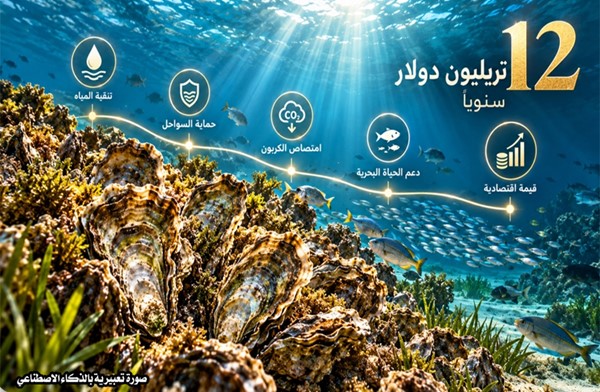
A scientific study reveals the immense economic and environmental value of global coral reefs, reaching $12 trillion annually.
Translated by Qiyas from الأنباء — Original source
A recent scientific study revealed that oyster reefs scattered around the world represent a vast ecological and economic asset, with the value of their services potentially reaching $12 trillion annually if their natural habitats are restored and protected. This comes at a time when the world has lost approximately 85% of these reefs over the past century.
According to the study, published in the journal *Frontiers in Marine Science*, the potential value of these reefs extends beyond oyster production for food purposes. It includes water purification, carbon sequestration, coastal protection, nutrient recycling, and providing a nursery environment for fish and marine organisms.
Researchers identified ten countries with the highest ecological potential for oyster reefs, notably the United States, Australia, China, and Japan, with suitable areas totaling 295,000 square kilometers. Currently, reefs occupy only 10% of this area, while only 23% is under marine protection.
Estimates indicate that restoring these reefs could enable the sequestration of 12.3 million metric tons of carbon annually. The potential value of nitrogen removal, carbon sequestration, and water purification services alone in the United States is estimated at $25.1 billion per year.
Researchers warned that realizing the estimated economic and ecological value requires rehabilitating 90% of suitable reef sites and protecting approximately 80% of them, amid challenges such as pollution, overexploitation, and climate change.
The study emphasized that the $12 trillion figure represents the potential value of ecosystem services, not actual financial revenue, and noted that global warming could reduce this value in the future.
