Qatari Movement in Beirut: Sovereignty, Energy, and Reconstruction Top the Agenda
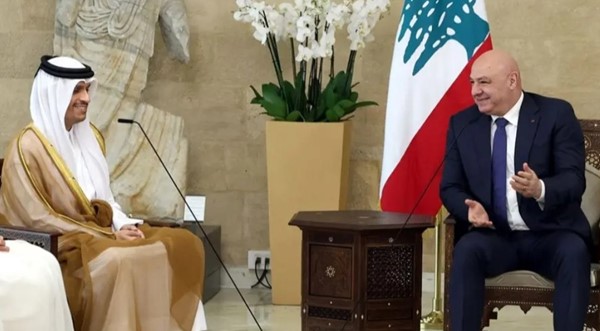
Qatari-Lebanese discussions on energy, reconstruction, and support for sovereignty.
Translated by Qiyas from الأنباء — Original source
Beirut - Mansour Shaaban
During a meeting at Baabda Palace with Qatari Prime Minister and Foreign Minister Sheikh Mohammed bin Abdulrahman bin Jassim Al Thani, President of the Republic General Joseph Aoun expressed his appreciation for the role played by His Highness Sheikh Tamim bin Hamad Al Thani, Emir of the State of Qatar, and the Qatari leadership in their constant efforts to restore stability to the countries of the region, by bringing together viewpoints and removing causes that lead to escalation.
The meeting was attended by Minister of Foreign Affairs and Emigrants Youssef Raji, Qatari State Minister Dr. Mohammed bin Abdulaziz Al Khalifa, and the Qatari Ambassador to Lebanon Sheikh Saud bin Abdulrahman Al Thani. President Aoun thanked the Emir of Qatar and the Qatari government for “the support Lebanon receives in all fields,” and expressed his hope that “Qatar will continue its efforts with sister Arab countries and friendly nations to pressure Israel to halt its attacks in the south and implement the framework agreement reached as a result of negotiations between Lebanon and Israel under US sponsorship.”
In a statement from Baabda Palace, the President of the Republic reiterated “his condemnation of the attacks suffered by Gulf countries, the latest of which were attacks on the Kingdom of Saudi Arabia,” affirming “Lebanon’s solidarity, leadership and people, with our brothers in the Gulf countries.” He also addressed Lebanese-Qatari relations, reiterating his welcome of any “cooperation between the two countries in various fields, especially in the energy sector, in which Qatar had previously expressed its readiness to help find solutions to the electricity crisis plaguing Lebanon.”
President Aoun outlined the continuous Israeli attacks on the south and their resulting casualties, injuries, and destruction of southern villages and towns occupied by Israel. He conveyed to the Qatari Prime Minister his greetings and best wishes for continued success to the Emir of Qatar, and for the State of Qatar to enjoy greater security, stability, and progress, emphasizing that “the Lebanese people will not forget what Qatar has provided and continues to provide to the Lebanese people during the difficult circumstances they have endured.” He thanked the Prime Minister for his visit to Beirut, “which reflects the love and support of Qatar, and is a new message of hope to the Lebanese.”
For his part, the Qatari Prime Minister and Foreign Minister, who arrived in Lebanon on Thursday after his meeting with Aoun, said that the discussion covered “bilateral relations between the two countries and ways to implement joint projects that contribute to the security, stability, and prosperity of the region,” noting that “the energy sector is at the heart of the interests of the Lebanese Republic, and the State of Qatar seeks to provide comprehensive solutions in this field. We will ensure, during subsequent meetings with the Prime Minister, to activate the projects that have been agreed upon.”
He added, “We discussed regional and international developments, particularly the situation in southern Lebanon and Israeli occupation practices toward Lebanon.”
Qatar supports the steps taken by the Lebanese state, the withdrawal of the Israeli occupation army from occupied territories, and their handover to the Lebanese Army, and Qatar will remain a supporter of Lebanon.”
From Baabda Palace, the Prime Minister of Qatar proceeded to the Second Presidency in Ain al-Tineh, where he met with Speaker of the Parliament Nabih Berri, in the presence of the Qatari Ambassador to Lebanon, Sheikh Saud bin Abdulrahman Al Thani, and Ali Hamdan, the media advisor to the Speaker of the Parliament. The visitor conveyed “the gratitude and appreciation of the Lebanese people to Qatar and its Emir for their steadfast support of Lebanon, all of Lebanon and its south in particular, and Qatar’s commitment to supporting Lebanese sovereignty, the complete liberation of its land from Israeli occupation, the return of displaced persons to their villages and towns, and its readiness to assist in Lebanon’s recovery and its various sectors, as well as to contribute to reconstruction.”
Speaker Berri emphasized “the alignment of positions with the Qatari minister on the importance of strengthening internal national unity and supporting institutions, particularly security ones, foremost among which is the Lebanese Army, as the guarantor and protector of these principles.”
Subsequently, Prime Minister Dr. Nawaf Salam received the Qatari Minister of Foreign Affairs at the Presidential Palace (Saraya), where they held a bilateral meeting. They exchanged views on ways to halt the war in the region and in Lebanon, and reaffirmed their respect for the sovereignty of the two brotherly countries. President Salam thanked Sheikh Mohammed bin Abdulrahman for “Qatar’s support for Lebanon in its efforts to achieve the Israeli withdrawal and extend state control over all its territories.” Salam expressed “Lebanon’s gratitude for the continuous assistance Qatar provides to the Lebanese Army and to various health and social projects.”
The talks between the two sides addressed providing gas supplies and developing infrastructure for electricity production. The two sides discussed preparations for an agreement between the governments of the two countries, which would launch comprehensive efforts to address Lebanon’s energy crisis, and renewed their confidence in the strength and durability of Lebanese-Qatari relations.
Following this, an expanded meeting was held with members of the Lebanese and Qatari delegations present.
Meanwhile, Minister of Foreign Affairs and Emigrants Youssef Raji met with Jean-Pierre Lacroix, Under-Secretary-General for Peace Operations at the United Nations, in the presence of the Commander of the United Nations Interim Force in Lebanon (UNIFIL), Major General Dioudaté Abaniara, and the accompanying delegation. They reaffirmed “Lebanon’s position calling for the retention of an international force to replace UNIFIL upon the conclusion of its mandate at the end of this year.”
Lacroix stressed “the importance of preparing for the next phase,” confirming that “the Security Council will soon begin negotiations on this file,” and affirmed “the United Nations’ commitment to playing a constructive role in this phase, with full respect for Lebanon’s position.”
