Farewell to the leap second... International decision may change the way time is regulated worldwide
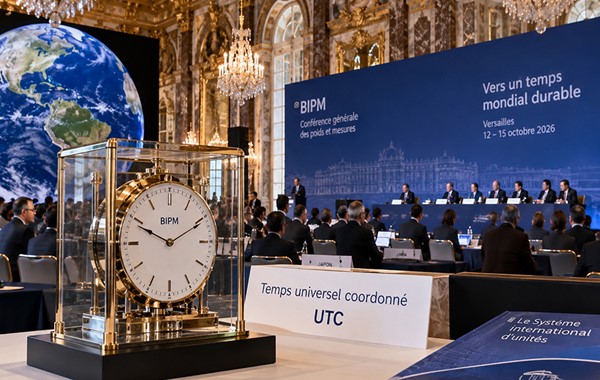
Discussion on the future of the leap second in Versailles.
Translated by Qiyas from الأنباء — Original source
International bodies responsible for regulating global time are preparing to discuss the future of the “leap second” in a move that could end a system used for more than half a century to synchronize atomic clocks with Earth’s rotation.
The General Conference on Weights and Measures, convening in Versailles, France, from October 13 to 15, 2026, is examining new measures to ensure the stability of Coordinated Universal Time (UTC), following technical disruptions to certain digital systems caused by sudden time adjustments.
Since 1972, 27 leap seconds have been added, the most recent in 2016. The issue arises because atomic clocks maintain exceptional precision, while Earth’s rotation speed varies due to multiple natural factors.
In 2022, the conference had decided to phase out the leap second system by 2035. However, Earth’s accelerated rotation in recent years has raised the possibility of needing to remove a full second for the first time—an unprecedented measure.
Proposals include allowing the discrepancy between atomic time and Earth’s rotation to accumulate over a longer period instead of making frequent adjustments.
This could postpone the need for major time corrections for centuries, possibly up to a millennium, without eliminating the need for timekeeping adjustments entirely.
