Alpine Mountain Cracks at Summit as Scientists Measure Millimeters Awaiting Collapse
&cropxunits=450&cropyunits=289&w=600)
Researchers from the Technical University of Munich warn of a potential collapse of the Hochvogel mountain on the German-Austrian border, where monitoring devices have recorded accelerated crack movement linked to climate change, with expectations that populated areas will not be affected.
Translated by Qiyas from الأنباء — Original source
Nearly two centuries ago, the fissure at the summit of Mount Hochvogel was as wide as a man’s shoulders. Today, it spans several meters.
The mountain, which rises to 2,592 meters on the border between Germany and Austria’s Tyrol region within the Northern Limestone Alps, lost approximately 2,000 cubic meters of rock last June. Now, researchers at the Technical University of Munich are warning of a much larger potential collapse, estimated at between 250,000 and 400,000 cubic meters, according to Euronews.
What concerns the team most is the speed of movement: in spring, instruments recorded shifts of up to 5 millimeters per week, whereas the Alps typically move by an average of just 1.8 millimeters over an entire year.
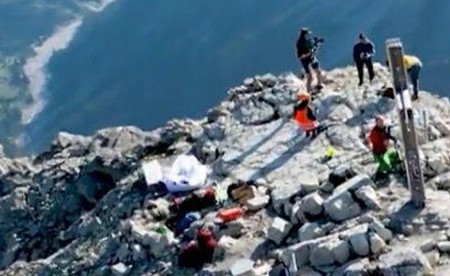
Scientists have been monitoring the summit for 12 years, installing more than 30 sensors that transmit data several times an hour, and employing a drone equipped with a laser scanner. The highest rates of movement are concentrated in a new fissure on the southwestern edge, which they call “Fissure 6.”
Researcher Johannes Lainer attributes this acceleration to heavy rainfall, storms, and snowmelt, noting that these events are becoming more frequent and intense due to climate change.
The ascent from the Austrian side has been closed for some time, while the route from Germany remains open. Professor Michael Krautblatter, who oversees the monitoring, believes the question is no longer “if” the mountain will collapse, but “when.” Projections indicate that the collapse will not affect populated areas.
