Kuwait stresses importance of implementing the 'Seville Commitment' and enhancing development financing for developing countries
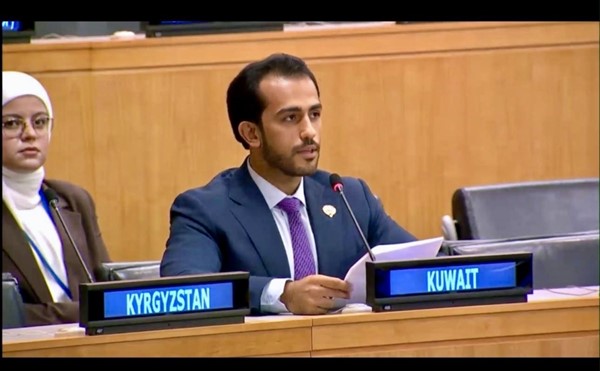
Kuwait emphasized the importance of implementing the Seville Commitment and enhancing development financing for developing countries, while condemning Iranian attacks on maritime navigation.
Translated by Qiyas from الأنباء — Original source
Kuwait has emphasized the importance of implementing the (Santiago Commitment), fulfilling official development assistance obligations, enhancing concessional financing, and addressing debt burdens, thereby enabling developing countries to achieve the Sustainable Development Goals (SDGs) while safeguarding essential services, in full respect of national ownership and development priorities.
This was stated in Kuwait’s address delivered by Diplomatic Attaché Abdullah Boushkhar to the Second Committee of the United Nations General Assembly, which deals with economic and financial affairs, during the discussion of Agenda Item 17 on sustainable development.
On behalf of the country, Boushkhar called for the provision of new, additional, predictable, and accessible climate finance to support adaptation and build resilience, in accordance with the principle of common but differentiated responsibilities. He stressed the importance of technology transfer, capacity building, and enhanced South-South cooperation to exchange expertise in water management and sustainable agriculture.
He noted that the 2026 SDG Progress Report revealed that only 36 percent of measurable targets are on track or making moderate progress. He urged linking the SDGs to national plans and budgets, and directing investments to enhance water and food security, energy security, and statistical capacities to measure the impact of development on people’s lives.
He pointed out that, within the framework of (Kuwait Vision 2035), the State of Kuwait places great importance on environmental protection, efficient resource use, and promoting sustainable consumption and production patterns. He cited Kuwait’s cooperation with the United Nations Development Programme (UNDP) in preparing its plan to implement the Kigali Amendment to the Montreal Protocol, supporting more efficient and climate-friendly cooling solutions.
In this context, he emphasized the importance of ensuring reliable and affordable energy for all, and enhancing private sector participation in achieving the SDGs.
Regarding the challenges facing development, Boushkhar reiterated Kuwait’s strongest condemnation of Iranian attacks targeting its territory. He called for the full implementation of Security Council Resolution 2817, and urged Iran to immediately cease actions and threats that obstruct legitimate transit or freedom of navigation in the Strait of Hormuz, or threaten maritime security in the Bab al-Mandab.
He warned that disruptions to navigation raise the cost of essential goods and undermine efforts to achieve the goals of the 2030 Sustainable Development Agenda. He called on Iran to ensure freedom and safety of navigation in accordance with international law and the United Nations Convention on the Law of the Sea (UNCLOS), to protect development gains.
In conclusion, Boushkhar reaffirmed Kuwait’s commitment to international cooperation in implementing the 2030 Sustainable Development Agenda and ensuring that no one is left behind.
