Banks Inject KWD 1.26 Billion into Kuwaiti Economy
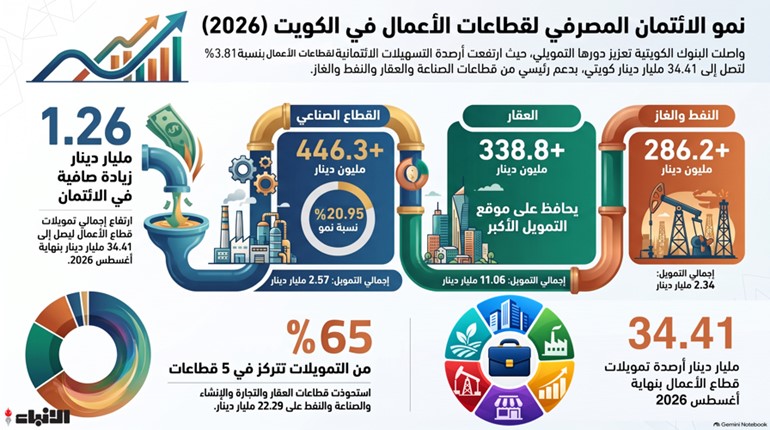
Non-personal financing balances rise to KWD 34.41 billion by end of August 2026
Translated by Qiyas from الأنباء — Original source
Kuwaiti banks have continued to strengthen their role in supporting the local economy and maintaining the flow of financing to various economic sectors, despite the challenges and exceptional conditions facing the region. Non-personal credit facilities directed at business sectors recorded a net increase of 1.26 billion dinars during the first eight months of 2026, reflecting the continued growth of credit activity and the banking sector’s role in meeting the financing needs of companies and institutions and supporting economic activities.
Data from the Central Bank of Kuwait revealed that the total balance of business sector financing, excluding all components of personal facilities, rose to 34.41 billion dinars by the end of August 2026, compared to 33.15 billion dinars at the end of December 2025, representing a growth of 3.81%. This serves as an indicator of the continued expansion of bank credit directed toward economic sectors since the beginning of the year.
These indicators gain particular importance amid regional changes and the challenges they impose on the business environment, supply chains, and the movement of trade and investment. Banks have continued to provide financing for various economic activities, thereby supporting the ability of companies and institutions to meet their operational and investment needs, and contributing to the continuity of business operations and economic activity in the local market.
The data showed that the increase in financing balances was not limited to a single economic activity but extended to a number of key sectors, including industry, real estate, oil and gas, construction, and services, reflecting the diversity of activities that recorded credit growth during the first eight months of the year.
Financing of Vital Sectors
The industrial, real estate, and oil and gas sectors collectively recorded a net increase of 1.07 billion dinars during the period. The industrial sector led economic activities in terms of the absolute volume of financing increases, reaching 446.3 million dinars, with its balances rising to 2.57 billion dinars by the end of August, compared to 2.13 billion dinars at the end of December 2025, a growth of 20.95%.
The real estate sector ranked second in terms of net increase, reaching 338.8 million dinars, with its financing balances rising to 11.06 billion dinars, maintaining its position as the largest economic sector in terms of the volume of existing credit facilities. The crude oil and gas sector recorded an increase of 286.2 million dinars, with its balances rising to 2.34 billion dinars by the end of August, compared to 2.05 billion dinars at the end of last year.
Financing growth extended to other economic sectors, as balances for other services financing increased by 281.2 million dinars, construction by approximately 164.7 million dinars, alongside an increase in financing for non-bank financial institutions by 132.4 million dinars, and public services by approximately 93.1 million dinars, highlighting the broad scope of activities that recorded credit increases during the period.
The data showed that the total balance of credit facilities directed toward purchasing securities rose to 4.81 billion dinars by the end of August 2026, compared to 4.79 billion dinars at the end of December 2025, with a net increase of 23.6 million dinars during the first eight months of the year, representing a growth of 0.49%. These financings were distributed as 2.96 billion dinars for companies and institutions, and 1.85 billion dinars for individuals. Individual financing recorded an increase of 170.1 million dinars, while financing for companies and institutions declined by 146.5 million dinars, reflecting the divergence in credit movement directed toward securities investment between the two categories.
Despite the modest rise in total balances during the period, while economic activity remained continuous, some sectors witnessed a decline in their financing balances. The most notable declines were in “Trade,” which fell by 239.6 million dinars, and bank loans, which dropped by 256 million dinars, alongside Agriculture and Fishing, which decreased by 7.6 million dinars. This reflects the uneven movement of credit among economic activities, despite the continued overall growth in non-personal financing balances.
The sustained growth in bank financing highlights the important role played by Kuwaiti banks in supporting the national economy, particularly during periods when there is an increased need to maintain the stability of financial services and provide financing channels for various sectors. This helps companies and institutions manage their financing needs and continue their operations amid changes in the business environment.
65% of Financing Concentrated in Five Economic Sectors
Data from the Central Bank of Kuwait revealed that five major economic sectors accounted for 22.29 billion dinars out of the total non-personal financing balances of 34.41 billion dinars at the end of August 2026, representing 64.78% of the total balances.
These financings were distributed as follows: 11.06 billion dinars for Real Estate, 3.46 billion dinars for Trade, 2.84 billion dinars for Construction, 2.57 billion dinars for Industry, and 2.34 billion dinars for Crude Oil and Gas. This distribution reveals the significant relative weight of these activities within the credit portfolio of local banks, while the remaining financings are distributed among other economic and financial sectors.
