Video: 'Research Institute' Uses Modern Techniques to Multiply Plants
&cropxunits=450&cropyunits=300&w=770)
The Kuwait Institute for Scientific Research announced the use of modern techniques such as tissue culture to multiply plants, focusing on crops suitable for Kuwait's environmental conditions, such as date palms, potatoes, and onions.
Translated by Qiyas from الأنباء — Original source
The Kuwait Institute for Scientific Research (KISR) announced that it is conducting studies and research aimed at achieving food security across its various sectors and centers, including the Center for Environmental and Life Sciences Research.
It stated that it does not rely on a single technology to improve agricultural production; rather, there are two key areas and modern technologies relevant to this issue: plant biotechnology and sustainable agricultural production. The priority is not to attempt to produce all crops locally, but to select crops best suited to Kuwait’s environmental conditions and available land and water resources, ensuring efficiency, sustainability, and appropriate costs, particularly given that arable land accounts for less than 1% of Kuwait’s total area, in addition to challenges posed by high temperatures, sandy soil, and limited water resources.
The Institute clarified that it is a specialized applied research and development institution, not an agricultural production entity; therefore, its impact is measured not by output volume, but by its ability to develop practical technologies and test their efficiency and viability.
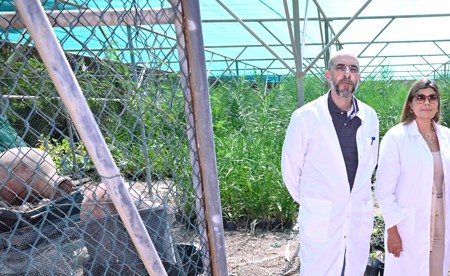
For more details, Al-Anbaa visited the Center for Environmental and Life Sciences Research at KISR and spoke with researchers Dr. Dalal Bader Al-Buainain and Dr. Mohammed Al-Hasan about tissue culture techniques within the framework of the food security program.
“Research”: Arable land represents less than 1% of Kuwait’s area, and our goal is to produce crops suited to environmental conditions and available resources.
The Kuwait Institute for Scientific Research is working on studies and research that contribute to achieving food security across its various sectors and centers, including the Center for Environmental and Life Sciences Research, which is one of the Institute’s four research centers. The center works on developing scientific solutions that help protect the environment and natural resources, enhance food security, and improve the quality of life in Kuwait.
The center includes four research programs, among them the Food Security Program, which focuses on improving the efficiency and sustainability of local food production, enhancing food quality and safety, reducing waste, and leveraging modern technologies and biotechnology to support the production sector.
Al-Anbaa visited the center and spoke with scientific researchers Dr. Dalal Bader Al-Buainain and Dr. Mohammed Al-Hasan, learning about tissue culture as one of the research-based solutions to enhance the sustainability of agricultural production. Tissue culture-based propagation of date palms is considered one of the Institute’s most successful applications, as this technology has transitioned from research and development to large-scale production, with more than 450,000 tissue-cultured date palm seedlings produced from over 45 varieties.
The Institute is working on research projects related to potatoes and onions to develop propagation and production technologies, aiming to reduce reliance on imported sources. The following are the details of the meeting:
What are the key studies and experiments on improving agricultural production implemented by the Institute, and which products are these experiments conducted on?
The Institute does not rely on a single technology. There are two main areas to discuss in this regard: plant biotechnology and sustainable agricultural production. In the field of plant biotechnology, the Institute employs modern technologies to develop and propagate plants, including plant tissue culture techniques. This means that a very small part of a plant can grow and develop into a complete plant. Propagating date palms through tissue culture is one of the most successful applications at the Institute. This technology has transitioned from research and development to large-scale production, with more than 450,000 tissue-cultured date palm seedlings produced from over 45 varieties. Additionally, the Institute is conducting research projects on potatoes and onions to develop propagation and production technologies, thereby reducing dependence on imported sources.
The other area is sustainable agricultural production. Efforts in this domain include protected agriculture and soilless farming, improving irrigation efficiency, and managing crops and pests. The Institute is also working on developing and testing biochar and soil amendments to improve the properties of sandy soils, which is crucial under Kuwait’s agricultural conditions.
Food and Economic Returns
Which crops can have their production improved to contribute to food security?
The priority is not to attempt producing all crops locally, but rather to select crops best suited to Kuwait’s environmental conditions, taking into account the limited agricultural land and water resources. The goal is to produce crops that align with Kuwait’s environmental conditions and available land and water resources, with efficiency, sustainability, and appropriate costs. This is particularly important given that arable land represents less than 1% of Kuwait’s total area, along with challenges such as high temperatures, sandy soils, and limited water resources.
Protected greenhouse crops, such as tomatoes, cucumbers, peppers, and leafy vegetables, are at the forefront. Soilless farming, precision irrigation, and control of environmental conditions can be used to enhance productivity and water-use efficiency. Potatoes and onions are also important food crops whose local production can be developed by improving seeds and propagation materials. Date palms remain a strategic crop for Kuwait due to their relative suitability for the desert environment and their nutritional and economic importance. It is essential to continue developing heat-, salt-, and drought-tolerant crops and varieties. Therefore, the focus should be on crops that yield the best food and economic returns for Kuwait, with optimal use of available resources, primarily land and water, at a production cost that is appropriate and sustainable.
Developing Practical Technologies
To what extent do the Institute’s studies contribute to increasing agricultural production in the country to achieve self-sufficiency and ensure food security?
It is important first to clarify the Institute’s role. The Kuwait Institute for Scientific Research is a specialized applied research institution focused on scientific research and development, not an agricultural production entity. Therefore, the Institute’s impact is not measured by production volumes, but by its ability to develop practical technologies, test their efficiency and viability, and then transfer them to government entities and the private sector for broader application.
Typically, a technology begins with development and improvement in the laboratory, followed by testing on a pilot scale. This is followed by field, technical, and economic evaluation. If the technology proves its efficiency and viability, it moves to the application stage, where the technology is transferred to an implementing entity or a private-sector partner.
To expand commercial trade, date palms serve as a clear example of transitioning research findings from the laboratory to application. The institute began working on tissue culture for date palms in the 1990s, reaching the stage of mass propagation and commercial production since 2000. It then expanded its production services to farmers and the private sector. In 2025, it offered approximately 19,000 tissue-cultured date palms of five varieties, derived from surplus production resulting from previous research programs and projects, for sale to consumers and farmers through Kazma Company, the institute’s commercial arm for marketing its products.
Three Pathways
What are the institute’s future plans to enhance food security and agricultural production in the country?
These plans focus on three main pathways. The first pathway is to continue developing and diversifying farming models, including protected agriculture, field agriculture, and soilless cultivation, while improving the efficiency of water and fertilizer use, preventing and controlling pests, and selecting varieties better suited to Kuwait’s conditions, particularly high temperatures, salinity, and water scarcity. The second pathway involves employing biotechnology, primarily plant tissue culture, to produce high-quality plant propagation materials. Examples include producing potato seed tubers and working on developing local onion seed production. The institute also continues to conserve plant genetic resources and biodiversity, given their importance in supporting breeding programs, improving crops, and preserving future agricultural options for the state. The third pathway is transferring successful technologies from research to application. After confirming their efficiency and economic viability, efforts are made to transfer these technologies to beneficiary entities, cooperating with government agencies, farmers, and the private sector to expand their commercial application and use where appropriate.
Potato Seed Production
Where have you reached in the project to improve potato production?
First, it is important to clarify that the proposed project primarily focuses on producing potato seed tubers using tissue culture techniques, rather than producing potatoes for direct consumption. The goal is to support the availability of high-quality seed tubers that can contribute to raising local production efficiency and reducing reliance on external sources. The project has been submitted, and currently, the necessary procedures are being completed to secure funding and begin implementation.
Let us briefly explain “potato seed tubers” and their cultivation in Kuwait.
Potato seed tubers are the tubers planted to produce the crop in the following season, representing the starting point of the production chain. Kuwait does produce potatoes, particularly in agricultural areas such as Abdali and Al-Awafi. However, local production remains limited compared to consumption levels. Agriculture relies heavily on importing certified seed tubers from abroad, which are typically planted during two main seasons: the autumn season in September and October, and the winter season in January and February. Therefore, the timely availability of seed tubers is a key factor in stabilizing local production. According to current data, local potato production reached approximately 18,000 tons in 2023, representing less than 10% of local demand.
What are the main challenges facing this type of agriculture?
The main challenges facing potato production in Kuwait involve three key aspects. First is the reliance on importing potato seed tubers, which makes their availability and cost dependent on external markets and supply chains. Delays in the arrival of seed tubers can cause them to miss the appropriate seasonal planting window, leading to a decrease in total annual production. Second is the quality of imported seed tubers, as commercially imported seed tubers are often...
They are relatively late-generation field stocks; therefore, their potential for reuse in agriculture is limited, which negatively impacts the yield and quality of potato crops. The third factor is climate and agricultural resources: high temperatures, limited water and land resources, and rising production costs constrain agricultural expansion.
What are the details of this project?
The project idea emerged to address part of these challenges. Producing potato seed tubers locally reduces reliance on imports and mitigates the risks of delayed seed delivery and the loss of a planting season. Furthermore, producing early generations using tissue culture provides high-quality propagation material and helps address the problem of declining seed efficiency due to repeated planting and virus accumulation. The project also utilizes four promising varieties previously developed by the Institute—Al-Tahrir, Al-Qarin, Al-Istiqlal, and Al-Kout—which showed promising indicators for salt tolerance under laboratory conditions, with their performance to be evaluated later under field conditions.
Development of Onion Production
The Institute has been working on a project to develop local onion production. What is this project?
Initially, onions are considered an important vegetable crop in Kuwait, cultivated on a limited scale during the period from approximately October to April. The proposal, titled “Project for Developing Local Onion Production,” notes that the annual onion demand reaches about 98,000 tons, while local production is estimated at only about 8,000 tons. Consequently, most local demand is met through imports. Additionally, local agriculture relies on imported seeds.
What is the importance of this project, and what are the main challenges it addresses?
The importance of the project to develop local onion production lies not only in increasing onion production for direct consumption but primarily in establishing a local system for producing high-quality onion seeds. This includes collecting onion germplasm and varieties from reliable sources, evaluating them under Kuwaiti field conditions, propagating promising varieties using tissue culture, and producing sets and seeds on a pilot scale. The project also involves developing methods for storing onion sets and seeds. It addresses several key challenges, including reliance on imported onion seeds, which makes seed availability and prices dependent on external sources and markets. High seed costs and the lack of good-quality seeds at reasonable prices are factors that limit farmers’ expansion into onion production. Moreover, there are no locally developed or selected onion varieties specifically adapted to Kuwait’s conditions. Therefore, the project aims to evaluate several genetic lines and varieties under local field conditions and select the best performers in terms of growth, adaptation, and productivity. Additionally, there is no local system for seed production and storage. Producing onion seeds requires an integrated chain starting with healthy plant material, followed by the production of mother sets and their storage under suitable conditions, replanting, seed harvesting, drying, storage, and quality testing.
Can it contribute in the future to increasing local production and achieving higher self-sufficiency rates?
Regarding self-sufficiency, it is too early to confirm full self-sufficiency before the project is implemented and its technical and economic results are tested. The proposal indicates the potential to increase production in the current cultivated area, estimated at about 687 hectares, from approximately 8,000 tons to up to 34,000 tons, provided high-quality seeds and appropriate production technologies are available. However, this figure represents a projected possibility in the proposal, not an achieved field result to date. Therefore, the realistic objective of the first phase is to localize onion seed production technology, select varieties suitable for Kuwaiti conditions, and reduce reliance on imported seeds. If the system proves successful...
Technically and economically, production can be gradually expanded through partnerships with farmers and the private sector, thereby supporting increased local output and raising the self-sufficiency rate for onions.
Commercializing research via the private sector:
Dr. Dalal Al-Buwayjan and Dr. Mohammed Al-Hasan, researchers at the Center for Environmental and Life Sciences Research at the Kuwait Institute for Scientific Research, stated that the institute does not limit itself to scientific publishing. They clarified that the institute’s research outputs can be transformed into applicable products or services, with the private sector playing a key role in this process. Engagement with the private sector occurs through multiple channels. The first involves providing production services based on funded requests, as demonstrated in the field of tissue-cultured date palms after the technology reached the stage of large-scale production. The second channel is direct marketing to the public through Kazma Company, the institute’s commercial arm, which marketed approximately 19,000 tissue-cultured date palm seedlings of five varieties in 2025.
They further explained that the third channel involves licensing or transferring the technology to an applied partner from the private sector after its technical and economic feasibility and efficiency have been proven. The partner then assumes responsibility for scaling up production and marketing on a commercial basis. This is the targeted pathway for projects involving the tissue-cultured production of potato seed tubers and onion seeds.
