Kuwait: Firm support for international justice and rejection of violations of UN Charter principles
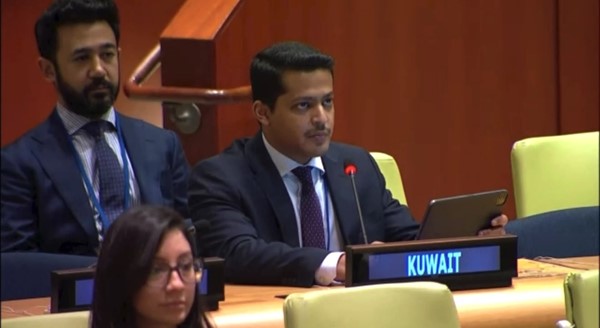
The State of Kuwait reaffirmed its firm support for strengthening international justice and its rejection of violations of international law and the principles of the United Nations Charter, emphasizing its commitment to enhancing multilateralism and settling disputes by peaceful means, as well as the necessity of establishing an international system based on justice and equality, free from selectivity and double standards.
This was stated in Kuwait’s address delivered by Diplomatic Attaché Mohammed Al-Mutairi before the Sixth Committee (Legal) of the UN General Assembly during the discussion of agenda item 84, titled “The rule of law at the national and international levels.”
Al-Mutairi underscored the importance of the International Court of Justice (ICJ) as the principal judicial organ of the United Nations and the necessity of respecting and implementing its rulings in accordance with relevant legal obligations, stating that the rule of law constitutes the foundation for achieving peace, security, development, and respect for human rights.
On regional matters, Al-Mutairi condemned Iranian attacks on Kuwait, the Gulf Cooperation Council (GCC) countries, and Jordan, describing them as violations of state sovereignty and threats to regional security and stability, while warning against the dangers of escalation and the widening of conflict in the region. He also condemned attacks on ships and tankers in the Strait of Hormuz, citing their threat to maritime navigation safety and international peace and security, and called on Iran to comply with UN Security Council Resolution 2817 and respect its obligations under international law.
He further denounced attacks launched by the Houthi militia on the Kingdom of Saudi Arabia, as well as attacks and threats targeting navigation in the Red Sea and the Bab al-Mandab Strait, noting that these actions constitute violations of sovereignty and threats to global trade and supply chains.
Regarding the Palestinian issue, Al-Mutairi affirmed Kuwait’s support for international efforts aimed at implementing the two-state solution, regarding the New York Declaration on the Peaceful Settlement of the Palestinian Question as a significant step toward achieving a just and permanent peace based on the establishment of an independent Palestinian state on the borders of June 4, 1967, with East Jerusalem as its capital. He stressed the importance of respecting the ICJ’s advisory opinion issued on July 19, 2024, which affirmed the illegality of the continued Israeli presence in the occupied Palestinian territory and the legal obligations arising therefrom.
He strongly condemned Israeli occupation practices against the Palestinian people, including starvation, forced displacement, attacks on civilians, and settlement expansion, emphasizing the need to end the illegal occupation, ensure accountability for violations, and safeguard the legitimate rights of the Palestinian people.
He also condemned ongoing Israeli attacks on Syria, including incursions, arrests, and kidnapping operations targeting civilians, calling for an end to these attacks and withdrawal from all occupied Syrian territories, including the occupied Golan Heights.
Al-Mutairi affirmed Kuwait’s full support for Lebanon in asserting its sovereignty and authority over its entire territory and monopolizing weapons within the state, warning against the repercussions of continued Israeli attacks in Lebanon on international peace and security.
In this context, Al-Mutairi recalled Kuwait’s experience with the Iraqi aggression in 1990, which highlighted the importance of adhering to the UN Charter, respecting state sovereignty and territorial integrity, and the inadmissibility of acquiring territory by force. He emphasized that respecting international law and implementing Security Council resolutions constitute fundamental guarantees for the security and stability of states, particularly small states.
On the national level, he pointed to Kuwait’s continued development of its legislative and judicial framework and the enhancement of institutional efficiency.
The Ministry of Justice, facilitating access to justice, empowering women and ensuring equal opportunities, thereby enhancing transparency, accountability, and good governance. He emphasized the importance of strengthening cooperation between the Sixth Committee and the International Law Commission, and of effectively engaging Member States in the development of international legal rules, taking into account diverse legal systems and national experiences. At the conclusion of Kuwait’s statement, Al-Mutairi reaffirmed the country’s commitment to strengthening the rule of law at both the national and international levels, supporting efforts to achieve justice and accountability without discrimination, and building a more just and equitable international system.
