Aoun: Political parties are a source of richness in political life, but they must not become an obstacle to state authority
&cropxunits=360&cropyunits=450&w=770)
President Aoun warns against the politicization of the economy and emphasizes the role of parties without hindering state authority, while Nabih Berri discussed relations with Syria with Press Syndicate head Awani Al-Kaaki, and Nawaf Salam celebrated the centenary of the constitution.
Translated by Qiyas from الأنباء — Original source
Beirut – Mansour Shaaban and Agencies: His Highness Sheikh Mohamed bin Zayed Al Nahyan, President of the United Arab Emirates, sent a written message to Lebanese President General Joseph Aoun, which was conveyed to him by UAE Ambassador to Lebanon Fahd Salem Al Kaabi. The message includes an invitation to attend the opening ceremony of the “Abu Dhabi Sustainability Week,” honor the winners of the “Zayed Sustainability Prize,” and participate in the “Abu Dhabi Sustainability Week Summit,” delivering a speech there, on January 12 and 13, 2027.
President Aoun had previously delivered a speech during his reception of a delegation from the Union of Municipalities of the Byblos region, stating that “attempts to politicize the economic situation and inflate it for political goals, and talking about an increase in the dollar exchange rate and crises similar to those in 2019, with the aim of creating confusion and marginalizing efforts to revive Lebanon, cannot be allowed.” He affirmed that “the state’s duty is to stand by municipalities,” and emphasized “the importance of their fulfilling their role for the benefit of all, as they are the foundation and must enjoy the trust of their people.” He added, “Political parties are a source of richness in political life, but they must not become an obstacle to state authority.”
Meanwhile, President Aoun was briefed by Minister of Energy and Water Joe Sodeh on the reasons that led him to announce his withdrawal from attending Cabinet sessions, affirming his continued assumption of his ministerial responsibilities, and expressing hope that those reasons would be addressed.
In a parallel development, the Acting Head of the Syrian Embassy in Beirut, Eyad Al-Hazzaa, visited Lebanese Parliament Speaker Nabih Berri. The Syrian Embassy stated in an official press release that the two sides discussed ways to enhance fraternal relations between Syria and Lebanon and to develop cooperation and coordination between the two countries in the interest of both peoples. The statement added that the meeting addressed several files of mutual interest, particularly facilitating transit and movement across border crossings and simplifying related procedures, as well as easing residency procedures for Syrians in Lebanon, thereby contributing to addressing issues related to their affairs within established legal frameworks.
The two sides also discussed the latest developments and updates in the region and their repercussions on Syria and Lebanon. The meeting emphasized the importance of strengthening communication between the two countries to consolidate fraternal relations between their peoples and support stability and shared interests, according to the Syrian Embassy.
Also in Ain El-Tineh, Press and Journalists Syndicate President Awni Al-Kaaki and Joseph Al-Quseifi visited Parliament Speaker Berri and requested his support for their efforts to amend the new Media Law.
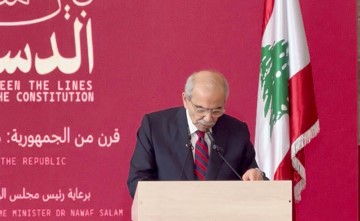
From the National Library in Beirut, Prime Minister Nawaf Salam announced that a century has passed since the Lebanese Constitution, stating, “One hundred years since a text that was not born from a single idea, nor from a single experience, nor from a single intellectual source. This is not merely a detail in the history of our Constitution, but a key to understanding Lebanon itself.”
Highlighting, after recounting the historical context of the Constitution during the opening of the exhibition “Between the Lines of the Constitution,” that “the Lebanese Constitution is a child of plurality—plurality in its intellectual sources, plurality in the preceding experiences, and plurality in the society that sought to organize its political life.” He considered that “celebrating the Constitution does not mean merely returning to the moment the text was drafted, but rather asking what we have done with it, what our experience has added to it, what remains incomplete, and what we have learned after a full century of crises, wars, and settlements.”
Therefore, he said, “if we are truly committed to Taif, we must first implement it in its entirety. It is not permissible to declare our commitment to Taif while leaving a large part of its reforms pending.”
Lebanese Minister of Culture, during the opening of the “Between the Lines of the Constitution” exhibition: Five fundamental dilemmas characterized the constitutional experience
Beirut: Culture Minister Dr. Ghassan Salame paused his opening of the exhibition “Between the Lines of the Constitution,” commemorating the centenary of the 1926 Constitution, at the National Library, under the patronage and in the presence of Prime Minister Dr. Nawaf Salam, at “five fundamental dilemmas that have shaped Lebanon’s constitutional experience over the course of a century, starting with the dilemma of balancing individual rights and group rights, up to the relationship between centralization and decentralization.” He noted that “the 1926 Constitution is a composite one that did not turn a blind eye to identities, as European constitutions did under John Rawls’ theory of the ‘veil of ignorance,’ but rather recognized them in Article 95.” He stressed that “the exhibition’s aim is not to celebrate an old piece of paper, but to disseminate constitutional culture among youth and remind them that a state founded on a constitution that is a century old is the sole guarantor of their freedoms and rights,” adding that “more than half of the documents on display are being shown for the first time, drawn from the archives of the National Archives, the French Foreign Ministry Archives, and the Oriental Library.”
